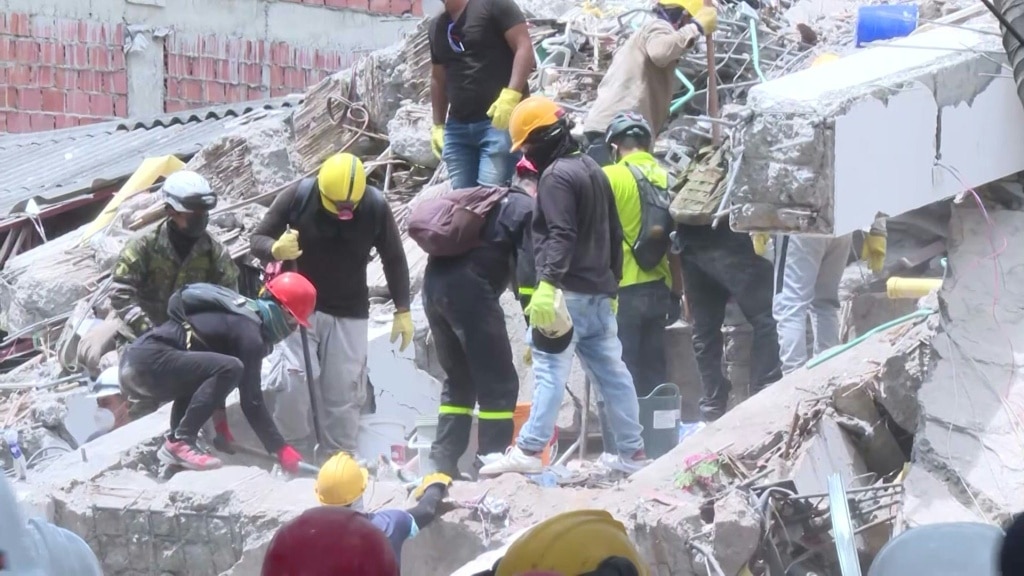
Three days after Colombia’s strongest earthquake in a century struck, rescue teams entered what national officials have termed the “final phase” of search operations on Wednesday, racing against the critical 72-hour window that experts identify as the period with the highest odds of pulling trapped survivors alive from collapsed infrastructure.
The 7.4-magnitude seismic event, which hit central and western Colombia on Monday, has already left 265 people dead, more than 3,500 injured, and nearly 500 unaccounted for, according to updated local government data. Official assessments confirm over 11,000 residential structures have been completely destroyed, leaving thousands of families homeless, with many forced to sleep outdoors amid ongoing aftershock fears and persistent power outages.
In the hard-hit city of Pereira, rescue crews have centered their urgent efforts on the rubble of a collapsed bakery, where they hold out hope for street vendor Pablo Loaiza, who has been trapped since the quake struck. Using specialized vibration-detecting equipment, teams detected faint potential signs of life from Loaiza, drawing anxious family members to the site to wait for updates. Relatives reported that Loaiza appeared to respond to rescuers’ instructions to knock twice, then three times from beneath the debris—a small, hopeful development that drew quiet applause from gathered onlookers. “They tell us it could be him,” said Sara Loaiza, Pablo’s 16-year-old niece, her voice breaking. “My heart is about to burst out of my chest.”
Across affected regions including Cali and Pereira, emergency teams and volunteer rescuers have prepared to work through their third consecutive night, relying on a combination of bare-hand digging, heavy cranes, and sniffer dogs to navigate unstable rubble. Operations pause every half hour to let crews fall silent and listen for any signs of trapped people, a painstaking process that has already yielded three rescued survivors and three recovered bodies in the area, according to volunteer Johana Sanchez.
Cali Mayor Alejandro Eder clarified that entering the final phase of search operations does not mean efforts to find survivors will end entirely. “That doesn’t mean there won’t be survivors afterwards, but it is more difficult,” he explained Wednesday, acknowledging the grim reality of post-72-hour rescue efforts.
The disaster has prompted urgent action from Colombia’s newly sworn-in presidential administration, which has declared an “economic emergency” in affected regions and ordered three days of national mourning. “We will do what is necessary,” government spokesperson Abelardo de la Espriella said in a public statement, vowing that the country would “emerge again as a country and as a society.”
For residents across the impacted zone, the immediate aftermath has been marked by uncertainty and loss. In the mountain town of El Cairo, residents gathered at community-run soup kitchens Tuesday as power outages continued, with most still refusing to return to damaged homes. “People don’t want to go inside their homes, people don’t want to sleep, people don’t know what to do,” local resident Adriana Gonzalez told reporters.
In nearby Roldanillo, Yuliana Mendez sorted through the rubble of the beauty supply store where she worked, one of hundreds of local businesses destroyed by the quake. “It’s like starting over from scratch,” she said. In Pereira’s Providencia neighborhood, lawyer Ana Paulina Crosthwaite joined other residents hauling salvageable belongings from their condemned apartment block, still reeling from the sudden upheaval. “We’re in a state of shock,” she said. “We’re not prepared to tell our children that we have to pack whatever we can and start a new life.”
Amid the widespread devastation, a wave of grassroots solidarity has swept across Colombia, with ordinary citizens mobilizing to support affected communities. Thousands of residents have traveled to impacted neighborhoods to deliver bottled water, non-perishable food, and emergency supplies, while long lines of donors formed outside blood banks across the country to contribute to emergency medical efforts. “It’s about wanting to help your community, your city and your country,” said Ferney Cabrera, one of the dozens of donors who turned out to give blood.