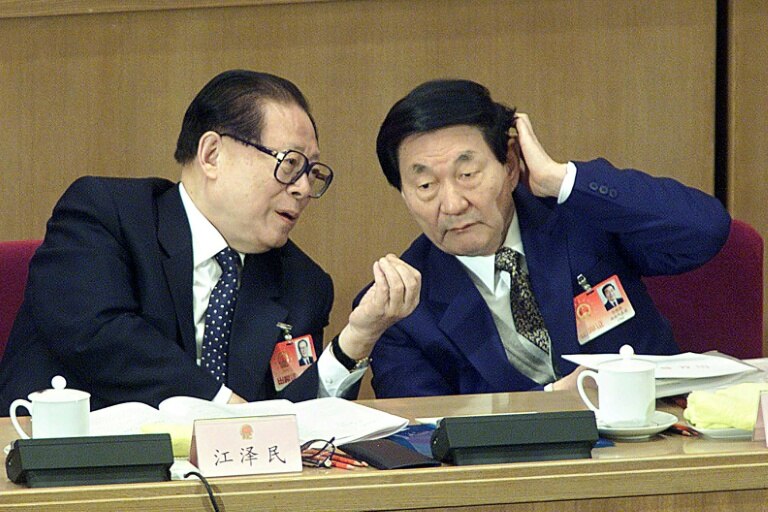
Former Chinese Premier Zhu Rongji, whose bold market-oriented reforms reshaped China’s economy and set the foundation for its decades-long rapid expansion, has passed away at the age of 96. Official state news agency Xinhua announced that Zhu died Wednesday morning in Beijing following a prolonged illness, after medical interventions were unsuccessful.
Zhu assumed the office of Premier in 1998, and quickly cemented his reputation as a decisive, results-driven advocate for free-market adjustments to China’s previously state-dominated economic system. Among his most impactful policy overhauls was a large-scale privatization initiative for unprofitable state-owned enterprises, the end of decades of state-provided urban housing, and the rollout of a national private home ownership system.
His reforms triggered an unprecedented boom in China’s real estate and construction sectors, which eventually grew to account for nearly a quarter of the country’s total gross domestic product ahead of the 2020 national property debt crisis. Beyond domestic restructuring, Zhu’s leadership is widely credited with shielding China from the most severe damage of the 1997 Asian Financial Crisis, when most regional economies suffered crippling downturns. He also spearheaded years of grueling negotiations that culminated in China’s historic accession to the World Trade Organization in 2001, a milestone that cemented China’s transition from a largely closed, centrally planned economy to a central player in global trade.
A joint obituary issued by China’s highest ruling political bodies, carried by Xinhua, hailed Zhu as a revolutionary leader whose lifetime of service was dedicated entirely to the Communist cause and the Chinese people. “The life of comrade Zhu Rongji was a life of revolution, a life of struggle, a life of glory,” the obituary stated. “It was a life dedicated wholeheartedly to serving the people, one given to the communist cause. His passing is a major loss for the Party and the country.” The obituary also characterized Zhu as “an outstanding member of the Communist Party of China, a long-tested and loyal communist fighter… an outstanding leader of the Party and the state.”
While Zhu’s reforms lifted hundreds of millions of Chinese citizens out of poverty, they also introduced new levels of economic inequality across the country. In the years following Xi Jinping’s rise to China’s top leadership in 2012, Zhu’s unapologetic market-first approach fell out of step with the current policy direction. Under Xi, Beijing has cracked down on unregulated capitalist expansion, moved to address wealth inequality, reined in monopolistic private firms, and pursued a more balanced development model. The obituary emphasized that the public should channel grief into strength, carry forward Zhu’s revolutionary spirit, and rally more closely around the Party Central Committee headed by Xi Jinping.
News of Zhu’s death quickly dominated domestic social media, rising to the number one trending spot on Weibo within hours of the official announcement. By midday, the top trending topic had accumulated more than 190 million views, with thousands of users leaving tributes. One top comment reading “The people’s good premier, rest in peace” earned more than 17,000 likes, while countless users shared candle emojis to express their remembrance.