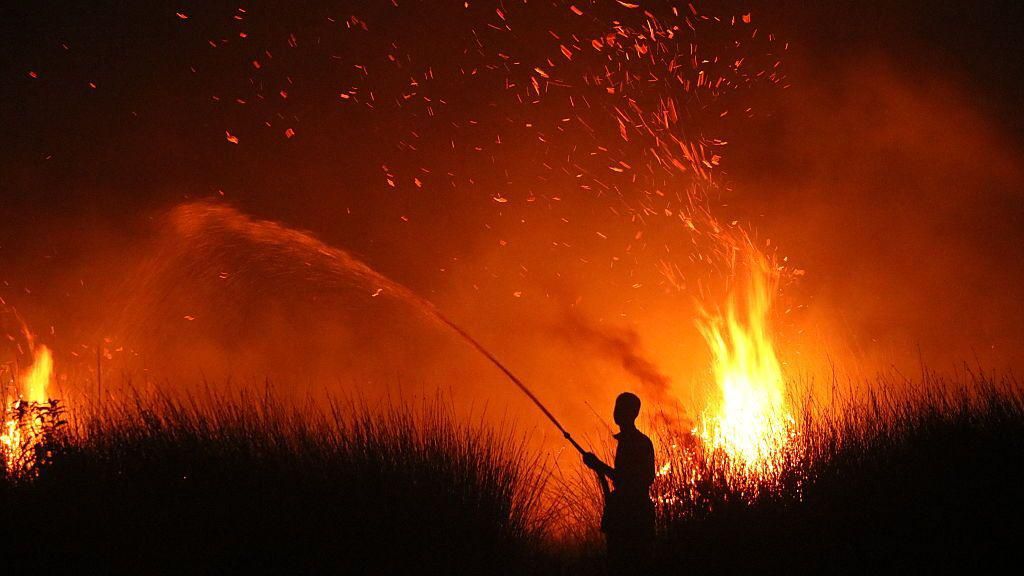
A crippling climate-driven disaster is unfolding across Indonesia, where intense wildfires fanned by an unusually severe El Nino event have scorched more than 107,000 hectares of land, forcing widespread school closures and triggering cross-border air quality alarms in neighboring Malaysia.
This year, much of Southeast Asia is confronting an extended, hotter than average dry season supercharged by one of the strongest El Nino events in recent memory, dubbed the “Godzilla El Nino” by climate observers. The climatic phenomenon, which drives warmer ocean temperatures and altered weather patterns across the tropical Pacific, has created tinder-dry conditions across Indonesia’s vast archipelago, particularly in peatland-rich regions that are inherently fire-prone during dry months.
Indonesian disaster response authorities have prioritized six hard-hit provinces for their containment efforts: Jambi, South Sumatra, West Kalimantan, Central Kalimantan, South Kalimantan, and Riau. Local residents in these regions have described weeks of worsening conditions that have upended daily life. Darwin Romy, an indigenous Dayak resident based in Palangka Raya, Central Kalimantan’s largest city, told reporters that blazes have burned for more than a month, with flames now encroaching on residential neighborhoods. “The smoke has become quite thick. When we step outside, our eyes start to sting. The smell of the smoke is also quite strong,” Romy said, adding that drought has left firefighting teams critically short on water to douse blazes.
Schools across affected regions have been forced to adapt, with many suspending in-person instruction to protect students from toxic haze. In Pontianak, the capital of West Kalimantan, Mayor Edi Rusdi Kamtono announced that classes would shift to fully online learning for the duration of the fire crisis, AFP reported. “We have started to feel it, especially at night and in the morning, as haze has already blanketed the city of Pontianak,” Kamtono said earlier this week. The shutdown of in-person schooling has already stretched into three consecutive days in multiple affected provinces.
To combat the spreading blazes, Indonesian authorities have deployed cloud-seeding aircraft in an effort to trigger much-needed rainfall across fire zones, a last-ditch tactic to supplement ground firefighting efforts when water supplies are depleted. Even popular tourist sites have not escaped the crisis: a separate blaze burned for nearly a week at Mount Bromo National Park, a famous active volcano and top tourist draw in East Java, before it was fully contained on Monday. The fire destroyed roughly 550 hectares of park land, and authorities have ordered the site closed to all visitors since August 8 amid warnings of new active hotspots near the volcano’s caldera. Local disaster chief Gatot Soebroto told reporters that early investigations point to preventable human carelessness as the likely cause: “A person lit a fire, then put it out, but the fire was not fully extinguished,” he explained.
The impact of Indonesia’s wildfires has already crossed national borders, as thick haze has drifted to parts of neighboring Malaysia. On Wednesday, the small Sarawak state town of Serian recorded an Air Pollutant Index (API) reading of 195, a level categorized as unhealthy by global air quality standards. By Wednesday afternoon, at least nine separate areas across Sarawak had logged unhealthy API readings, Malaysian local media reported. Under the standard API ranking system, readings between 101 and 200 are classified as unhealthy, 201 to 300 as very unhealthy, and any reading above 300 is considered hazardous to all population groups.