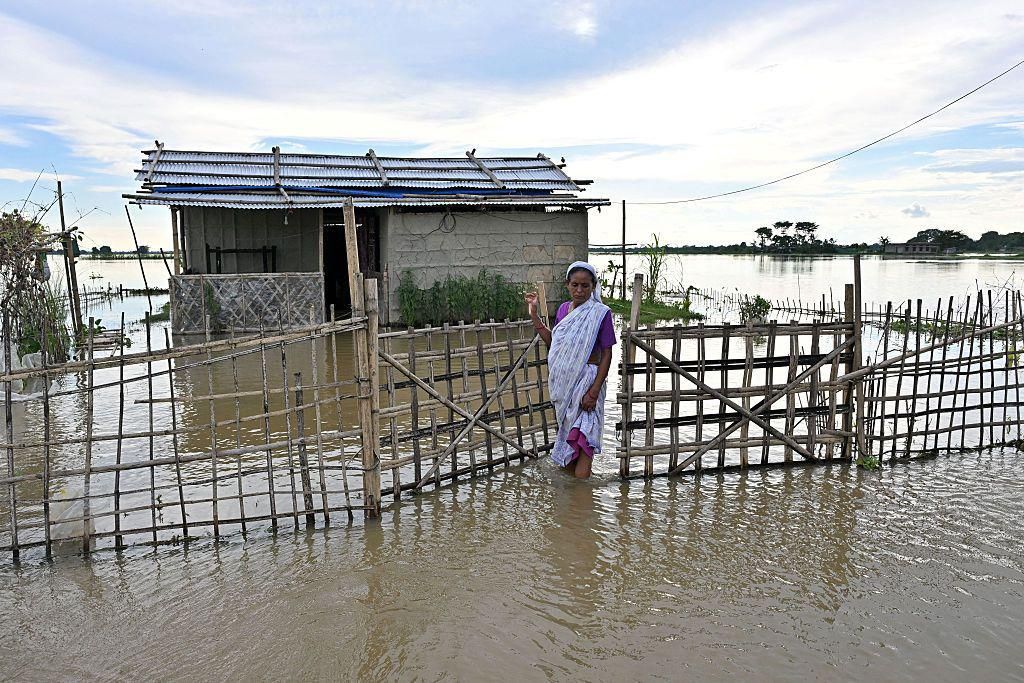
Deep in the night of July 19, rushing floodwaters swallowed Charing village, a small community in India’s northeastern Assam state’s hard-hit Sivasagar district. For 40-year-old Bornali Baruah and her husband, the hours that followed would become a fight for life: their 97-year-old family member, Lokada Duarah, was nearly bedridden and unable to walk through the rising water. With no rescue craft, no emergency team on site, and neighbors all scrambling to save their own homes and families, the couple improvised. They lashed banana trunks into a rough makeshift raft, lifted Duarah onto it, and set off through the churning current, clinging to each other’s hands and propping themselves steady with wooden sticks.
An hour of slow, treacherous travel brought the three to safety at a relief camp set up on a nearby national highway. By that time, Baruah’s childhood home had already vanished beneath the surging flood, with water eventually climbing to five feet deep inside the eight-room single-story house.
This harrowing escape is one of hundreds that unfolded across Assam this summer, when a record-breaking flood event devastated swathes of the region. Official data puts the total death toll at 100, with 456 villages across 10 districts submerged, and more than 1.2 million people impacted across 25 Assam districts. Authorities have established 252 relief camps that currently house more than 75,000 displaced residents, with 52 additional camps activated in the earliest days of the disaster. More than 19,000 homes have been damaged or destroyed, and the floods have reached areas that have never experienced inundation in living memory — including Charing village.
For Baruah, who has lived in Charing her entire life, with generations of her family rooted in the land, the disaster is a profound shock. “This is the first flood we have experienced in this area in our lifetime,” she explained. While the region is crisscrossed by several rivers connected to the Brahmaputra — the Jhanji 10 kilometers away, the Mitong just 5 kilometers from her property — her home has never sat close enough to a river to face flood risk, and no major inundation has hit the area since a 1950 event decades before she was born.
The flood destroyed far more than just her family home: it wiped out the livelihood Baruah spent years building after leaving a career in journalism to pursue animal husbandry in 2016. Just three years after switching careers, she was named Assam’s “Best Livestock Farmer,” growing her operation to 300 goats, 500 ducks, 1,000 chickens and a productive fish farm. The disaster erased most of that progress: she lost the majority of her goats, 300 ducks, 300 chickens, much of her fish stock, and the machine used to process animal feed. All of the family’s furniture, personal electronics, vehicles and book collection were also ruined, and no livestock insurance exists to cover the losses. “There is no insurance system here for livestock, especially goats,” Baruah noted.
The first warning signs emerged on July 17, when the Jhanji River began to swell rapidly. Two days later, heavy rainfall pushed the Brahmaputra and its tributaries past their banks, with the Dikhow and Mitong rivers overflowing and breaching embankments. By the time Baruah and her family evacuated their home nearly a day after water levels started rising, four feet of water already filled the property. They spent 10 days in the relief camp, where five days brought no electricity or mobile connectivity, leaving Baruah unable to even charge her phone. While the government provided basic relief kits with rice, lentils and cooking oil, the most meaningful support came from strangers in the camp: one young woman helped care for the 60 goats that survived the flood, while another tended to sick animals, bringing food and medical care.
Climate and river experts explain that this unprecedented flood event is part of a shifting pattern for the Brahmaputra Valley. Dhrubajyoti Sahariah, a geography professor and director of the Centre for Brahmaputra Studies at Gauhati University, notes that while flooding has always been a natural annual occurrence in the low-lying Brahmaputra Valley, today’s floods differ drastically from historical norms. “What has changed is the frequency, intensity and severity of floods well beyond historical norms,” he said.
The Brahmaputra is one of the world’s largest river systems, ranking among the top five globally for both water discharge and sediment load, with most sediment carried from its origin in Tibet. As the river enters Assam’s vast, populous floodplains hemmed in by surrounding hills, it slows down, deposits sediment, and naturally drives erosion and seasonal flooding. Severe flood events are not new: the 2004 Assam floods killed 251 people and displaced 12 million. But recent years have brought far more extreme events that reach once-unaffected areas.
Sahariah attributes this shift to a combination of human activity and extreme rainfall. The recent 2025 floods were triggered by days of continuous heavy downpour across Upper Assam and neighboring Nagaland’s Mon district, which caused widespread flooding and silt deposition across Sivasagar, Charaideo and Jorhat districts. Today, floods are reaching once-spared areas due to increased settlement on active floodplains, widespread deforestation, mining and hill-cutting that add excess sediment to river systems, and infrastructure development that does not account for the region’s unique hydrology.
Addressing the growing flood risk will require coordinated action that extends beyond Assam’s borders, Sahariah argues: many of the Brahmaputra’s tributaries originate in neighboring hill states, but current flood control planning is done only at the state level within Assam. “What is needed is basin-scale planning,” he said, calling for cross-state coordination and improved understanding of the river system’s changing geography to build more effective long-term flood management.
For Baruah, the disaster is a deeply personal upheaval that has forced her to adapt to a new reality. After the floodwaters receded, she and her family returned to the area, staying temporarily with a nearby neighbor while they plan to repair their damaged home and move back within a week. She has no plans to leave Charing: the economic and social resources required to relocate are simply out of reach for her family. Instead, she is learning to live with the new flood risk that has entered her life.
Baruah is already planning future adaptations: if heavy rain returns, she will need to raise her home’s foundation to keep water out, though she is still uncertain how to fund or execute the work. She also plans to build a raised emergency platform for her family to retreat to during floods, and stockpile emergency food and drinking water ahead of monsoon season. When asked if she considers herself a climate refugee, she rejects the label.
“No. If we regain our economic and mental strength, life will return to the way it was before,” she said. “We will have to learn to coexist with the floods.”