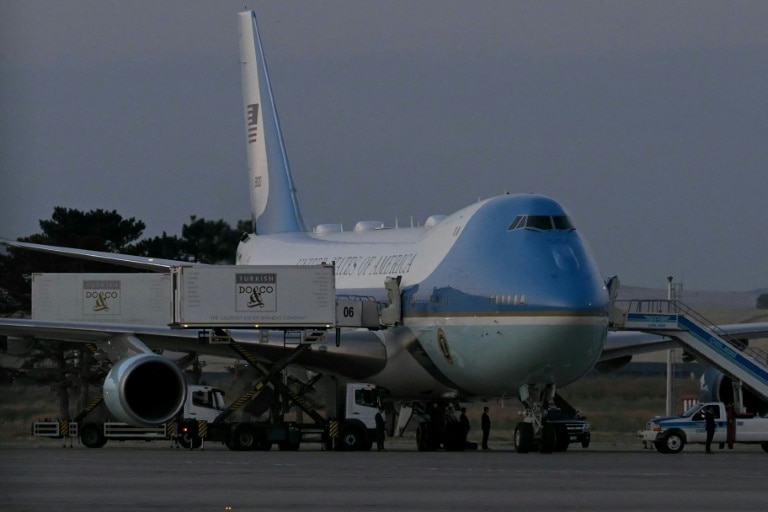
A clandestine security operation that moved former president Donald Trump off the official Air Force One and onto a smaller backup jet while leaving traveling journalists and White House staff on the original plane amid a reported Iranian assassination threat has ignited fierce debate over U.S. presidential security protocols and press treatment.
According to an initial report from The Washington Post published Monday, the unusual swap unfolded on the tarmac of Ankara, Turkey on July 8, 2024, ahead of Trump’s departure for a NATO summit. The operation was crafted specifically to evade what U.S. officials have described as a ‘credible’ Iranian threat against the president, amid ongoing open hostilities between the U.S. and Iran.
Witness accounts and visual evidence confirm that Trump initially boarded the main Air Force One in full view of assembled press and photographers, with AFP capturing images of two large cargo containers positioned at the front and rear of the aircraft via hydraulic lifts. After entering the jet, Trump reportedly exited quickly into one of the sealed cargo containers, which was then transported to a smaller U.S. Air Force jet waiting nearby. Roughly a dozen reporters, who were seated in a separate section of the original Air Force One with no access to the president, remained completely unaware of the switch and departed Turkey on the decoy plane despite the active threat.
The move has drawn sharp anger from the traveling press corps, many of whom say they were unknowingly used as human decoys to distract potential attackers. ‘When you sign up to work at the White House, even as a civilian, part of your job is to defend the president. That’s not my job. I cover the president. Reporters take risks as part of the job, but not on behalf of the president,’ an unnamed White House reporter told The Washington Post.
Pool reporters on board the decoy plane also noted an unusual order from the U.S. Secret Service to lower all window shades during takeoff – a step that is rarely implemented outside of active combat zones. When pressed on the order at the time, Trump responded to reporters: ‘because you’re probably on a dangerous flight because of the sleaze bags that we have to deal with. If I go, you go. Right? Perhaps someday you want to change professions.’
The incident also adds new scrutiny to a controversial arrangement from Trump’s trip: he arrived in Turkey aboard a luxury Boeing 747 gifted to him by Qatar, which had been retrofitted to accommodate the president. However, that aircraft was reportedly not outfitted with standard anti-missile defense systems required for presidential travel, so the traditional Air Force One was called in to replace it for the leg of the trip. At the time, Trump claimed the Qatari-gifted plane was being sent ahead to the U.K. as a treat for American troops to tour, and he returned to the jet for the final flight to Washington from a British stopover.
To date, the White House has not issued a direct confirmation or denial of the reported plane swap. In a general statement addressing security measures, White House Communications Director Steven Cheung said: ‘There are many enemies of America who have their sights on him, and we use every tool at our disposal to address those threats.’
The tactic of using decoy aircraft for presidential travel is not unprecedented. In 2000, former president Bill Clinton executed a last-minute plane switch traveling from India to Pakistan, using a decoy jet filled with Secret Service agents to mislead potential threats. More recently, President Joe Biden’s 2023 unannounced visit to Ukraine relied on strict travel secrecy for his cross-continental trip by plane and train, though the traveling press pool was notified in advance and a reporter and photographer accompanied Biden throughout the journey.