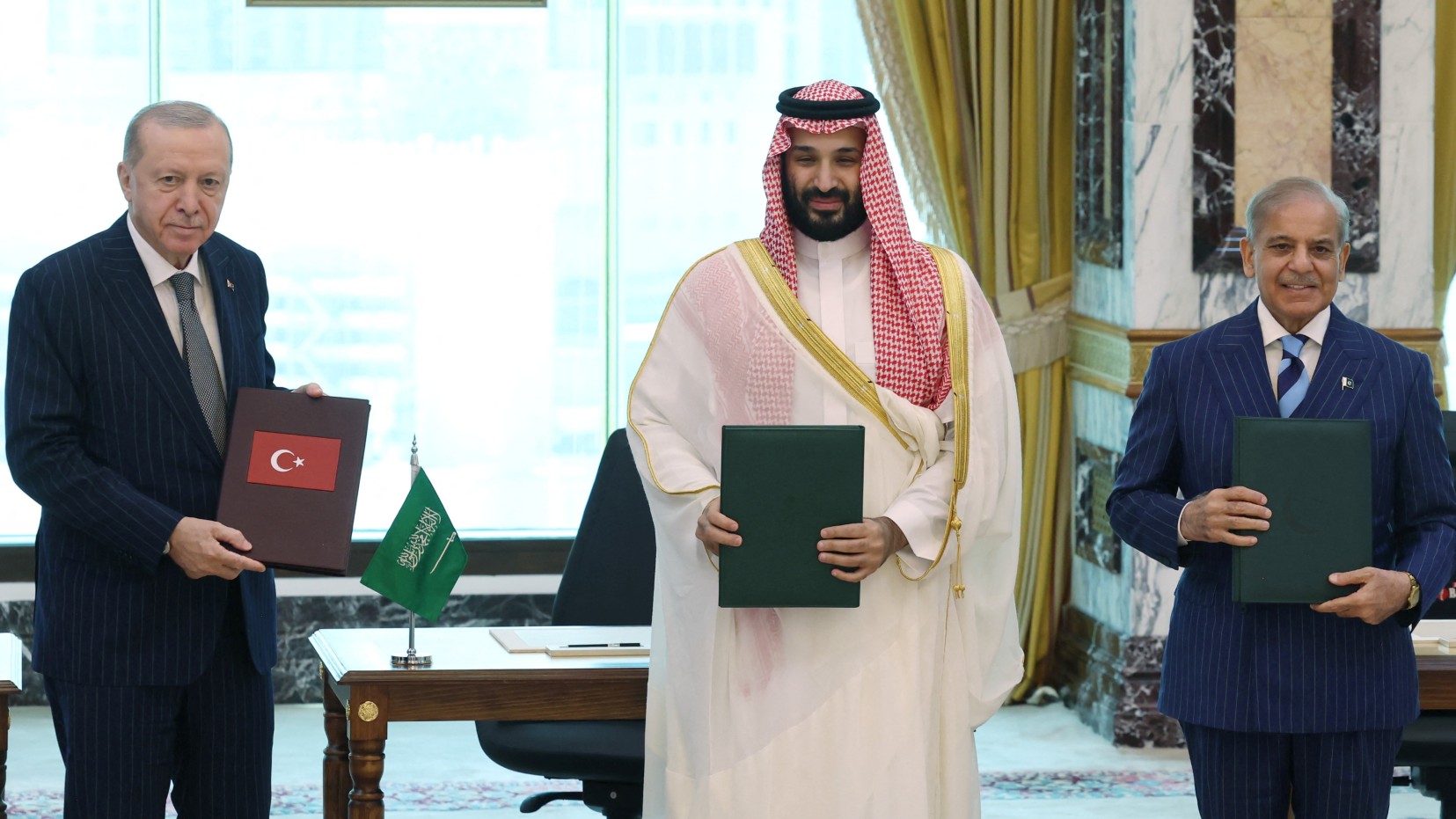
Riyadh has blocked Cairo’s planned accession to the newly signed Mecca Joint Defence Agreement, a mutual defense pact between Saudi Arabia, Turkey and Pakistan, three anonymous Saudi sources with direct knowledge of internal negotiations told Middle East Eye. Turkey had actively pushed to include Egypt in the alliance from the earliest negotiation stages, but Saudi officials have ruled out Cairo’s membership “at least for now”, citing deepening frustration with Abdel Fattah el-Sisi’s government and a growing conviction that Egypt no longer delivers the strategic and military value it once provided to regional partners.
The defense pact, signed last Friday in Islam’s holy city of Mecca, establishes a collective security framework: any armed attack against one of the three signatory states is considered an attack against all three. Saudi government officials have framed the agreement as a mechanism to boost collective regional defense capabilities, though the text remains notably vague on operational protocols, specific activation triggers, and the practical logistics of delivering joint military support during a crisis.
According to the Saudi sources, Riyadh’s opposition stems from long-simmering bilateral tensions that have intensified in recent years. Following Sisi’s 2013 rise to power, Saudi Arabia emerged as Cairo’s largest international financial backer, injecting roughly $25 billion into Egypt’s struggling economy to stabilize it. In recent years, however, Saudi leadership has grown increasingly frustrated by what it views as a persistent lack of reciprocal support on critical regional security issues.
One key point of contention is Egypt’s limited and inconsistent contribution to Saudi Arabia’s nearly decade-long military campaign against the Houthi movement in Yemen. Saudi officials also expressed disappointment with Cairo’s position during the 2023 U.S.-Israeli military campaign against Iran. Further strains have emerged from what Riyadh views as Cairo’s growing alignment with the United Arab Emirates, a shift that deepened after Abu Dhabi backed Southern Yemeni separatist groups Riyadh considers a threat to its core national security and interests.
Two sources noted that when Iran launched attacks on UAE territory, Egypt quickly deployed fighter jets to Abu Dhabi, and Sisi has made repeated trips to meet UAE President Mohamed bin Zayed in recent years of regional conflict. No comparable gestures of support were extended to Saudi Arabia, reinforcing Riyadh’s concerns over Cairo’s strategic priorities. Saudi decision-makers also point out that Abu Dhabi has pursued multiple policies that contradict Cairo’s own stated national interests—including the UAE’s military and diplomatic involvement in Somaliland, its normalization of deep strategic ties with Israel, its backing of Ethiopia in the long-running Grand Ethiopian Renaissance Dam dispute, and its support for the Rapid Support Forces in Sudan’s ongoing civil war. Cairo’s continued close partnership with Abu Dhabi despite these frictions has only deepened Saudi doubts about Egypt’s reliability as a strategic ally.
“Egypt has always been a dependent on us, on the US, and it does not give back, it just takes and takes with no return,” the former senior Saudi royal adviser, one of the three sources, told Middle East Eye. This framing echoes a broader shift in Riyadh’s assessment: under Sisi, the relationship has evolved into one where Egypt relies heavily on Gulf financial support, rather than functioning as an equal, reliable strategic partner.
Turkey has repeatedly pushed for Egypt’s inclusion in the pact. On Saturday, Turkish Foreign Minister Hakan Fidan said Cairo was a “natural partner” for the alliance, and suggested Egypt could join eventually once outstanding technical issues were resolved. Multiple Turkish sources told Middle East Eye that Ankara had launched extensive diplomatic efforts to secure Egypt’s inclusion and formally submitted a proposal for Cairo’s membership. Turkish sources have claimed that once it became clear Egypt itself was uninterested in joining, the three original signatories moved forward without it.
Saudi sources reject this account outright. The former senior Saudi adviser, who remains closely connected to the kingdom’s decision-making circles, called the claim that Egypt declined membership “laughable.” “The matter of fact is, Sisi would have been eager to join so he can reap the financial gains of this agreement, as he usually does,” he said. He added that Saudi decision-makers hold deep concerns about Sisi’s loyalty, and do not trust Cairo to the same degree they trust the leaderships of Turkey and Pakistan. The adviser did leave open the possibility of future membership, noting that “maybe in the future, if we see that there is change or improvement” in Cairo’s alignment and contributions, Riyadh could revisit the question.
Beyond political alignment, Saudi officials argue that Turkey and Pakistan deliver far more tangible military value to the alliance than Egypt. Turkey has rapidly expanded and modernized its domestic defense industrial base in recent years, producing a wide range of advanced indigenous weapons systems. Pakistan, meanwhile, has an established, large-scale weapons manufacturing sector and one of the largest standing militaries in the Muslim world. In contrast, the sources noted, Egypt’s military-owned industrial sector is overwhelmingly focused on civilian production, and lacks comparable advanced defense technology. One source criticized the Egyptian military for prioritizing investments in civilian sectors like food processing rather than upgrading its defense manufacturing and combat capabilities. Saudi officials also question the overall combat readiness and operational effectiveness of the Egyptian armed forces.
This assessment aligns with a broader regional shift: recent international analysis has highlighted Egypt’s diminishing role as a core regional security and diplomatic player. The Economist reported this week that Egypt, which long positioned itself as a central pillar of regional order, has increasingly been sidelined as both a mediator and a military power. For decades, Egypt was a key military partner for Gulf Arab states, most notably joining the U.S.-led coalition that expelled Iraqi forces from Kuwait in 1991. Today, the sources note, even Kuwait has expressed greater interest in joining the Mecca agreement than relying on its decades-old defense partnership with Egypt for security.
Even amid the current rejection, the former senior adviser emphasized that despite Riyadh’s current opposition, relations with Turkey—once deeply strained—are now viewed as more reliable than relations with Cairo. “The decision makers in the leadership have serious concerns about Sisi’s loyalty,” he said. “He is simply seen that he cannot be trusted, and rightly so.” In contrast, he described Riyadh’s relationships with “the Pakistanis and the Turkish brothers” as solid and aligned on core regional priorities.
Public opposition to Egypt’s membership has also emerged on Saudi social media, with many accounts aligned with the Saudi leadership posting content arguing that Cairo does not belong in the alliance. A prominent anonymous account widely believed to be controlled by Saud al-Qahtani, a former senior aide and still close confidant of Crown Prince Mohammed bin Salman, echoed the official Saudi position. “The door of the alliance is not open to those who only want to address their problems and benefit from it without participating in the same secure mission for the region,” the post read. “Whoever wants to join must share the same common interests of the three countries. The era of illusory entitlements, charity, and one-sided giving has passed, and the time of ‘my fate alone’ has ended, giving way to the phase of ‘our single fate’.”
All three sources stressed that the current decision does not permanently close the door to Egyptian membership. For the immediate future, however, Riyadh remains firm that Cairo will not be included in the new regional defense pact.