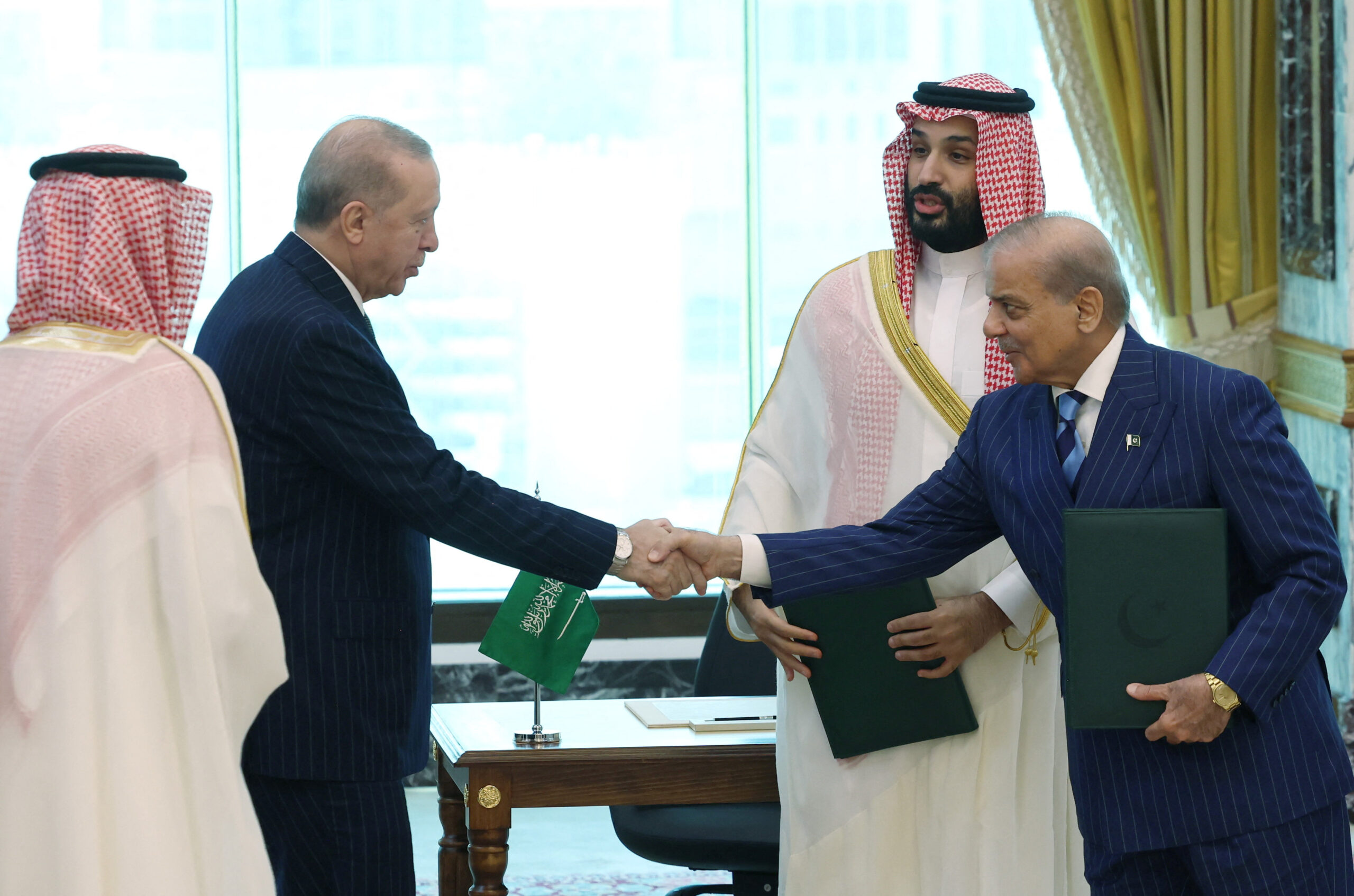
A landmark collective defense agreement signed by Saudi Arabia, Turkey, and Pakistan has triggered an unprecedented public dispute between Saudi Arabia and the United Arab Emirates, exposing long-simmering divisions over regional security strategy within the Gulf Cooperation Council (GCC).
Dated August 7, 2026, the accord — officially named the Mecca Joint Defence Agreement — enshrines a core mutual defense principle: any armed aggression against one of the three signatory states will be considered an attack on all three. While the pact was framed by Riyadh as a step to broaden regional deterrence capabilities, it has drawn sharp pushback from prominent Emirati public figures, who challenge Saudi Arabia’s choice to build a new security architecture outside the GCC framework.
The GCC, founded in 1981, is a 6-nation regional bloc consisting of Bahrain, Kuwait, Oman, Qatar, Saudi Arabia, and the United Arab Emirates, all energy-rich Gulf monarchies that have long coordinated on political, economic, and security matters. Leading the Emirati criticism is Abdulkhaleq Abdulla, a respected political analyst and former senior advisor to UAE President Mohammed bin Zayed. In a series of public posts on X, Abdulla questioned the strategic rationale behind the trilateral pact, arguing that prioritizing a broader regional partnership over deepening intra-GCC cooperation was a misstep.
“Congratulations on the establishment of this alliance, but strengthening Gulf military and political cooperation and unifying the Gulf house is far more important than investing in regional military and political cooperation that includes countries whose credibility and ability to confront the Iranian-Israeli threat are not taken seriously,” Abdulla wrote. He also pressed the three signatories on a core question of alliance-building, asking, “One of the conditions for the success of any alliance is identifying the common enemy. So who is the enemy for the countries of this alliance?”
Abdulla’s public critique drew an immediate and firm rebuttal from Saudi officials and commentators. Saudi Prince Abdulrahman bin Musaid pushed back directly against Abdulla’s claims, framing the new agreement as an exercise of Saudi Arabia’s inherent national sovereignty. “What is the problem, Doctor, if it is an alliance, a treaty, an agreement, or under any title?” the prince wrote on X. “How can this conflict with unifying the Gulf house? Is it not the right of any state to make agreements with any state or states according to what it sees as achieving its interests?”
Fahad al-Arabi al-Harthi, chairman of the Saudi-based Asbar Centre for Studies and Research, further clarified Riyadh’s position, rejecting the characterization of the Mecca agreement as a bloc targeted at any specific nation or regional actor. He emphasized that the pact was not structured around a shared enemy, but rather focused on building collective defensive and deterrent capacity to safeguard regional security and stability against any potential threat from any origin.
Other Saudi social media users took a more confrontational tone, pointing to the UAE’s own independent foreign policy moves that bypassed GCC coordination, most notably the 2020 Abraham Accords that normalized the UAE’s diplomatic relations with Israel. “I wonder, did the UAE inform and notify the Gulf states before its alliance with the Zionist entity?” one Saudi commenter asked.
As the public debate escalated, Abdulla doubled down on his position, sharing a post widely interpreted as a rejection of broader pan-Arab or pan-Islamic alliances in favor of a strict, homeland-first approach to national interest. “He whose sect is more important than his homeland, there is no safety for him… He whose nation, Arab or Islamic, is more important than his homeland, there is no safety for him,” Abdulla wrote. “Belonging, loyalty, and sincerity are for the homeland alone, with no partner.”
That post drew a sharp response from Abdulaziz al-Tuwaijri, former head of the Islamic World Educational, Scientific and Cultural Organisation (Isesco), who alluded directly to the UAE’s diplomatic ties with Israel in his reply: “Anyone who betrays and collaborates with the Zionists will never find security.”
In a follow-up tweet, al-Tuwaijri also called out the inconsistency of the UAE’s criticism, pointing to the UAE’s own bilateral defense agreement with India and its extensive security cooperation with Israel — partnerships the UAE has pursued independently without similar scrutiny from within the GCC. He closed his post with a pointed Arabic proverb, “those who have shame are dead,” a rebuke implying that critics of the Saudi-led pact lack the moral standing to question Riyadh’s strategic choices.
The public clash marks a rare breakdown in the usually discrete diplomatic culture of Gulf monarchies, where internal disagreements are rarely aired publicly. The dispute highlights growing rifts over how Gulf states should navigate shifting regional power dynamics, with differing visions on whether security cooperation should remain centered within the GCC or expand to extra-regional and non-GCC actors.