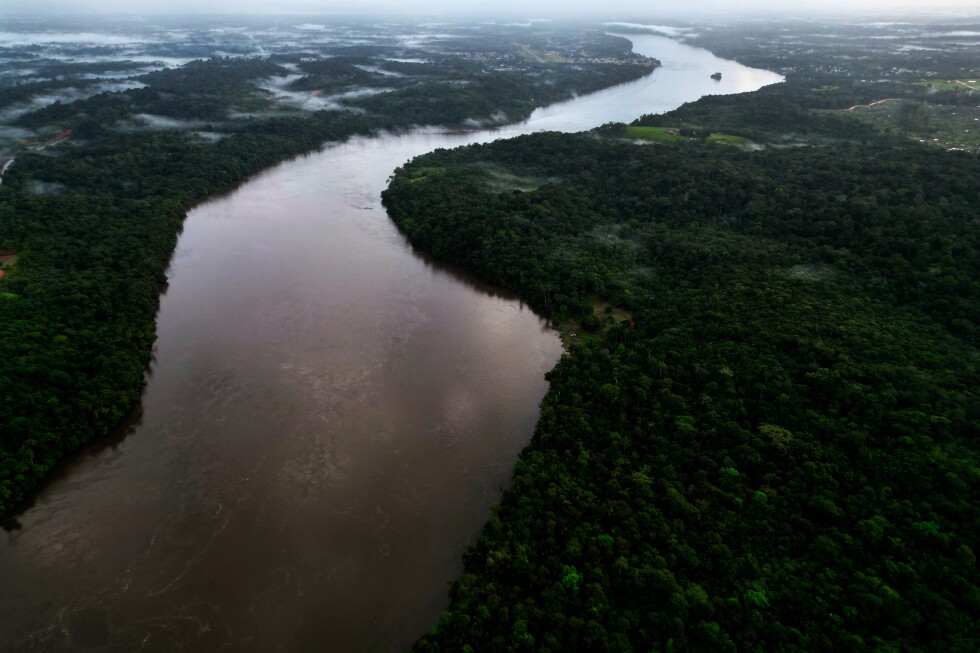
SAO PAULO – In the coming days, Brazil’s highest judicial body will deliver a series of landmark rulings that stand to fundamentally alter the trajectory of Amazon rainforest protection and the rights of the Indigenous communities who have stewarded these lands for millennia. The batch of pending cases touches on three critical, interconnected flashpoints: long-disputed Indigenous land title claims, recent congressional rollbacks of long-standing environmental safeguards, and streamlined approval rules for large-scale infrastructure projects. All these disputes have landed on the Supreme Court’s docket after a series of clashes between Brazil’s left-leaning executive branch and a conservative-dominated legislature, with environmental advocates increasingly framing the court as the last remaining bulwark against the erosion of protections for the world’s largest tropical rainforest.
For more than three years, Brazil’s Congress, led by a powerful bloc of lawmakers aligned with the country’s massive agribusiness sector, has advanced a slate of measures that environmental and Indigenous rights groups argue violate the environmental and indigenous rights protections enshrined in Brazil’s 1988 Constitution. Current President Luiz Inácio Lula da Silva, who campaigned on a pledge to reverse the devastating deforestation surges of his far-right predecessor Jair Bolsonaro, has used executive power to veto a number of these anti-environmental measures outright, and struck out harmful provisions in others. But lawmakers in Congress, where agribusiness interests hold a clear majority, have repeatedly voted to override Lula’s vetoes, forcing the disputes into the judicial system.
These court battles lay bare the stark political constraints facing the Lula administration, even as it has won praise for cutting Amazon deforestation by nearly 50% during its first term and redirecting federal resources toward ecological conservation and sustainable development. With conservative agribusiness-aligned lawmakers outnumbering the administration’s allies, Lula’s government has consistently struggled to advance its environmental agenda through the legislative branch. Lawmakers in recent years have also shifted more control of the federal budget—an indispensable tool for political bargaining and coalition-building—away from the executive branch, further weakening the administration’s leverage.
“The government is extremely weak on the legislative playing field,” explained Suely Araújo, policy coordinator at the Climate Observatory, a coalition of more than 50 Brazilian environmental nonprofits. “It regularly opposes bills that roll back environmental protections, but it simply lacks the political capital to persuade enough members of Congress to align with its position.”
Brazil’s agribusiness sector is one of the largest and most economically influential parts of the country’s economy, accounting for nearly a quarter of national GDP. The country is the world’s top exporter of beef and soybeans: official trade data shows that between January and July 2026, 50% of Brazil’s beef exports and 70% of its soybean exports went to China, Brazil’s largest single trading partner. Agricultural expansion for cattle ranching and soy cultivation is the leading driver of Amazon deforestation, which releases massive stores of carbon stored in rainforest vegetation and soils and accelerates global climate change. The Amazon plays an irreplaceable role in regulating global and regional rainfall patterns and limiting global temperature rise, making its protection a core priority for global climate action. Agribusiness groups have pushed back against criticism, arguing they oppose illegal deforestation and pointing to gains in productivity that allow output to expand without additional forest clearing. The Parliamentary Agricultural Front, the leading caucus for agribusiness interests in Congress, did not respond to requests for comment for this report.
The most closely watched of the pending cases centers on a 2025 Supreme Court ruling that rejected the so-called “time limit thesis,” a legal position long championed by the agribusiness caucus. That thesis would restrict Indigenous land claims exclusively to territories that Indigenous groups physically occupied, or had active legal claims over, when Brazil’s current Constitution took effect on October 5, 1988. Proponents of the cutoff argue it delivers much-needed legal certainty for rural landowners. But Indigenous organizations counter that the rule ignores decades of forced displacement and violent expulsion of Indigenous communities from their traditional lands during the aggressive agricultural expansion of the 20th century.
The Supreme Court began reviewing final motions from all parties last Friday, with final voting scheduled to conclude by August 18. Justices are set to address critical follow-up questions, including new compensation rules for non-Indigenous occupants of disputed lands and potential new deadlines for completing the official demarcation of Indigenous territories. Ricardo Terena, a lawyer for the Articulation of Indigenous Peoples of Brazil, the country’s largest Indigenous advocacy network, warned that some of the proposals on the table would effectively bring future Indigenous land demarcation to a halt. The new rules would add layers of costly administrative hurdles and expand compensation rights for non-Indigenous occupants, allowing those groups to remain on disputed territory until payment is finalized, a process that can take decades.
One of the many Indigenous communities whose futures hang in the balance is the Kawahiva, an isolated, uncontacted group that remains nomadic in the Amazon rainforest of Mato Grosso state. Brazilian authorities first confirmed the Kawahiva’s presence in the region in 1999, but only completed the physical demarcation and official mapping of their territory earlier this month. According to UK-based Indigenous rights nonprofit Survival International, the remaining Kawahiva are hunter-gatherers who survived decades of violent attacks and introduced diseases that wiped out much of their population, and they continue to avoid contact with outside settlers.
Beyond the Indigenous land rights case, the Supreme Court will take up two other high-stakes cases on Wednesday that will shape how the Amazon is governed. First, justices will review an injunction issued by Justice Flávio Dino that temporarily blocked state laws passed by top soy-producing states that effectively ended the Brazilian Amazon Soy Moratorium, a landmark voluntary pact that has operated for nearly 20 years. The moratorium barred major grain traders from purchasing soy grown on recently deforested land in the Amazon, and independent analysts credit it with drastically cutting deforestation linked to soy production. The pact collapsed earlier this year after the state legislatures passed laws revoking tax benefits for any trading company that participated in the agreement, leading major global traders to withdraw from the pact.
The second case Wednesday challenges a new national environmental licensing law that took effect in February, which streamlines and fast-tracks permit approvals for large infrastructure projects including mines, highways, and industrial plants. Environmental advocates argue key provisions of the law are unconstitutional, including a rule that allows project operators to issue their own environmental permits for projects with moderate environmental impact, eliminating independent government review.
Araújo said she expects the court to strike down at least the most clearly unconstitutional provisions of the new licensing law, noting that the law is already causing harm to the Amazon even before the court issues its ruling. She pointed to the ongoing paving of a controversial cross-Amazon highway and plans to dredge a major Amazon river that moved forward without the full environmental impact assessments required under previous rules. The Ministry of Environment, which has backed challenges to both the state laws ending the soy moratorium and the most harmful provisions of the licensing law, noted that the moratorium had proven it could cut deforestation while allowing agricultural output to grow. The ministry added that Brazil does need a more efficient, technically sound licensing system to support needed infrastructure investment, but that the current law undermines core standards needed to protect the Amazon and address climate change.
The office of the president’s chief of staff, which coordinates the administration’s relations with Congress, declined to comment on pending cases before the Supreme Court. The Associated Press’ climate and environmental reporting is supported by grants from multiple private foundations, with AP retaining full editorial control over all content.