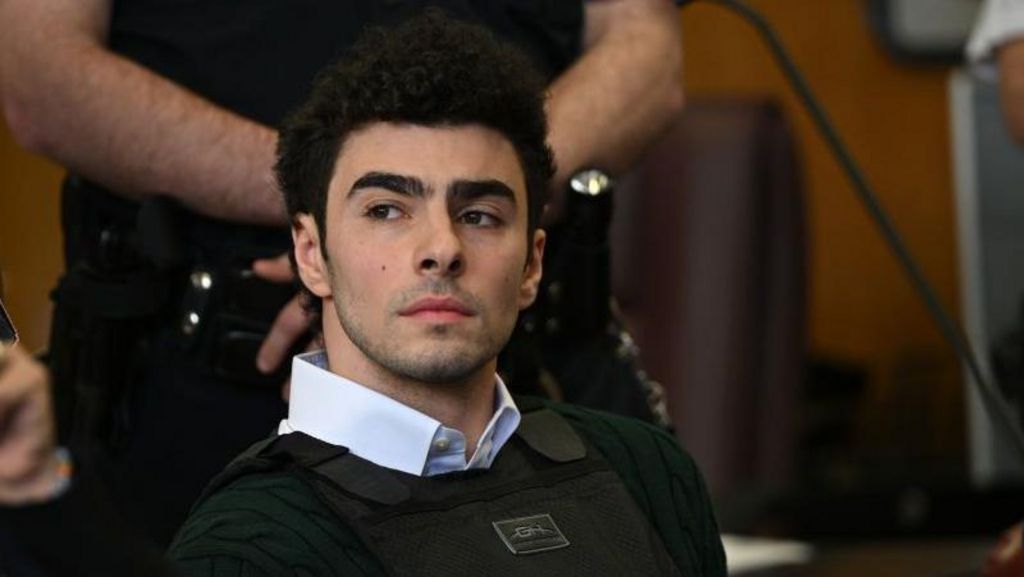
With less than four weeks remaining before jury selection kicks off in the high-stakes murder trial of Luigi Mangione at a New York state court, the already nationally watched case is poised to erupt into one of the most publicized criminal spectacles in recent U.S. history. On Tuesday, Mangione is scheduled to return for a final pre-trial hearing, where long lines of supporters are expected to form hours before proceedings begin. For many of these backers, Mangione has become a symbolic figurehead for growing public anger over the soaring cost of healthcare in the United States, turning a routine criminal trial into a flashpoint for national policy debate. Online, the case has already split public discourse: supporters and critics have debated every detail of the incident, from Mangione’s alleged motives to his public persona, generating millions of posts and discussions across social media platforms.
Prosecutors allege that in 2024, Mangione shot and killed Brian Thompson, a UnitedHealthcare executive and father of two, in a public attack in Midtown Manhattan. If convicted on the charges against him — which include second-degree murder and multiple weapons offenses — Mangione faces the possibility of spending decades in a state prison. He has entered a plea of not guilty to all counts.
Over months of pre-trial filings and closed-door arguments, both the prosecution and defense have previewed their core strategies and legal battles, though several key questions remain unresolved ahead of Tuesday’s hearing, where Judge Gregory Carro is expected to finalize the last of the trial’s ground rules. The most significant pre-trial ruling came earlier this summer, following a multi-day December hearing focused on which evidence would be admissible at trial.
Mangione’s defense team launched an aggressive legal push to block evidence collected by authorities following his arrest in Pennsylvania, arguing that state police violated his constitutional rights by improperly searching and seizing his personal belongings and failing to properly read him his Miranda rights before questioning. The defense secured a partial victory: the judge ruled that a gun magazine, cell phone, passport, wallet, and computer chip recovered from Mangione’s backpack cannot be presented to the jury. However, Carro ruled that two key pieces of evidence the prosecution has described as critical to their case — the alleged murder weapon and a notebook containing writings purportedly from Mangione — will be allowed to enter the trial record.
Prosecutors have already outlined their case, which includes surveillance video capturing the moment Thompson was shot from behind by a hooded individual, as well as additional footage that investigators say tracks Mangione’s movements immediately after the attack. They have also noted they will present ballistics and fingerprint evidence that they argue links Mangione directly to the killing.
To date, Mangione’s legal team has not publicly revealed its full trial strategy, and has not put forward a clear alternative narrative to the prosecution’s account of the shooting. “We do not have, like in ‘The Fugitive,’ the idea of the one-armed man who’s the real killer,” explained Mitchell Epner, a former federal prosecutor, referencing the popular 1993 legal thriller. Earlier this summer, the defense floated and then quickly withdrew a proposed defense centered on extreme emotional disturbance, a legal framework under New York law that would allow the jury to reduce a second-degree murder charge to manslaughter if the defense can prove the defendant acted under the influence of an extreme and reasonably explainable emotional breakdown at the time of the killing. Many legal experts had speculated the defense might turn to an insanity plea, a separate legal standard that requires proving the defendant could not understand the nature of their actions at the time of the crime, but the defense has not moved forward with that strategy.
Cheryl Bader, director of the Criminal Defense Clinic at Fordham University School of Law, noted that insanity defenses are rarely successful in U.S. courts. “Short of being delusional, or having no understanding of the nature of what one is doing, an insanity defence is not likely to be successful,” Bader said. Mangione’s legal team has declined to comment publicly on their trial strategy ahead of jury selection.
Under U.S. criminal law, the burden of proof rests entirely with the prosecution, which must prove its case beyond a reasonable doubt — a high legal standard that requires jurors to have no reasonable uncertainty about the defendant’s guilt. Epner explained that the trial’s outcome may hinge on how much the proceedings center on the broader national conversation around healthcare costs rather than the core question of whether Mangione killed Thompson. “The more his case is about the question of who killed the victim, the easier it is for the prosecution,” Epner said. “The more it’s about the other peripheral issues, the harder it is for the prosecution.”
Whether the trial becomes a national public spectacle hinges in part on unresolved debates around media and public access, which the judge is expected to address on Tuesday. In recent weeks, Mangione’s legal team has raised objections to existing procedures for press entry to the court, and has criticized the lack of an overflow room to accommodate additional members of the public and press who want to observe the trial. The defense also formally requested that the entire trial be broadcast live to the public, a request that conflicts with existing New York state court rules that ban public live streaming of criminal proceedings.
Prosecutors with the Manhattan district attorney’s office have said they have no role in setting media access procedures, and in a new court filing submitted Monday night, the DA’s office said it would defer to Judge Carro’s judgment on public access questions. The office did, however, note that adequate security protocols are required to prevent spectators from illegally recording the proceedings from any overflow space, in violation of state law. Court spokesperson Al Baker confirmed that the court is currently finalizing a plan for the trial, including arrangements for an overflow room. “We remain firmly committed to providing the greatest possible access for both the media and the public,” Baker said, adding that the court is “evaluating the complex logistical and safety considerations involved” to accommodate the high level of public interest in the case.