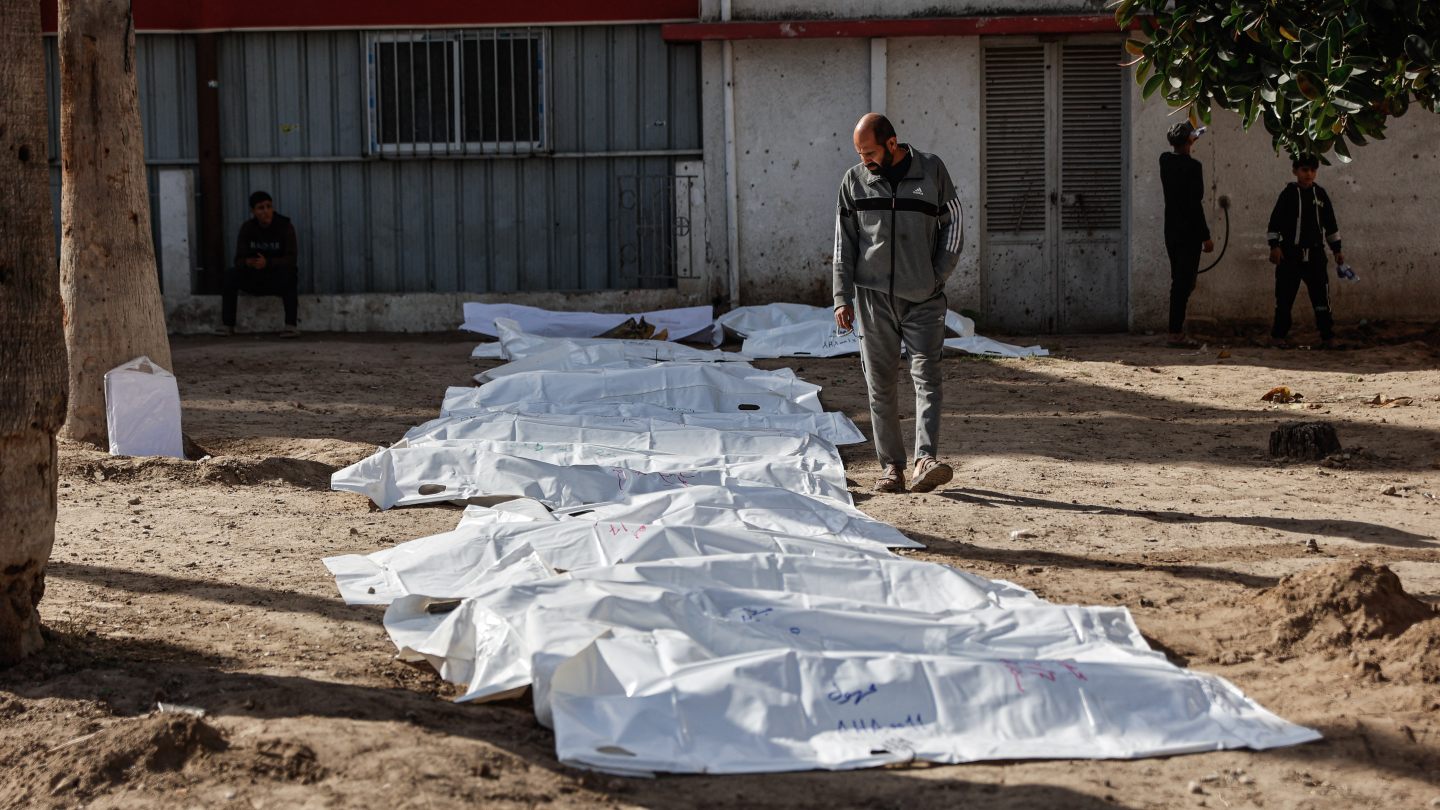
In a bombshell new report from leading Israeli newspaper Haaretz, Israel is currently detaining the remains of roughly 1,700 Palestinians to use as potential bargaining chips in future talks—even after Palestinian armed groups have returned all captured Israeli hostages and their remains. The report outlines that the country’s domestic intelligence agency, Shin Bet, is led by director David Zini, who has publicly pushed for Israel to hold onto the remains for future hostage negotiation leverage, a stance that has received full backing from the Israeli military. According to Haaretz’s breakdown, the vast majority of the retained remains are linked to Palestinian fighters who participated in the October 7, 2023 attack led by Hamas, but the collection also includes the bodies of Palestinian civilians and 13 Israeli citizens who died alongside them. Legal experts and sources quoted in the investigation have raised serious objections to the policy, noting that Israel has no legal or official authority to hold the remains of non-combatant Palestinians, as no formal Security Cabinet policy backs the decision. The report builds on earlier reporting from the same Israeli outlet from July 2025, which exposed one high-profile case of a detained Palestinian photographer, a father of four, who was arrested in December 2023 and died in custody just one day later at the Erez Crossing detention facility. Israeli authorities only admitted to holding his remains in response to a petition filed with the High Court of Justice, and to date, no autopsy has been performed on his body. It was not until July 2025 that the photographer’s family learned of his death, after submitting a court petition through Gisha, an Israeli human rights organization focused on Palestinian freedom of movement. Even after notifying the family of his passing, Israeli officials have refused to release key details about the date, location, or specific circumstances of his death, as well as any legal justification for retaining his remains. Israeli authorities have labeled the photographer a “military Hamas operative,” a claim the family has forcefully denied. The July 2025 Gisha report put the number of Palestinian remains held by Israel after death in custody at more than 100, originating from both the West Bank and Gaza Strip. At least 68 of these retained remains are people from Gaza. In court proceedings, Israeli state representatives acknowledged that a formal review of the policy of holding these remains was underway, but that the review has been put on hold indefinitely amid the ongoing conflict with Iran. Israel’s policy of seizing and holding remains of Palestinians killed by its forces is not a new practice, and for years it has drawn widespread condemnation from international human rights organizations, which have repeatedly called for the immediate return of all remains to their grieving families. International humanitarian law mandates that all deceased people must be treated with dignity. The International Committee of the Red Cross notes that these legal standards are designed in large part to prevent people from being listed as missing, and to ensure that families receive clarity about the fate of their loved ones. The Fourth Geneva Convention, a cornerstone of international humanitarian law, further requires that the bodies of deceased detainees must be given honorable burial, that their graves must be properly maintained and clearly marked to allow for future identification. The convention also mandates that the dead must be treated in accordance with the religious rites of the deceased’s faith wherever possible. While this policy violates international humanitarian standards, it is permitted under Israeli domestic law, and has been systematically implemented across the occupied Palestinian territories for decades. In a November 2025 report from Reuters, Palestinian armed groups confirmed that all remains of Israeli captives had already been returned to Israel as part of a broader exchange agreement that was supposed to result in the return of Palestinian remains to their families. As of this reporting, that exchange has not been completed on the Israeli side, leaving more than a thousand families waiting for the return of their loved ones to carry out proper burial rites. This coverage is originally reported by Middle East Eye, an independent outlet providing unmatched reporting and analysis on the Middle East, North Africa, and surrounding regions.