Global financial markets traded mixed on Tuesday, driven by persistent uncertainty around the reopening of the Strait of Hormuz, a critical chokepoint for global crude oil shipments. The supply uncertainty sent oil prices surging more than 2% following a 5% jump in the previous session, while benchmark U.S. futures retreated modestly after Wall Street pulled back from recent all-time highs.
The standoff over the Strait of Hormuz intensified after former U.S. President Donald Trump rejected Iran’s demand that Washington pay reparations for five months of conflict-related damage as a precondition for reopening the waterway, which carries roughly a fifth of the world’s daily crude oil supplies. By Tuesday trading, international benchmark Brent crude climbed 2.4% to settle at $89.80 per barrel, while U.S. West Texas Intermediate crude rose 2.6% to hit $84.20 per barrel. Last month, oil prices swung wildly between $72 and $102 a barrel as expectations for a breakthrough U.S.-Iran agreement to allow unimpeded tanker transit through the strait rose and fell.
In early European trading, major regional indexes all posted modest losses. France’s CAC 40 shed 0.2% to close at 8,708.85, Germany’s DAX also slipped 0.2% to 26,272.81, and the United Kingdom’s FTSE 100 declined 0.2% to 10,840.84. Across the Atlantic, futures tied to the S&P 500 and Dow Jones Industrial Average both traded 0.1% lower, extending a pullback from Monday when the S&P 500 dipped 0.1% away from the record high it set the previous Friday. The Dow fell 0.1% and the Nasdaq composite dropped 0.3% on Monday.
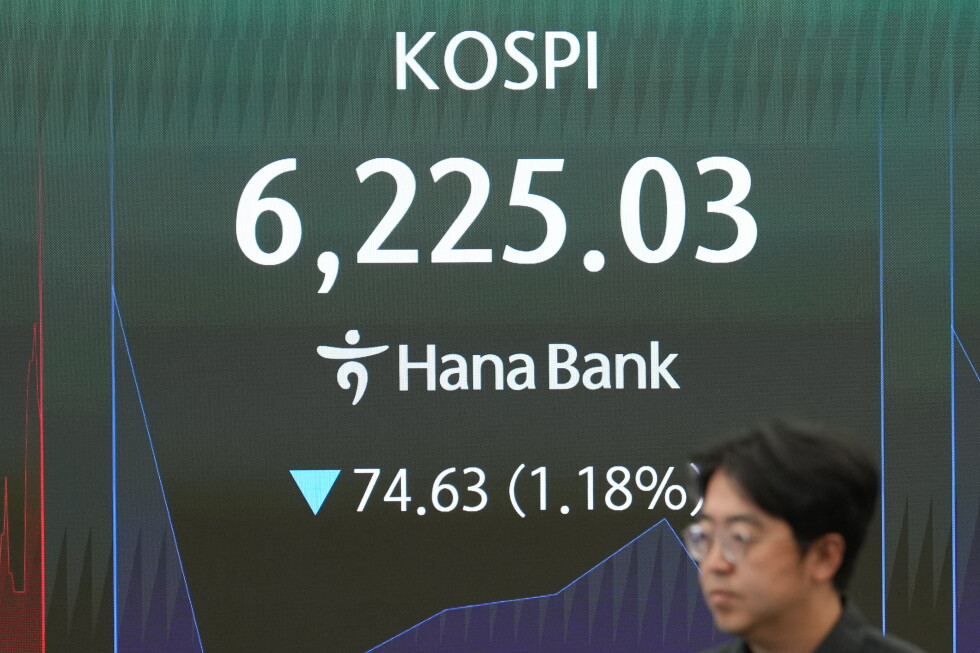
Asian markets delivered a mixed performance, with Tokyo closed for a public holiday. South Korea’s Kospi outperformed regional peers, gaining 0.7% to reach 6,345.53, lifted by a 4.1% jump in shares of industry giant Samsung Electronics and a 0.4% advance for memory chipmaker SK Hynix. However, the extreme volatility that rocked tech stocks in recent weeks, fueled by shifting expectations for AI-driven corporate profit growth, has calmed in recent days. Ipek Ozkardeskaya, senior analyst at Swissquote, noted that the broad AI-driven chip rally of the past year may be fading, even if major Korean chip manufacturers will continue to see benefits from global AI infrastructure expansion.
Elsewhere in Asia, Hong Kong’s Hang Seng Index fell 1.1% to 25,652.82, China’s Shanghai Composite retreated 0.8% to 3,934.09, India’s Sensex lost 0.5%, while Taiwan’s Taiex gained 0.4%. Australia’s S&P/ASX 200 edged 0.2% higher to 9,250.60 after the Reserve Bank of Australia announced it would hold its benchmark interest rate steady at 4.35%, matching market expectations.
On Wall Street, the AI-fueled rally that pushed major indexes to record levels has slowed in recent sessions, even as second-quarter earnings have outperformed expectations. Data from FactSet shows that S&P 500 companies are on track to report a 50% year-over-year jump in second-quarter earnings per share, which would mark the strongest growth since 2020, when the economy was rebounding from the initial COVID-19 recession. Warren Buffett’s Berkshire Hathaway, one of the latest companies to beat analyst profit forecasts, gained 1.5% on Monday. In contrast, chip giant Intel fell 4.1% after announcing plans to sell $15 billion in new common stock, a move that will dilute existing shareholders’ ownership stakes. The company noted it plans to use the proceeds from the offering to fund massive AI-related capital investments.
All eyes on Wall Street this week are fixed on Wednesday’s release of U.S. inflation data for July. Economists forecast that annual inflation will cool to 3.4% from 3.5% in June. A lower-than-expected inflation reading would ease pressure on the Federal Reserve to implement additional interest rate hikes. Higher interest rates curb inflation by slowing the overall economy, but they also raise borrowing costs for households and businesses and typically push down asset prices for stocks and bonds.
In currency markets on Tuesday, the U.S. dollar inched up slightly to 159.35 Japanese yen from 159.30 yen, continuing its gradual upward climb despite recent joint market intervention by Japan and the U.S. to support the yen’s value. The euro dipped modestly to $1.1539 from $1.1544. Safe-haven gold, which is commonly used as a hedge against market uncertainty, added 0.3% to trade at $4,434.20 per ounce.