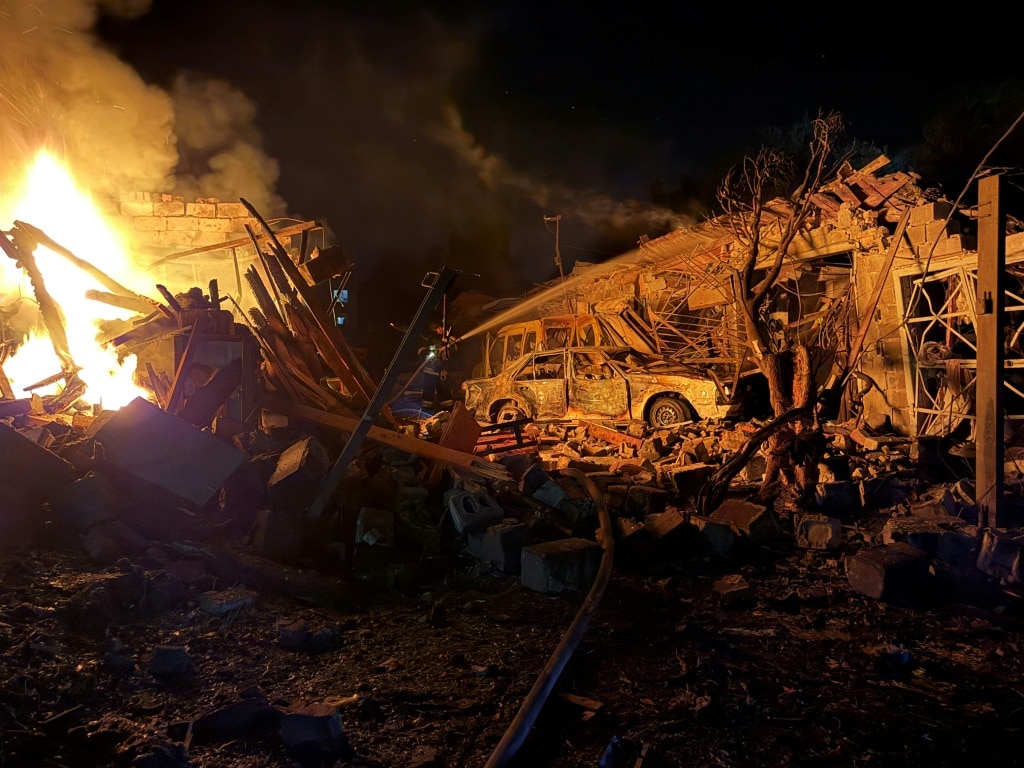
A new wave of Russian overnight bombardments targeting multiple cities across Ukraine has left at least nine civilians dead and dozens more injured, with Ukrainian authorities leveling fresh accusations Tuesday that Moscow used North Korean-supplied ballistic missiles in the deadly assault. The claims come amid escalating warnings from Ukrainian President Volodymyr Zelensky that North Korea is expanding its military support to Russia, even as Kyiv has yet to release public evidence to back its most recent assertions of growing Pyongyang-Moscow military cooperation.
Over more than four years of Russia’s full-scale invasion of Ukraine, North Korea has emerged as a key military backer for Moscow. Western, South Korean and Ukrainian intelligence have long documented Pyongyang’s weapons shipments to Russia, and earlier in the conflict, North Korea deployed thousands of troops to support Russian operations pushing back a Ukrainian counteroffensive into Russia’s western Kursk region, according to Kyiv’s accounts. The two countries formalized their deepening alliance with a mutual defense pact in 2024, just ahead of that troop deployment.
In the latest barrage, the southeastern Ukrainian city of Zaporizhzhia suffered the heaviest damage, recording six fatalities and 19 injuries, according to Zelensky. In a public address following the strikes, Zelensky stated the city was hit by a combination of North Korean ballistic missiles, Russian Zircon hypersonic missiles, and guided aerial bombs. He called the attack deliberately vicious, noting it was designed to inflict maximum harm on civilian infrastructure.
Three additional civilians were killed in Russian missile and drone strikes in neighboring Dnipropetrovsk region, local military officials confirmed. In Ukraine’s capital Kyiv, strikes damaged an infectious disease hospital and a separate children’s healthcare facility, according to Ukraine’s health ministry, which released photographs of shattered windows and debris scattered across the children’s hospital courtyard. The ministry added that no children or medical staff were harmed, as all personnel and patients had taken shelter in secure facilities before the strike hit. Frontline cities Kharkiv and Kherson also suffered strikes that knocked out power to large parts of the urban areas.
Russia’s defense ministry responded to the accusations with its own statement confirming the strikes, framing the operation as a targeted group attack using high-precision ground-based weapons against Ukrainian military-industrial sites and transport logistics hubs in Kyiv and Zaporizhzhia.
Zelensky has ramped up public warnings of the deepening military partnership between Moscow and Pyongyang in recent days, as he steps up appeals to Western allies for additional air defense supplies to counter the growing threat. On Monday, he claimed Russia had already taken delivery of a new shipment of ballistic missiles from North Korea. Over the preceding weekend, he alleged Pyongyang had made a decision to deploy between 30,000 and 50,000 additional troops to Russian territory to support the invasion effort. To date, Kyiv has not disclosed how it obtained these deployment figures, nor has it provided a specific timeline for when the troop buildup would occur. Zelensky has now expanded his appeal for air defense support to Asia-Pacific allies, asking them to contribute systems to counter capabilities supplied by North Korea.
In recent weeks, Russia has dramatically increased its use of ballistic missiles in strikes across Ukraine — fast, highly destructive projectiles that are extremely difficult for Ukrainian air defense systems to intercept. Only advanced Western systems such as the U.S.-made Patriot air defense system are capable of reliably shooting down incoming ballistic missiles. Ukraine has faced a critical shortage of Patriot interceptors since the outbreak of the U.S.-Israeli conflict with Iran in February, which has redirected large volumes of interceptor stockpiles to the Middle East.
In response to the intensified Russian strikes, Ukraine has stepped up its own long-range drone attacks targeting Russian territory, hitting key oil infrastructure and e-commerce warehouses. Ukrainian officials frame these counterstrikes as a legitimate effort to disrupt Russian military logistics and cut into revenue streams that fund Moscow’s war effort.
The United Nations has confirmed that this latest cycle of escalation has driven the monthly civilian death toll in Ukraine to its highest level since the opening months of the full-scale invasion in 2022, marking a dangerous new turn in the long-running conflict.