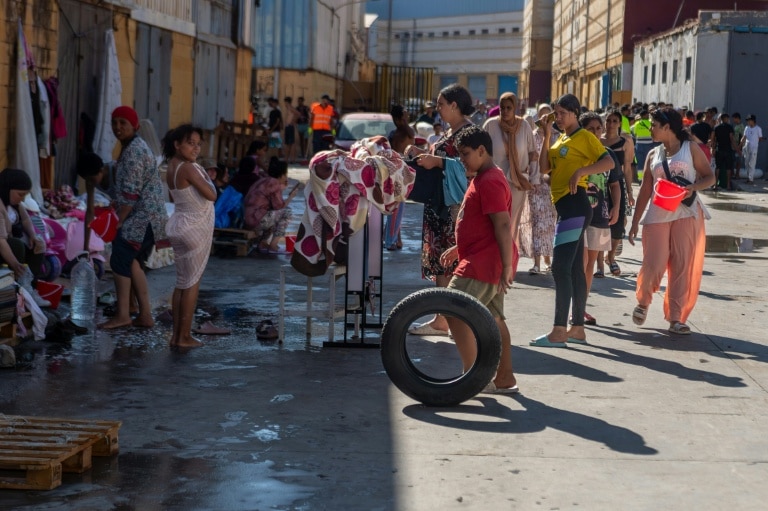
A sharp political clash has erupted between Spain’s leftist national administration and right-leaning regional leadership over the fate of thousands of migrants who remain stranded in the North African enclave of Ceuta, following an unprecedented mass border crossing from Morocco last month. On Monday, Juan Jesus Vivas, leader of Ceuta’s Popular Party (PP) administration, issued an urgent call for the construction of a dedicated detention facility to hold the remaining migrants, clearing the way for faster processing and eventual expulsion from the small Spanish territory. The crisis unfolded on July 30 and 31, when roughly 72,000 migrants stormed the fortified border between Morocco and Ceuta in one of the largest mass border crossings in recent European history. Spanish government data confirms that approximately 70,000 of those migrants have since been repatriated back to Morocco. But thousands remain, among them hundreds of unaccompanied minor migrants who are protected from immediate summary deportation under Spanish and EU law. Currently, these remaining migrants are forced to live in makeshift conditions on Ceuta’s streets, with limited access to basic necessities including food, clean drinking water, emergency shelter and proper sanitation. The small enclave, whose permanent population numbers just 84,000, has seen its public resources completely overwhelmed by the sudden arrival of such a large group of people. The unresolved situation of the remaining migrants has opened a major rift between the central government led by left-leaning parties, and regional governments controlled by the conservative PP and far-right Vox party. Right-leaning regional administrations across Spain have refused to comply with existing legal requirements to accept and resettle the unaccompanied minor migrants from Ceuta, deepening the political deadlock. Speaking to reporters on Monday, Vivas argued that a centralized internment facility for irregular migrants is an urgent necessity to address the current chaos. “A space that acts as an internment centre for foreigners must be set up, where these people can be held and remain confined,” Vivas stated. He emphasized that the facility would allow authorities to speed up deportation procedures and remove homeless migrants from Ceuta’s public streets, describing the current situation as completely “unsustainable” for the small territory. Vivas also pushed back against central government figures, estimating the actual number of remaining migrants is between 8,000 and 11,000, far higher than the central government’s official count of roughly 2,500. The growing public discontent over the crisis boiled over on Sunday, when thousands of Ceuta’s permanent residents gathered for a mass protest to condemn the central government’s handling of the emergency. Protesters argued that the crisis has left the enclave unsafe and abandoned by national leaders. In response to the growing outcry, Angel Victor Torres, Spain’s minister for regional relations, sought to reassure Ceuta’s population that the national government was stepping up its response. Torres confirmed that security force numbers had been significantly increased, including a 40 percent boost in the deployment of the national Civil Guard to the enclave. He added that reuniting unaccompanied migrant children with their family members is the administration’s top priority, but made no mention of plans for further expulsions of the remaining migrants, leaving key questions about the crisis’s resolution unanswered.