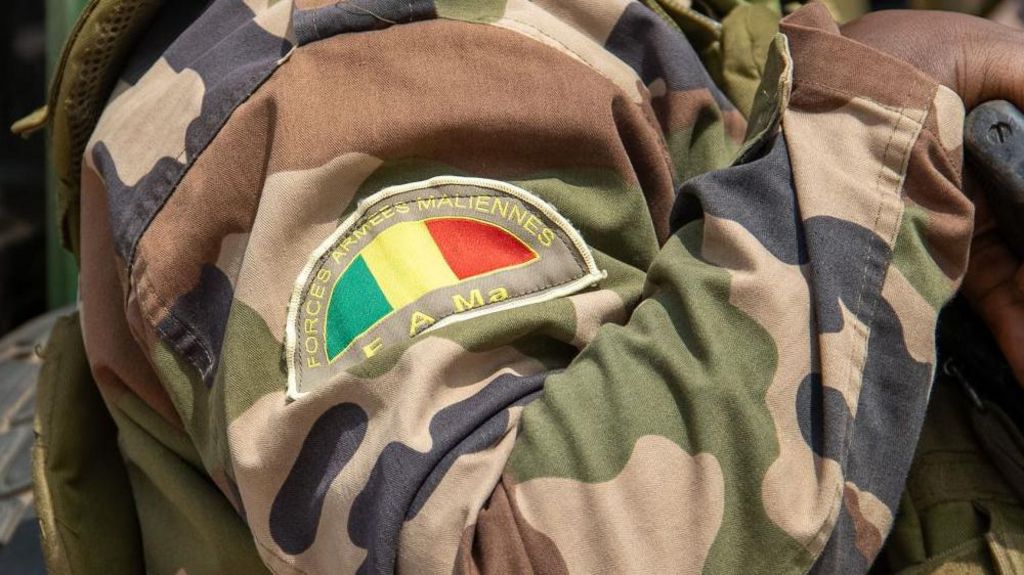
A brazen pre-dawn assault on a key Malian military garrison in the central town of San has left dozens dead and sparked conflicting official and insurgent claims about control of the base, deepening concerns over Mali’s worsening decade-long security crisis. The Sunday attack, which unfolded around 5 a.m. local time, marks another escalation for al-Qaeda-affiliated militant group Jama’at Nusrat al-Islam wal-Muslimin (JNIM), which has expanded its operational reach far beyond Mali’s northern insurgency heartland in recent years.
According to local witnesses cited by French broadcaster RFI, attackers infiltrated the base on foot and motorcycles, with a portion of the assault force disguising themselves in Malian army uniforms to slip past perimeter defenses. Malian military officials confirmed that militants deployed drones, heavy machine guns, and armored vehicles to breach the camp’s outer barriers, with clashes stretching on for roughly two hours. Multiple independent sources, including AFP, have reported that at least 10 Malian soldiers were killed in the fighting, with witnesses noting that militants held parts of the base for an extended period before withdrawing. Some surviving attackers fled to nearby forests or hid in local residential areas after the battle, one witness told RFI.
In an official video statement, Lieutenant Colonel El Oumrani, commander of the 23rd regiment stationed at the San garrison, claimed Malian forces had successfully repelled the assault and killed approximately 40 militant fighters. “The enemy was eliminated and the attack was successfully repelled,” he said, pushing back on claims that the army had lost control of the installation. “The camp of the 23rd is not empty, it is under the custody of the army. My soldiers have not gone anywhere.” The military did acknowledge that troops made a temporary tactical retreat from the site, but rejected JNIM’s assertion that its fighters fully seized and held the base. JNIM had earlier issued a statement claiming responsibility for the attack and stating its fighters had taken full control of the garrison.
The San assault comes amid a steady deterioration of Mali’s security environment, more than 11 years after a jihadist insurgency first took hold in the country’s northern regions. Since the initial 2012 uprising, large swathes of northern and eastern Mali have remained outside of central government control, and JNIM has steadily expanded its operations to target military and civilian sites in central and southern Mali, proving its ability to penetrate deep into government-held territory despite repeated counterinsurgency campaigns.
The current military leadership, led by General Assimi Goïta who seized power in a 2020 coup, rose to power partly on promises to reverse the country’s security decline. Since the coup, the junta has rejected long-standing French military counterinsurgency support and turned instead to Russian military assistance, including from the Wagner Group mercenary force. Just four months prior to the San attack, a coordinated nationwide offensive by an alliance of jihadist and separatist rebels calling itself the Azawad Liberation Front targeted government installations across northern Mali. That assault included a suicide truck bombing that killed Defense Minister Sadio Camara at his residence near the capital Bamako.
Security analysts warn that the brazen attack on a formal military garrison in central Mali underscores the continuing fragility of the junta’s hold on security across the country, even after its strategic shift away from Western partners and toward Russia.