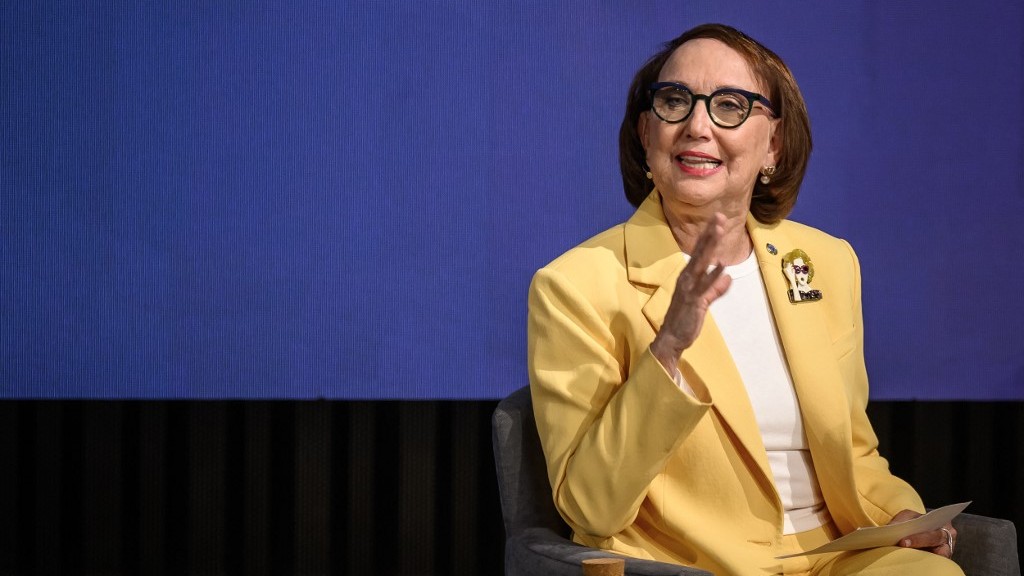
As the United Nations prepares to select a new leader to succeed two-term Secretary-General António Guterres when his tenure ends on 31 December, Costa Rican economist and diplomat Rebeca Grynspan has claimed an early lead in the race, bringing her Jewish heritage and deep family connections to Israel into the global spotlight.
The first unofficial, secret straw poll held by the UN Security Council on 30 July delivered a strong opening showing for Grynspan, who currently leads the UN Conference on Trade and Development (UNCTAD). She earned 10 votes in the “encourage” category, four “no opinion” votes, and just one “discourage” vote out of the 15 total Security Council members, which include five permanent members and 10 rotating elected members. Individual country votes are not made public, and while subsequent rounds of voting could shift the standings, Grynspan’s single objection leaves her well-positioned ahead of other contenders. The Security Council is on track to finalize its preferred candidate by October, though any of the five permanent members holds veto power that could immediately end her campaign.
Longstanding informal regional rotation practices at the UN have led to widespread expectations that Guterres’ successor will hail from Latin America, a geographic alignment that works in Grynspan’s favor. Born in 1955 to a Jewish family in Costa Rica, Grynspan’s background is rooted in a history of displacement and tragedy: her parents were European Jewish refugees who fled rising Nazi persecution in the years before World War II, and multiple members of her extended family were murdered in the Holocaust. If selected, she would make history as the first woman, the first Central American, and the first Jewish person to take the top UN post.
Israeli media outlets have dedicated extensive coverage to Grynspan’s family ties to the country, noting that her sister Frida Greenspan relocated to Israel at age 17 and currently resides in Mevaseret Zion, a town just outside Jerusalem. Greenspan’s children have all served in the Israeli military, some holding officer ranks, and she told Israeli outlet Ynet that the family “are Zionists by birth.” The reporting adds that Grynspan has relatives living in the occupied West Bank, and Israeli media has framed her as one of the most pro-Israel candidates in the field, emphasizing that she is open about her Jewish identity and has maintained close working relationships with Israeli officials based in Jerusalem for decades.
Despite these widely reported connections, it remains unclear how Grynspan would approach the decades-long Israeli-Palestinian conflict if she became Secretary-General. The candidate has rarely centered Israel in her public political profile, leaving her potential approach to the UN’s longstanding policy positions on Palestine untested. Even Israeli analysts acknowledge that her perceived closeness to Israel could become a significant liability in a contest where candidate support is needed from governments holding deeply opposing views on Israel’s occupation of Palestinian territory and its ongoing military campaign in Gaza.
A key contradiction has already emerged in Grynspan’s record: under her leadership, UNCTAD has published some of the UN system’s most critical assessments of the economic harm Israeli policies have inflicted on the Palestinian people. UNCTAD reports have repeatedly documented the economic costs of occupation, the damaging impact of Israeli movement restrictions across the occupied West Bank, and the total collapse of Gaza’s economy following Israeli military operations, directly linking Palestinian economic suffering to Israeli policy choices.
In January 2024, Israel’s foreign ministry cut diplomatic ties with multiple UN agencies and international bodies over their reporting on Israel’s military campaign in Gaza, labeling the coverage anti-Israel. UNCTAD was included on that list, with Israel accusing the agency of publishing “dozens of virulent anti-Israel reports.” Notably, however, Israeli officials have not publicly targeted Grynspan personally, in contrast to their repeated public attacks on current Secretary-General Guterres and other senior UN leaders.
Israel Hayom, a newspaper widely aligned with Israeli Prime Minister Benjamin Netanyahu, has examined Grynspan’s public comments on Gaza, noting that she has repeatedly called for full, unrestricted humanitarian access to Gaza and has insisted that aid must not be politicized or weaponized for political ends. The outlet concluded that “despite the candidate’s identity”, Grynspan largely adheres to the UN system’s traditional, longstanding position on the conflict. An opinion piece in Israel Hayom went further, arguing that Grynspan’s candidacy has been quietly promoted to key member states — most notably the United States and Israel — through a carefully framed narrative centered on her identity as a daughter of Holocaust survivors, her familiarity with Hebrew, and her close family ties within Israel.
Israeli media also suggests that Israel can wield indirect influence over the selection process, noting that Israeli positions on candidates tend to filter through to the permanent Security Council members that ultimately hold decisive power: the United States, the United Kingdom, and France. Ynet also reported that multiple candidates in the race have already sent representatives to court Israeli UN Ambassador Danny Danon in a bid to win his implicit backing.