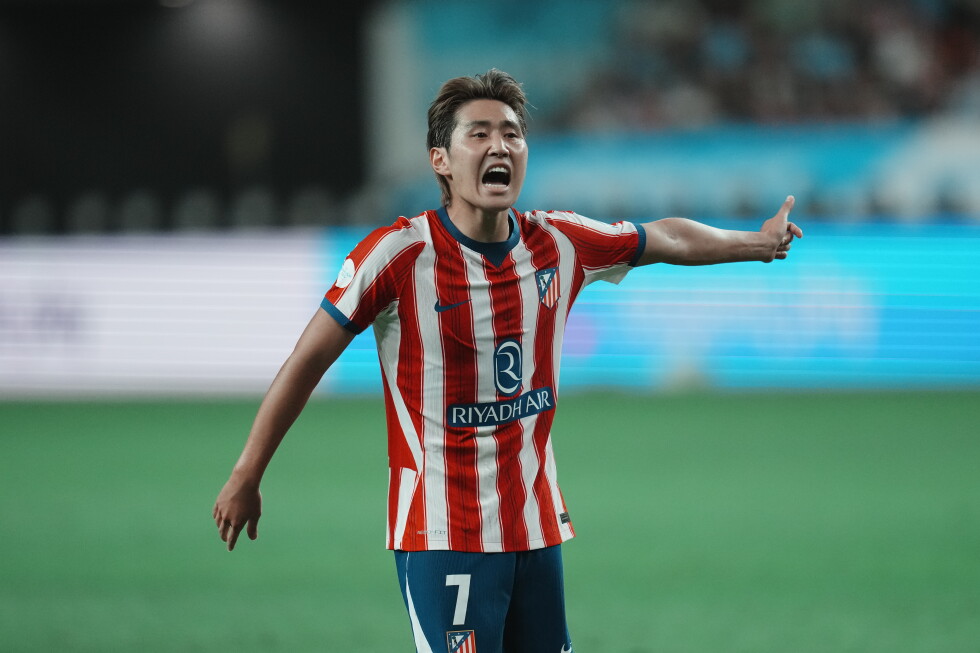
A sold-out pre-season exhibition match between two European soccer giants brought 50,000 cheering fans to Seoul World Cup Stadium on Sunday, providing a rare moment of uncomplicated on-field action for South Korean soccer amid a turbulent, scandal-plagued summer.
Manchester City rallied from an early second-half deficit to secure a 3-1 victory over Atlético Madrid, even with the introduction of South Korean fan favorite Lee Kang-in after halftime. Lee, the 23-year-old national team star, only completed his high-profile $40 million transfer from Paris Saint-Germain to Atlético Madrid last month, and his appearance marked one of the biggest local draws for the clash. Atlético held a 1-0 lead going into halftime after Jorge Dominguez netted a late first-half strike, but Manchester City flipped the script in the final 45 minutes: Omar Marmoush notched two unanswered goals, and Rayan Ait-Nouri added a third to seal the win.
For South Korean soccer, however, the friendly offered a much-needed distraction from a cascade of controversies that have roiled the Korean Football Association (KFA) for months. The latest scandal broke after a leaked government audit exposed that senior KFA officials used corporate credit cards to pay for visits to adult entertainment venues for foreign referees back in 2011 and 2012.
The KFA released an official apology on Saturday, acknowledging public concern over the string of controversies, ranging from parliamentary probes and a historic police raid to the decade-old entertainment venue scandal. “We express our sincere apologies for causing concerns over a range of issues, from a parliamentary hearing and an unprecedented police raid to media reports about incidents from more than a decade ago that even members within the federation were unaware of,” the statement read.
But prominent South Korean soccer commentator Park Moon-sung dismissed the apology as insufficient, questioning how the federation could expect to dismiss such serious misconduct as an old, forgotten issue. “Are match-fixing and sexual services — things so disgraceful that I do not even want to mention them — something that can be brushed aside by saying, ‘Why bring up events from more than a decade ago that we did not know about?’” Park wrote on social media.
This scandal is only the latest to hit KFA this summer. Public anger first erupted in June following South Korea’s underperformance at the 2026 FIFA World Cup co-hosted by the U.S., Mexico and Canada, where the national team lost two of three group-stage matches and failed to advance to the knockout round. The outcry prompted South Korean police to reopen a stalled investigation into the 2024 appointment of former head coach Hong Myung-bo, with critics accusing KFA President Chung Mong-gyu and technical director Lee Lim-saeng of bypassing the federation’s own formal hiring procedures. By July, both Hong and Chung had stepped down from their KFA positions and appeared before National Assembly lawmakers for questioning over the hiring scandal.
In response to the institutional crisis, the South Korean government launched a K-Football Innovation Committee tasked with overhauling the KFA’s governance structure. The panel is co-chaired by Park Ji-sung, the legendary former Manchester United and South Korean national team captain, and Ryu Seung-min, head of the Korean Sport and Olympic Committee. Its flagship proposal to date would dramatically expand the electorate for the next KFA presidential election, growing the voting body from just 300 hand-picked voters to roughly 20,000, including active professional players, coaches, referees, and amateur soccer stakeholders.
With both the top federation leadership and national team head coach positions currently vacant, the KFA is now moving to appoint an interim head coach in preparation for the 2027 Asian Cup, which is set to kick off in Saudi Arabia this coming January.