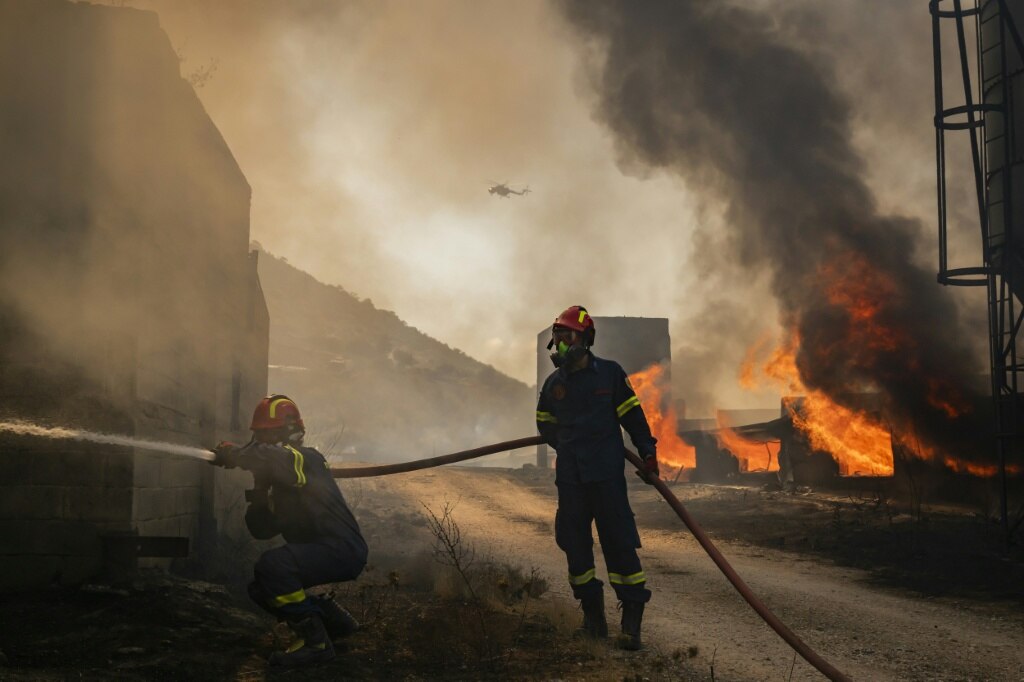
As human-caused climate change continues to drive accelerated warming across the European continent, much of the region is gearing up to face yet another extreme heatwave, following a summer already marked by record-low river levels, devastating historic wildfires and thousands of heat-related deaths.
Extreme heat warnings were already in effect for parts of Britain and France on Monday, with forecasters projecting peak temperatures will climb into the mid-30s Celsius in many affected areas. Unusually high temperatures are also on track to hit a broad swathe of central European nations unaccustomed to sustained extreme heat, including Switzerland, Austria and Hungary, in the coming days. According to Europe’s regional weather alert system MeteoAlarm, sweltering conditions have already settled across most of Italy and coastal Croatia as of Monday.
The United Kingdom’s Met Office issued alerts over the weekend warning that the country’s fifth distinct heatwave of the summer would spread northward across most of the nation. Unlike many warmer climates, the UK’s built infrastructure is designed for the country’s historic temperate, cool conditions, leaving it particularly vulnerable to sustained heat. “Yet another spell of extremely hot weather is set to spread north across much of the UK with temperatures reaching the mid-30s Celsius in places,” the agency announced on social media platform X on Sunday.
Already, half of England and the entirety of Wales are officially classified as being in drought, triggering hosepipe bans that impact roughly 23 million people. Additional English regions are expected to be added to the drought classification later on Monday, with no meaningful rainfall forecast for impacted areas through the coming week.
In France, national weather service Meteo-France warned Monday that temperatures would climb as high as 35 degrees Celsius in the country’s southeast, before spreading across nearly the entire country between Wednesday and Friday. The agency also cautioned that under ongoing climate change, “future summers will generally be hotter than those experienced to date.” Both France and the UK have already recorded thousands of excess deaths during earlier heatwaves this summer.
The combination of prolonged heat and parched conditions has already created tinder-dry fuel across much of southern Europe, spurring a series of large wildfires. On Monday, Greece reported its second major wildfire of the season near the capital Athens, and dispatched hundreds of firefighters and pieces of equipment to contain the blaze. A separate wildfire that broke out 10 days ago northwest of Athens has already burned more than 10,000 hectares of pine forest to ash. France and Spain have already faced unprecedented, historic wildfire seasons this summer, driven by record-breaking drought conditions across the Iberian Peninsula and western Europe.
Beyond wildfire risk, the ongoing heat and drought have pushed river levels across the continent to historic lows, disrupting critical transportation and energy infrastructure. German industry groups warned Monday that water levels on the Rhine River, which cuts through the industrial heartland of Europe’s largest economy, could drop low enough to halt commercial shipping entirely. While cargo vessels have continued moving goods along the river so far, they have been forced to operate with sharply reduced loads, driving up transportation costs for key industrial materials.
In Poland, officials confirmed Monday that water levels on the Vistula, the country’s longest river, matched the all-time record low recorded in the capital of Warsaw – a record that was first set just three days prior on Friday. In central and eastern Europe, extremely low levels on the Danube River have forced nuclear power plants in both Hungary and Romania to suspend operations since late July, as the facilities rely on Danube water for cooling reactor systems.
An AFP analysis of data from national weather agencies and the EU’s Copernicus Climate Change Service found that nearly 120 million Europeans currently reside in regions where July 2022 marked the hottest July ever recorded, with the most extreme record warming concentrated in southern Britain, western France, and northern and eastern Spain. A separate analysis published last month by AFP found that at least 12,000 excess deaths occurred across nine European nations during a single major June heatwave, a toll that is expected to rise as additional mortality data is finalized.
Even amid the widespread heat emergency, a rare astronomical event is drawing attention across the continent: a partial total solar eclipse will cross parts of Europe on Wednesday, and skygazers are still planning to view the event despite the extreme heat. The European Space Agency’s observatory in Teruel, Spain, is hosting a full day of public events leading up to the eclipse, which will begin at 1733 GMT and reach totality at 1823 GMT local time. Temperatures in Teruel already climbed above 30 degrees Celsius on Monday, and the eclipse’s path will cross regions that were devastated by major Spanish wildfires just last month.