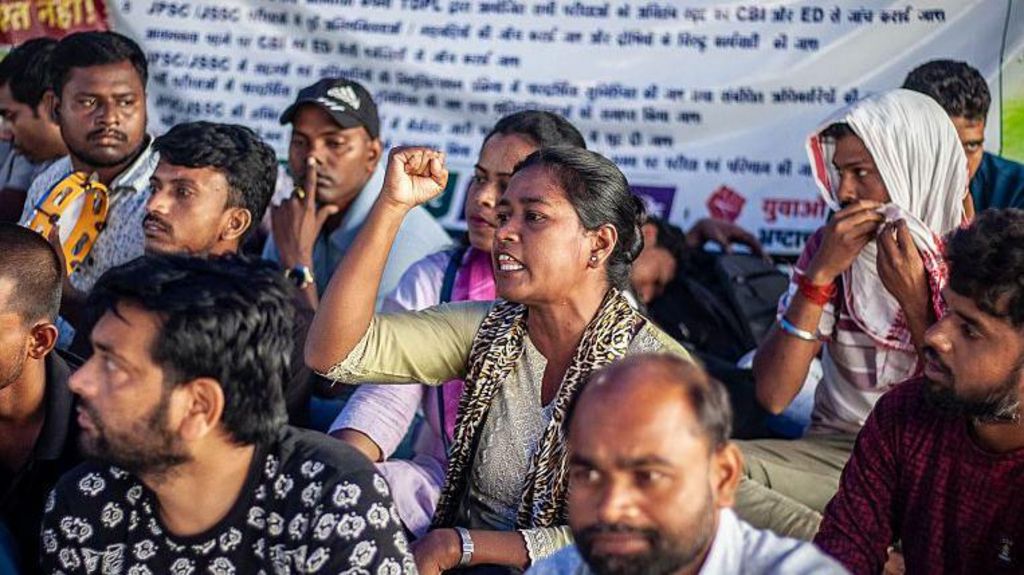
For more than two weeks, tens of thousands of angry students and unemployed job aspirants have filled the streets of Ranchi, the capital of India’s eastern Jharkhand state, turning a local exam controversy into a major political showdown over systemic corruption in government recruitment processes.
The current wave of unrest is rooted in results from a preliminary civil service examination administered by the Jharkhand Public Service Commission (JPSC) in April, which were publicly released in July. Almost immediately after the results were announced, unsuccessful candidates took to social media to share leaked answer sheets that exposed glaring inconsistencies: multiple candidates who secured top spots had answered far fewer questions correctly than low-ranking or failed applicants. The irregularities sparked widespread allegations of result manipulation and kickbacks, rapidly mobilizing young people across the state.
Since July 25, protesters have maintained a continuous encampment at a major Ranchi stadium, with many sleeping in open-air facilities and dozens launching hunger strikes to amplify their demands. On Monday, thousands of demonstrators marched toward the Jharkhand State Assembly to escalate their call for a complete overhaul of the state government’s broken recruitment exam system. Local law enforcement deployed increased security across the city, with large numbers of police officers and media personnel on site to monitor the unrest.
This agitation in Jharkhand comes on the heels of a nationwide protest movement known as the “cockroach protests,” which drew thousands of young job seekers to New Delhi to demand action over widespread exam paper leaks across the country. Organized by the loosely organized Cockroach Janta Party (CJP)—a grassroots movement unaffiliated with any established political party—the five-week national protest wrapped up on July 25 after Indian Education Minister Dharmendra Pradhan resigned from his post. The CJP movement had already gained cross-country support from unemployed youth in nearly every Indian state, laying groundwork for the current protest in Jharkhand.
In response to growing pressure, Jharkhand’s ruling government has already taken a series of steps to address the protesters’ anger. The JPSC chairman stepped down on July 22 and has since been questioned by investigators, followed by the resignation of three additional JPSC commission members. After multiple rounds of negotiations with protest leaders last weekend, the state government agreed to cancel the disputed JPSC exam, alongside two other tainted recruitment exams. The state’s Criminal Investigation Department (CID) has launched a full investigation into the allegations, which has so far led to more than a dozen arrests. Investigators are also probing the selection process for a private contractor that handled key portions of the exam administration, after candidates raised red flags about the firm’s hiring.
Despite these concessions, protest organizers have made clear that demonstrations will continue until all of their core demands are met. Their top remaining demand is the transfer of the entire investigation to the Central Bureau of Investigation (CBI), India’s top federal investigative agency, which protesters argue will be able to conduct an independent probe free of local political interference.
Unlike the national CJP movement, which intentionally stayed outside of established party politics, the Ranchi agitation has drawn open support from across India’s political spectrum. The Bharatiya Janata Party (BJP), which holds the opposition majority in Jharkhand’s state assembly, has organized its own parallel demonstrations, raised the scandal in legislative proceedings, and publicly joined calls for a federal CBI probe. Even the Indian National Congress, which is a coalition partner in Jharkhand’s ruling state government and the national political rival of the BJP, has publicly expressed support for the protesting students.
Jharkhand Chief Minister Hemant Soren, leader of the regional ruling Jharkhand Mukti Morcha (JMM) party, has pushed back against the escalating unrest. In comments Sunday, Soren claimed that outside vested interests are working to destabilize democratic governance in the state, warning that the protest movement must not be exploited for political gain. He nonetheless reaffirmed the state government’s commitment to delivering justice to aggrieved candidates and holding all wrongdoers accountable.
The unrest in Jharkhand underscores a growing national crisis in India, where persistent irregularities and corruption in government job recruitment have fueled widespread anger among the country’s large youth population, which faces chronically high unemployment rates.