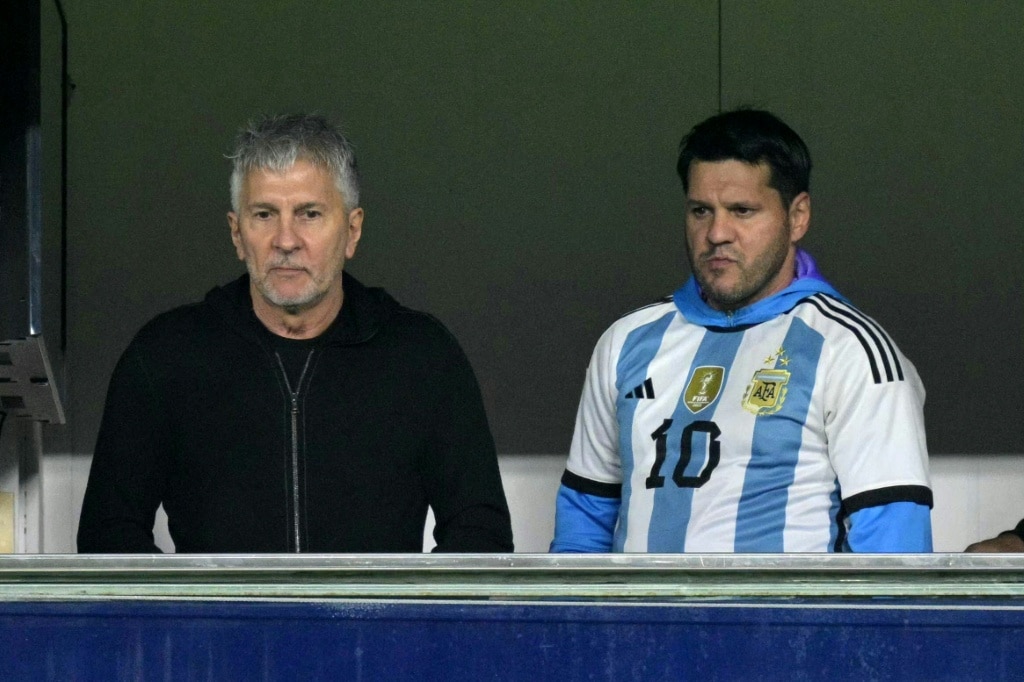
The global football community is united in grief this week following the passing of Jorge Messi, the father, first coach, and long-time agent of Argentine football legend Lionel Messi, at the age of 68 after a private battle with cancer. Lionel Messi, the eight-time Ballon d’Or winner, returned to his hometown region of Rosario, Argentina, over the weekend to lay his father to rest, arriving on a private jet from Miami on Saturday alongside his wife Antonela Roccuzzo and their three children.
On Sunday, a small, private memorial service was held at El Prado Cemetery in Perez, a small town adjacent to Rosario, attended only by close family members and a handful of Messi’s current and former Argentina national team teammates. Even as the service remained closed to the public, hundreds of messages of support from fans across Argentina and around the world appeared on the cemetery’s gates: handwritten notes offering comfort to the Messi family, a large floral wreath, and signs reading “Stay strong, Leo, we love you” dotted the entrance. Fans traveled hundreds of kilometers to stand with the football star during his time of loss. Fifteen-year-old Lucas Blanco was among those gathered outside, noting that Messi had spent decades bringing joy to Argentine people, and this was a small chance to return that support. One couple drove 700 kilometers from Tres Arroyos, a town south of Buenos Aires, just to be present to offer their condolences.
News of Jorge’s passing broke late Friday, when he died at a clinic in Rosario. Tributes began pouring in immediately from across the global football ecosystem. The Argentine Football Association (AFA) announced that all domestic matches across every age group would hold a minute of silence and require players to wear black armbands throughout the week. Clubs that Messi has represented throughout his iconic career—including FC Barcelona, Paris Saint-Germain, and Inter Miami—along with governing bodies like the Spanish Football Federation, have all released statements of sympathy to the Messi family.
Rodrigo de Paul, Messi’s close friend and current Inter Miami teammate, was among the first to pay public tribute. After scoring in Inter Miami’s 2-1 loss to Monterrey on Saturday, De Paul removed his match shirt to reveal a replica of Messi’s iconic number 10 Argentina jersey, honoring his friend’s loss. Leandro Paredes, a fellow Argentina international who plies his trade at Boca Juniors, told reporters after his club’s Saturday match that the national team’s players were rallying around their captain, saying “It will surely do him good for us to be there” as they planned their attendance at the service. De Paul had already traveled to Argentina to be with Messi before the service.
Speculation over Jorge’s health had been circulating for months before his passing, after his conspicuous absence from Argentina’s campaign at the 2024 FIFA World Cup in June. During the tournament, Messi’s family publicly asked media to respect their privacy, asking for “humanity” amid ongoing rumors about Jorge’s condition. After scoring against Algeria during the group stage, a visibly emotional Messi broke down in tears, later acknowledging he was navigating “a situation outside of sports” that had left him with “a few difficult, complicated days.” He thanked his teammates and the Argentine delegation for standing by him through the turmoil, and returned to Rosario immediately after Argentina’s final loss to Spain to be with his family.
Jorge Messi leaves behind a legacy as the foundational force behind one of the greatest football careers in history. A working-class metalworker from Rosario, Jorge also coached youth teams at local amateur club Grandoli, and introduced four-year-old Lionel to the game on the empty neighborhood lots where local children gathered to play. When 13-year-old Lionel was invited to join FC Barcelona’s youth academy in 2000—an opportunity that would allow him to access treatment for a growth hormone deficiency he had been diagnosed with as a child—Jorge made the life-altering decision to leave his job, his wife Celia, and his three other children behind in Argentina to relocate to Catalonia with his son.
In later interviews, Messi recalled the quiet struggle the pair endured in those early, uncertain days in Spain: “When we arrived in Barcelona, I used to lock myself in my room to cry alone, and my father did the same — either without me seeing him or thinking I didn’t see him. We pretended we were both fine, but we were struggling.” As Lionel’s career exploded into global stardom, Jorge stepped into the role of his long-time agent, negotiating every major contract of his son’s career from his first deal with Barcelona through his moves to Paris Saint-Germain and most recently Inter Miami. For decades, he remained Lionel’s closest advisor and emotional anchor, through every trophy, every win, and every setback of a glittering, record-breaking career.