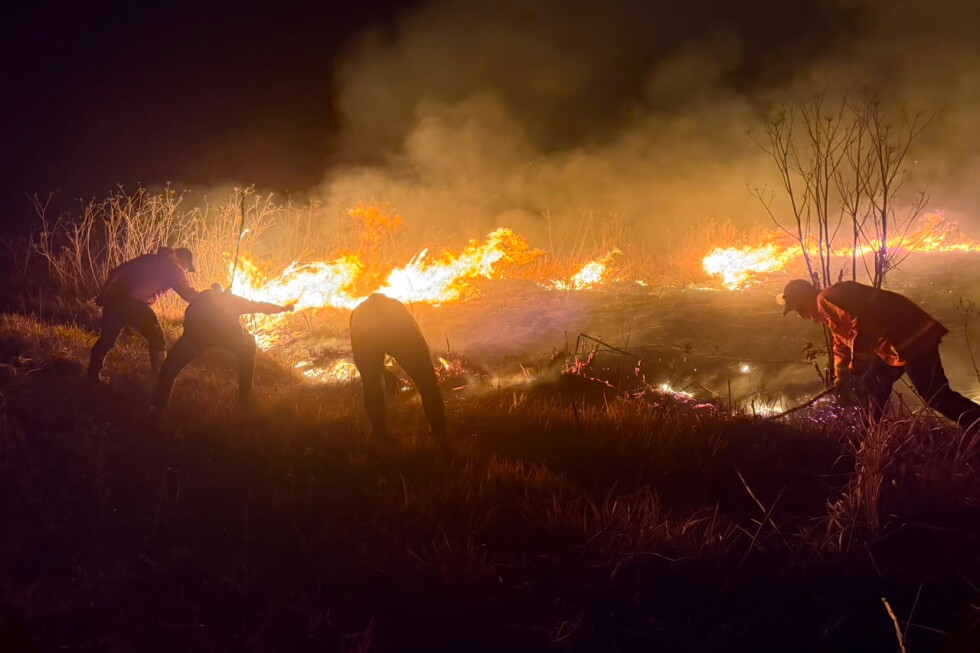
JAKARTA, Indonesia – As an unusually severe dry season amplified by the El Niño weather pattern pushes wildfire risk to multi-year highs across Indonesia, authorities have mobilized hundreds of emergency personnel and aerial assets to tackle a large out-of-control blaze at one of the country’s most famous tourist natural landmarks.
The largest active fire burning this week has scorched roughly 176 hectares, or 435 acres, of vegetation on Mount Bromo, a volcanic peak that forms the centerpiece of Bromo Tengger Semeru National Park in Indonesia’s East Java province. Drawing millions of domestic and international visitors annually for its dramatic volcanic landscapes, the park was closed to all visitors on Saturday, and park officials confirmed the shutdown will remain in place until fire crews fully contain the blaze, with no timeline for reopening provided.
More than 500 responders including professional firefighters, disaster management staff, local police, military personnel, park rangers and community volunteers have been assigned to bring the Bromo fire under control. To support ground operations, authorities have deployed helicopters equipped with water-dropping systems and surveillance drones to map hotspots and track fire spread. Crews have also constructed controlled firebreaks along the blaze’s perimeter to stop it from expanding into untouched forest and adjacent tourist areas.
Park chief Rudijanta Tjahja Nugraha noted that challenging geographic conditions have significantly slowed containment efforts. Many of the largest remaining hotspots are located on the steep, uneven slopes of the active volcano, which cannot be safely or quickly accessed by ground crews traveling on foot or with heavy equipment.
The Bromo fire is not an isolated incident: Indonesia is currently facing a wave of concurrent wildfires across multiple islands driven by the record-dry conditions. On Friday, a new blaze broke out in Banyumas Regency, Central Java, that authorities say was sparked by unauthorized land-clearing activities. Dry vegetation and hot temperatures allowed the fire to spread quickly beyond its starting point to neighboring forest and grassland areas. In West Java, a fire that ignited earlier this week at Suryakencana Meadow in Mount Gede Pangrango National Park, a popular hiking destination, forced officials to temporarily close all hiking trails leading to the peaks of Mount Gede and Mount Pangrango.
Indonesia’s national Meteorological, Climatological and Geophysical Agency warned that ongoing strong winds and severely parched vegetation are creating ideal conditions for fires to ignite and spread rapidly across large areas. The agency attributes the extreme dry conditions to a combination of the El Niño weather pattern, which brings reduced rainfall to much of Southeast Asia, and seasonal dry winds blowing north from Australia.
Historically, severe dry-season wildfires are most common on Indonesia’s Sumatra and Borneo islands, where many blazes are deliberately started illegally by commercial plantation operators and small-scale traditional farmers to clear vegetation for new crop planting. When large fires break out in these regions, they often produce toxic haze that spreads across national borders, threatening public health across much of Southeast Asia.