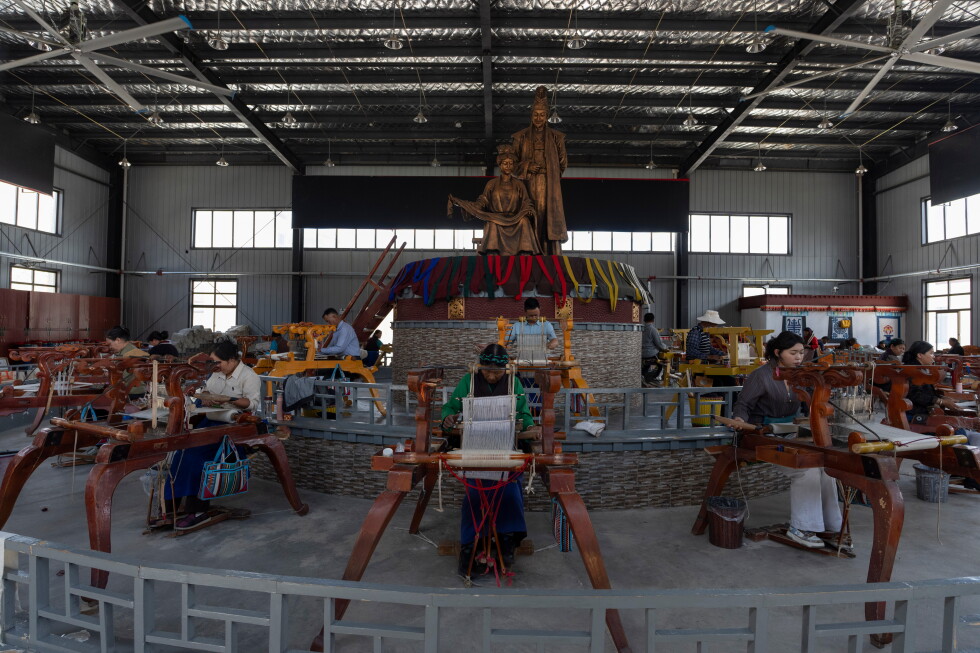
High on the windswept Tibetan Plateau, 12,100 feet above sea level in Shannan, more than a dozen skilled artisans sit hunched over traditional wooden looms, their hands moving in steady, practiced rhythm. They guide shuttles through tight rows of locally sourced wool yarn, pulling each thread into place with careful precision—a repetitive motion that has kept a centuries-old Tibetan cultural tradition alive against the odds. This is the art of weaving Pulu, the thick, durable wool fabric that has clothed plateau communities for hundreds of years, and at the Ethnic Huaji Handwoven Cooperative, this craft is getting a new lease on life.
Founded in 2008 by third-generation Tibetan artisan Pasang, the cooperative does more than just produce handwoven textiles: it is on a dual mission to safeguard one of Tibet’s oldest endangered weaving traditions and create stable, inclusive employment for local residents. Today, the workshop employs more than 100 people from surrounding communities, including artisans living with disabilities, while passing down rare skills to younger generations of Tibetans who might otherwise never learn the craft. For Pasang, the work is personal—when he was learning the trade from his parents decades ago, fewer than 10 people across the region still knew how to produce Zeter, the cooperative’s specialty and the rarest, most refined variant of Pulu.
Unlike ordinary Pulu, Zeter is spun from the exceptionally soft wool harvested from the necks and backs of local Shannan sheep. This finer material makes the spinning and weaving process far more technically demanding than standard Pulu production, but the result is a textile that is lighter, softer, and far more delicate than its everyday counterpart. According to historical records preserved by Pasang and local communities, Zeter was so highly prized that during China’s Ming Dynasty, it was sent as a tribute from Tibetan leaders to the imperial court in central China. Today, the craft holds even greater significance: it has been formally recognized as part of China’s national intangible cultural heritage, a designation that has helped bring new attention to Pasang’s work to keep it alive.
The history of the craft is woven into the very space of the cooperative. At the center of the workshop, two statues stand framed by rows of wooden looms: one of 7th-century Tibetan King Songtsen Gampo, and the other of his Chinese bride Princess Wencheng. Local tradition holds that Princess Wencheng introduced advanced weaving techniques to Tibet after her marriage to the king, merging cultural practices from across the region into the craft still practiced today. In official Chinese historical narrative, the royal union symbolizes deep, long-standing cultural and historical ties between Tibet and the rest of China, a connection Pasang says is reflected in the blended cultural heritage of Pulu weaving. “It integrated Tibetan and Chinese cultures,” he explained of the fabric’s centuries-long history.
All wool used in the cooperative’s workshop is sourced locally from sheep herds that graze the high-altitude grasslands surrounding Shannan, keeping supply chains local and supporting regional herding communities. Finished products—including soft scarves, warm shawls, tailored jackets, handwoven bags and other textiles—are displayed in a small showroom adjacent to the workshop, with most sales going to customers across Tibet, followed by buyers from other regions of China.
For the artisans who work at the cooperative, the craft is far more than a job—it is a connection to their cultural identity and a lifeline to stable income. Eighty-year-old Tsering Yangchen, who has woven at the workshop for seven years after relocating to Shannan from another county, says she struggled to find steady work before joining the cooperative. Instructors at the workshop taught her the craft from scratch, and today she calls Pulu far more than just a product to sell. “We usually wear them,” she said of the handwoven textiles. “They are made from pure wool.”
This report comes from an Associated Press reporter who participated in a government-organized reporting trip to Lhasa and Shannan last month, which included access to the cooperative, cultural heritage sites, Buddhist temples, tourist destinations, a local eldercare center, and other regional businesses. Associated Press video producer Olivia Zhang contributed to this reporting.