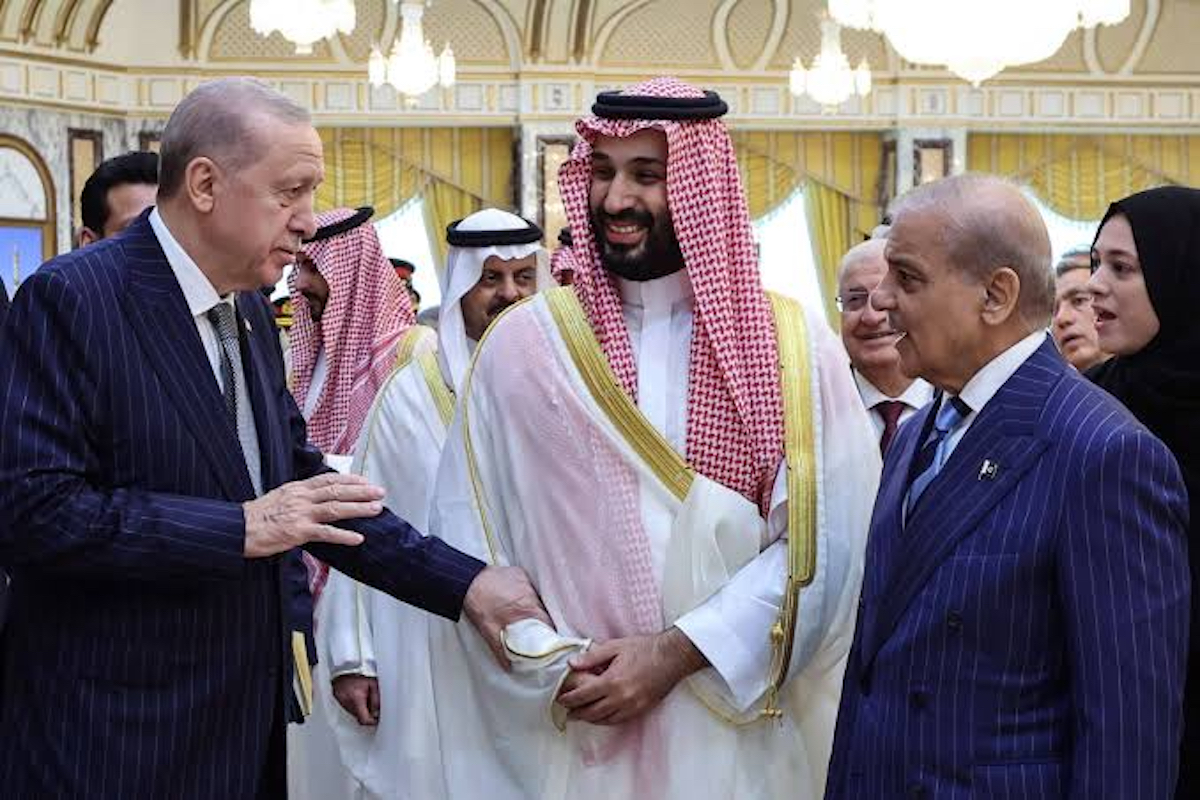
On August 7, 2026, a landmark trilateral defense agreement was signed in the Saudi holy city of Mecca by the leaders of Saudi Arabia, Pakistan, and Turkey. Named the Makkah Joint Defense Agreement, this pact formally enshrines a collective defense principle: any armed aggression against one signatory will be treated as an attack against all three nations. It builds on the 2025 bilateral Strategic Mutual Defense Agreement between Saudi Arabia and Pakistan, expanding cooperation to include joint military drills, defense industrial partnerships, cross-border technology sharing, and coordinated intelligence exchange. While the framework for deeper collaboration is publicly established, details of operational protocols, specific military commitments, and implementation timelines remain undisclosed. This new pact represents one of the most consequential shifts in Middle Eastern and South Asian geopolitics in recent years, driven by overlapping but not identical national priorities across the three countries.
### The Strategic Drivers Behind the Pact
The timing of the agreement is far from coincidental, rooted in a deeply unstable Middle Eastern security landscape. Decades-long tensions between the United States and Iran have yet to produce a lasting ceasefire, while Iran-aligned Houthi forces in Yemen have stepped up attacks and threats against Saudi territory and Saudi-linked commercial and infrastructure assets. A recently finalized U.S.-Saudi civil nuclear cooperation agreement remains tied to ongoing negotiations over Saudi-Israeli normalization, with Washington conditioning the deal’s implementation on Riyadh formally joining the Abraham Accords. At the same time, shifting dynamics in the ongoing Gaza crisis and stalled talks over a regional peace framework have put new pressure on major Muslim-majority nations to take more active roles in regional security and diplomacy.
For Saudi Arabia, the pact addresses growing anxieties over its vulnerability to regional threats as it pursues its ambitious Vision 2030 economic transformation agenda. Recent disruptions to Red Sea shipping and heightened risks of closure to the Strait of Hormuz, through which a quarter of global oil trade passes, have underscored how quickly regional conflict can derail Saudi economic goals by disrupting energy exports, scaring off foreign investment, and disrupting core trade routes. Riyadh thus needs strategic partners that can supplement its own defense capabilities with manpower, intelligence, advanced technology, and geographic depth.
Pakistan brings a long-standing defense partnership and a large, battle-tested military establishment to the alliance, while Turkey answers Saudi Arabia’s need for a second, ideologically aligned partner with expanding regional influence. Under President Recep Tayyip Erdoğan, Ankara has actively pursued a policy of expanding its strategic footprint far beyond its Anatolian heartland, positioning itself as a leading power across the entire Muslim world. Turkey has deepened political, military, and industrial ties across the Middle East, Africa, Central Asia, and South Asia, driven by Erdoğan’s goal of elevating Turkey to a top-tier global power. Its active military involvement in Syria, long-running confrontation with Kurdish militant groups, and expanding partnerships across the Muslim world confirm its broad extra-regional ambitions.
### Pakistan’s Dual Calculus: Benefits and Hidden Risks
For Pakistan, the pact offers immediate tangible benefits at a time of deep economic and political uncertainty. Islamabad has long been dependent on external financial assistance and bailout packages to stabilize its economy, and the China-Pakistan Economic Corridor (CPEC) has failed to resolve the country’s deep structural economic weaknesses. Beijing has also grown more cautious about extending new large-scale financing to Islamabad and has pushed for repayment of outstanding loans, while Pakistan has struggled to secure sufficient financial support from other global and regional partners.
Under the new trilateral framework, Saudi Arabia is expected to provide much-needed financial aid, discounted energy supplies, and new foreign direct investment, while Turkey will offer access to advanced defense technology, military training, intelligence sharing, and defense industrial collaboration. Domestically, Pakistan’s military establishment can frame the agreement as proof that the country has regained its status as a strategically critical global player, strengthening Field Marshal Asim Munir’s domestic legitimacy and consolidating the military’s long-held political influence.
However, the pact carries significant long-term risks for Pakistan that could undermine its national sovereignty and security. Unlike the earlier bilateral Saudi-Pakistan arrangement, which was built on Saudi financial support in exchange for Pakistani military capabilities, Turkey’s entry adds a broad new geopolitical and defense industrial dimension to the alliance. Turkey already has a deep defense partnership with Pakistan: the two countries cooperate on drone development, naval platform manufacturing, and joint defense projects, and their partnership expanded dramatically during the 2025 India-Pakistan border confrontation, when Ankara provided open political support to Islamabad and Turkish defense systems and advisors reportedly played a role in Pakistani military operations.
The new trilateral framework will accelerate this cooperation, giving Pakistan greater access to Turkish defense technology, including participation in Ankara’s cutting-edge KAAN fifth-generation fighter jet program. But for Turkey, this partnership is more than a commercial defense arrangement: it is a core component of Ankara’s “Asia Anew Initiative,” which seeks to expand Turkish geopolitical influence across South and Southeast Asia. Recent high-level military visits from Bangladesh and Pakistan to Ankara confirm this expanding strategic push, which includes a growing Turkish maritime presence in the Indian Ocean.
The greatest long-term risk for Pakistan is what analysts term “strategic entrapment.” If the pact’s collective defense commitments require Pakistani military deployments beyond Saudi territory, Islamabad could find itself drawn into conflicts in Yemen, Syria, and other regional hotspots that serve no core Pakistani national interest. Pakistan already stretched its military resources during the 2026 Iran conflict, when it deployed approximately 8,000 troops, a full fighter jet squadron, and advanced air defense systems to Saudi Arabia under its 2025 bilateral pact.
Most critically, closer alignment with Saudi Arabia and Turkey threatens to severely damage Pakistan’s historically delicate relationship with Iran. Pakistan shares a 900-kilometer porous border with Iran, and Tehran has already issued sharp criticism of the new trilateral pact, warning that it will not deliver greater security to Saudi Arabia. If Iran views Pakistan as an active participant in Saudi and Turkish efforts to counter Iranian regional interests, Islamabad could face rising diplomatic pressure and increased militant activity along its western border, particularly in Balochistan, where the Pakistani military is already fighting a long-running separatist insurgency and countering militant violence.
Pakistan currently finds itself balancing multiple competing strategic demands: securing Saudi financial support, deepening defense ties with Turkey, maintaining its all-weather alliance with China, managing its complex relationship with the United States, and avoiding open confrontation with Iran, all while positioning itself as a neutral mediator in the ongoing Iran crisis. This balancing act is growing increasingly unsustainable, and once Pakistan commits military and logistical resources to Saudi and Turkish security goals, withdrawing from those commitments will become progressively more difficult.
### New Strategic Challenges for India
The Makkah Pact creates a new set of complex security challenges for India, which cannot afford to dismiss the trilateral alliance as a purely Middle Eastern development. For New Delhi, the core concern is not just that Pakistan will receive additional military support from Saudi Arabia and Turkey: it is that Pakistan will act as a gateway for Turkey to expand its strategic footprint into South Asia and the Indian Ocean region.
At the same time, Indian policymakers need not view Saudi Arabia’s participation in the pact as a sign that Riyadh intends to abandon its deepening strategic and economic ties with New Delhi. Saudi Arabia holds massive economic, energy, and investment interests in India, and its primary motivation for joining the trilateral pact is to counter Iranian-aligned threats closer to home, not to undermine Indian security interests.
The real risk for India lies in the combined capabilities the three allies bring to the table: Saudi Arabia’s financial resources can bolster Pakistan’s military capacity, Pakistan provides geographic access, manpower, and military infrastructure across South Asia, and Turkey contributes advanced defense technology, training, and intelligence coordination. This creates a far more capable military ecosystem in Pakistan than the earlier bilateral Saudi-Pakistan arrangement.
Turkey’s long-standing open support for Pakistan on Kashmir and its expanding maritime and defense presence in the Indian Ocean mean that New Delhi cannot treat the Turkey-Pakistan partnership as a purely bilateral matter. Shared ideological alignment on political Islam also creates opportunities for greater cross-regional strategic coordination that could run counter to Indian interests.
To protect its national security, India will need to closely monitor the implementation of the pact, particularly with regard to practical cooperation on intelligence sharing, joint military exercises, defense industrial collaboration, technology transfer, and cross-regional military deployments. New Delhi should also deepen strategic engagement with other nations that share concerns over expanding Turkish influence, strengthen its own defense, maritime, and intelligence capabilities, and deepen security and economic cooperation with other Gulf Cooperation Council members.
Notably, India should not abandon its own expanding strategic partnership with Saudi Arabia. Riyadh has repeatedly signaled that it values its ties with New Delhi, and New Delhi can work to make clear that the trilateral defense pact need not derail bilateral cooperation between India and Saudi Arabia. India’s goal should not be to force Saudi Arabia to choose between India and Pakistan, but rather to make Riyadh aware of the potential risks of enabling the buildup of Pakistani military capabilities that could eventually be used against Indian interests.
As regional geopolitical alignments grow increasingly complex, Pakistan has gambled that the pact will restore its strategic relevance in the Middle East and South Asia. But by entering this trilateral alliance, Islamabad has stepped into a far larger geopolitical game whose long-term consequences it may ultimately be unable to control.