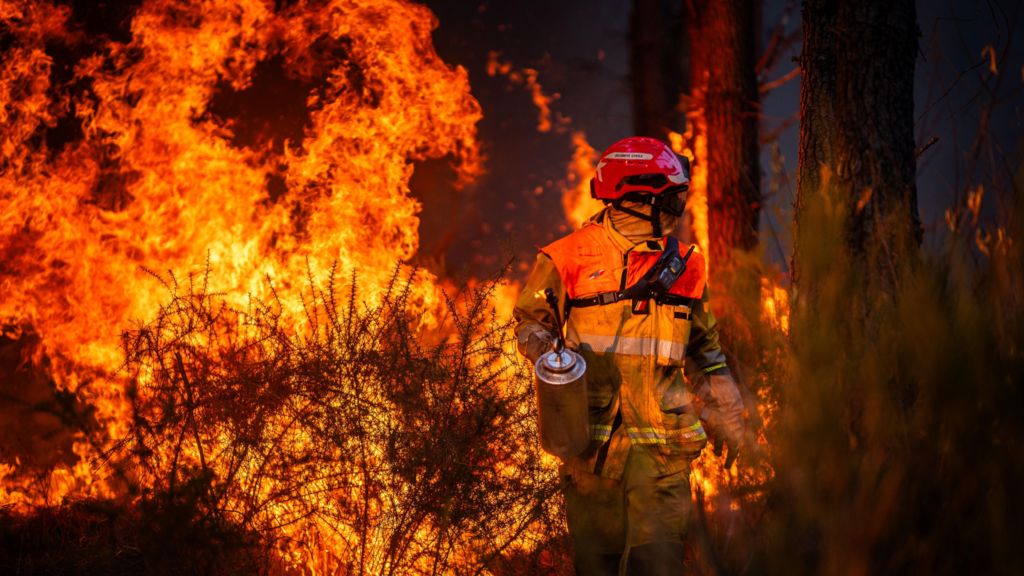
This summer, France has faced its most destructive wildfire season since the end of World War II, with flames scorching more than 300,000 acres of land across the country and forcing emergency responders into action, most notably in the southwestern Gironde region where an all-out crisis response was launched in late July. As smoke clears from the worst-hit areas, the French public and experts are increasingly asking one pressing question: what has driven this unprecedented catastrophe?
Climate scientists and fire investigators point first to the long-documented impact of human-caused fossil fuel emissions, which have pushed global temperatures steadily upward and created the dry, parched conditions that allow wildfires to ignite and spread with alarming speed. But official data reveals a stark secondary truth: nine out of every 10 wildfires in France are started by human activity, a statistic that has pushed the Paris government to launch a widespread crackdown on those deemed responsible – even as critics accuse the administration of being chronically underprepared for the scale of this year’s infernos.
So far, France’s interior ministry has announced 420 arrests of people accused of either deliberately or accidentally igniting blazes, more than 160 of whom are minors. The scope of these arrests ranges widely: one 23-year-old man is facing up to 15 years in prison and a €150,000 fine if convicted of deliberately starting 10 separate blazes across southeastern Var over just five days last month. Other defendants have already received immediate sentencing, including a man handed a three-year jail term for starting three fires in the Raon-L’Étape forest in the Vosges region, even though local newspaper L’Est Républicain noted only a few square meters of vegetation burned.
Critics argue that many of these prosecutions are disproportionately harsh and unfair. Reports have emerged that a homeless person and an individual with severe autism have both been jailed for accidentally starting fires after throwing away discarded cigarette butts. Muriel Gestas, a defense lawyer who has represented multiple people accused of arson – including two professional firefighters – says she was stunned by the sheer volume of arrests, describing the crackdown as excessive. She also casts doubt that most of the cases will ultimately result in convictions.
Leading French newspaper Le Monde has echoed these concerns, pointing out that authorities have refused to release key details about the cases, including whether most charges involve deliberate arson or accidental ignition, and how arrest numbers compare to previous fire seasons. This lack of transparency, the outlet argues, makes any meaningful assessment of the crackdown impossible. But supporters of the hardline approach, including Bordeaux chief prosecutor Renaud Gaudeul, defend the strategy, arguing that current extreme conditions justify strict action. “The conditions for a charge of endangering lives are met for those who throw a cigarette butt or light a barbecue in wooded areas,” Gaudeul told Le Monde. “It only takes a tiny spark for it to start.”
Pinpointing the exact origin of a wildfire is an inherently complex process, especially during extreme drought. Eric Dufayet, a veteran fire investigation officer, explained that even the smallest spark can ignite a major blaze when vegetation is as parched as it is this summer. After a fire is contained, Dufayet’s team first maps the burn perimeter to trace the flames back to their point of origin, which often forms a distinct V-shape when wind patterns are consistent. Investigators then work backward from that point to identify the cause, and in cases of deliberate arson, they often recover DNA or fingerprint evidence from ignition devices left at the scene.
Industry experts broadly agree that deliberate arson accounts for only a small share of this year’s fires. The vast majority are accidental, with ignition sources ranging from sparks from construction equipment and faulty power lines to discarded cigarette butts and unattended outdoor barbecues. Dufayet notes that even a cigarette butt can easily start a blaze under the right conditions, referencing the so-called “30 rule”: fires are most likely to ignite when temperatures hit at least 30°C, relative humidity drops below 30%, wind speed stays under 30km/h, and at least 30% of the cigarette remains unburnt. During this summer’s record drought, he adds, these conditions are nearly ubiquitous, making even small accidental risks far more dangerous than usual.
Psychiatrists break down those who start wildfires into three broad categories: people who act out of negligence, those who stand to benefit from the fire (such as through insurance payouts), and people living with pyromania, a rare psychiatric condition where individuals feel a compulsive attraction to fire. Michel Lejoyeux, a professor of psychiatry and addictive behavior at Paris 7 University, explains that pyromaniacs do not seek financial gain or revenge – they are drawn to fire for its own sake. Still, he notes that pyromania is extremely rare, difficult to diagnose, and accounts for very few arson convictions.
In some cases involving firefighters accused of starting blazes, Gestas says motives can vary: some accused firefighters may have started fires to be seen as heroes who would then lead the response, while volunteer firefighters may have been motivated by financial gain from tax-free overtime pay for emergency work.
As the controversy over the government’s crackdown continues, broader concerns over wildfire risk are far from over. Meteorological forecasts show another major heatwave is just days away from reaching France, raising the risk of new blazes. President Emmanuel Macron, who has described this year’s fire season as “completely unprecedented,” says that public criticism of the government’s response is not a priority right now. “We will have to replant and rebuild a different kind of forest because we must adapt to the structural conditions of climate change,” Macron said this week. “The time for reviewing lessons learned will come. In the meantime, the country must remain united.”
Even so, the widespread damage from this year’s wildfires – which have destroyed hundreds of homes, devastated local tourism and small businesses, damaged ecosystems, and worsened air quality across large swathes of the country – has left the French public demanding answers about what went wrong, and how the country can better prepare for future fire seasons amplified by climate change.