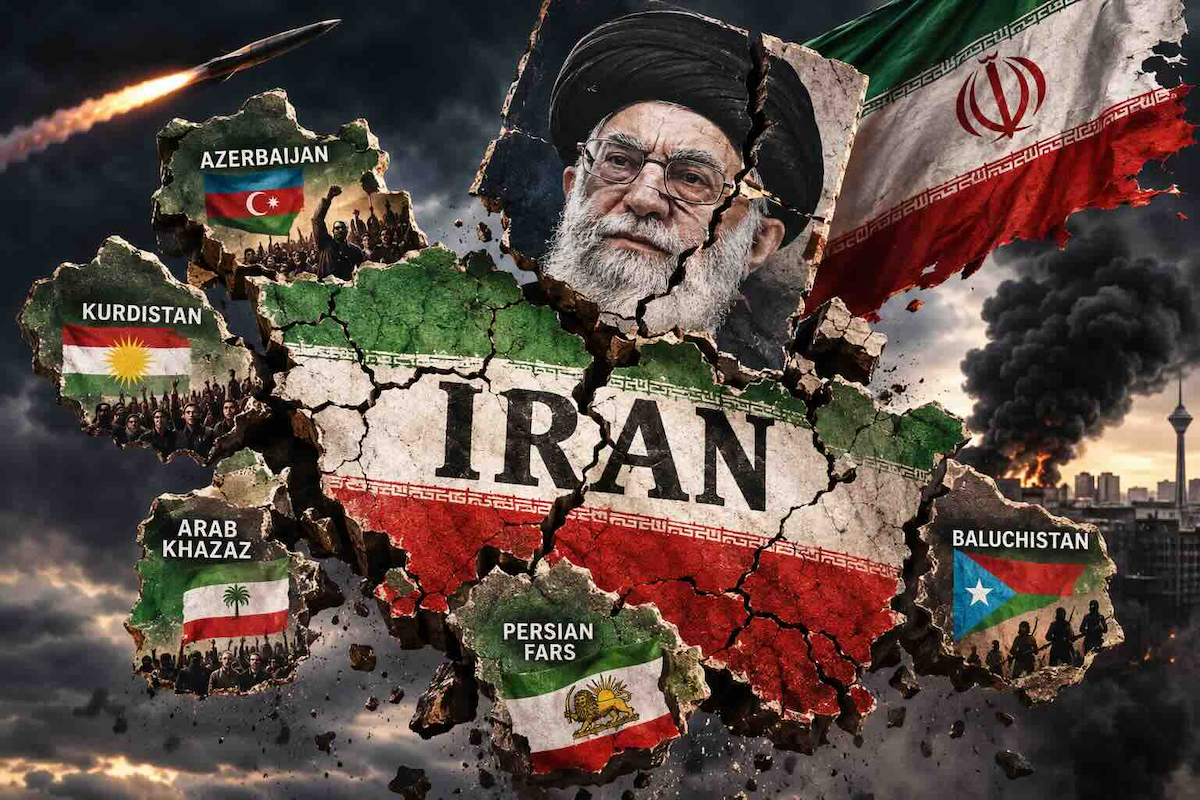
Uncertainty over the status of Iran’s supreme leader and deepening internal power rifts have pushed the country to the brink of state failure, sending ripple effects of instability that reach all the way to China’s doorstep and leaving Beijing facing a tricky diplomatic dilemma. At the center of current regional tensions is a newly emerging Iran-Oman agreement that regime-affiliated media in Iran claims will formalize Tehran’s continued control over the Strait of Hormuz, the critical chokepoint through which roughly a fifth of global oil supplies pass daily. From Washington’s perspective, any international recognition of Iran’s full control over the strait would deliver a major blow to U.S. and global commercial interests, granting Tehran a powerful strategic tool to blackmail the international community during future political disputes by threatening to block traffic through the waterway.
With U.S. midterm elections approaching and high-stakes multilateral negotiations underway with Beijing across a range of issues, the Biden administration is strongly motivated to block international recognition of Iran’s claim, a move that carries major stakes for U.S. global influence. But behind what appears to be a political win for Tehran lies a far more concerning, underreported transformation inside Iran’s ruling regime that points to accelerating fragmentation of central power and looming systemic chaos.
On August 5, China’s state-run Xinhua News Agency published remarks from Iranian President Masoud Pezeshkian, who openly acknowledged that communication with Supreme Leader Mojtaba Khamenei has become extremely difficult in recent weeks. Analysts say this unusual public comment, amplified by a major Chinese state media outlet, may be a quiet signal that Beijing itself is struggling to establish reliable lines of communication with Tehran’s top decision-makers, raising questions about who actually holds power in the country. Iranian media reports have further fueled these doubts, claiming Pezeshkian was only granted a brief meeting with a figure presented as Khamenei, held in a dark, tinted-window vehicle at a secret location outside the capital.
It remains unclear whether Mojtaba Khamenei, the son of Iran’s late long-time supreme leader Ali Khamenei, even exercises full control over his own circumstances, let alone the affairs of the entire country. These disclosures from Iran’s own elected president confirm long-running rumors of bitter, intractable splits at the highest levels of Iran’s leadership. The most radical factions within the Islamic Revolutionary Guard Corps (IRGC) are widely believed to have seized de facto ultimate power, using Mojtaba as a largely powerless figurehead to legitimize their rule. This arrangement has isolated both Mojtaba and the hardline IRGC leadership, creating a cascade of disruptive internal power dynamics that threaten to unravel central governance.
To compound this instability, Iran’s military command structures were deliberately decentralized and devolved to local regional units years ago to pre-empt the risk of U.S. decapitation strikes on top leadership, and there is little sign these structures can be re-centralized any time soon to restore clear top-down command. Unconfirmed but persistent rumors also suggest Israeli intelligence has cultivated close contacts with senior Iranian officials who are prepared to launch a coup against the current hardline regime, fueling a culture of pervasive paranoia and mutual suspicion across all levels of government. Under this climate, any official, for any reason, can be targeted and purged on accusations of treason, making it nearly impossible to build consensus or implement consistent policy.
The result is a broken decision-making system: any proposed compromise with external powers can be immediately vetoed by radical factions that dismiss any deal as a “traitor’s surrender,” while the official supreme leader remains a distant, opaque figure controlled by unelected hardline factions behind the scenes. Despite this political chaos, Iran still retains active production capacity for missiles and drones, as well as large stockpiles of these weapons, creating a dangerous scenario: a fractured state with plentiful tools to project destabilizing force across the region.
This portrait adds up to a country mired in deep institutional disarray, on the edge of full state failure. Yet history shows that failing states can survive for years while remaining a major threat to regional security, as seen in Myanmar, where years of brutal civil conflict have failed to unseat the ruling military junta. A collapsed, failing Iran would expand a broad arc of instability stretching from Central Asia all the way to the Mediterranean coast. The U.S. has thus far avoided being drawn into the messy Iranian quagmire, but even if Tehran retains de facto control over the Strait of Hormuz, the country’s political fragmentation poses unique new risks to regional security and global oil markets.
One potential path to de-escalation that has been floated by geopolitical analysts involves offering security guarantees to Mojtaba Khamenei and other top Iranian leaders in exchange for Tehran rolling back its claims to full control over the strait. On a more positive note, Iran’s growing internal instability has paradoxically helped unify regional states that were once deeply divided over how to address Tehran’s expansionist threats. Middle Eastern nations are now converging on coordinated strategies to limit Tehran’s harmful regional influence, building new medium- and long-term pressure campaigns to constrain the regime. This has also accelerated regional plans to build oil and gas export pipelines that bypass the Strait of Hormuz entirely, a shift that will ultimately restrict Iranian trade and further isolate the country’s hardline religious leadership.
For China, the current situation creates a tricky diplomatic balancing act. While Beijing would likely welcome any setback to U.S. interests in the region, its demonstrated inability to intervene and mediate the dispute for Gulf allies has left China sidelined from evolving regional political dynamics, which are increasingly dominated by the U.S. and Israel. Finding common ground with Washington and Jerusalem to address the Iranian crisis would be a major challenge for Beijing, in large part because it is not clear what strategic benefits Beijing would gain from such collaboration. However, the emergence of a large, unstable political black hole along China’s western border will almost certainly create new security and economic risks for Beijing in the near term. The Iranian meltdown is unfolding at the same time that Russia faces ongoing military setbacks and struggles to hold its position in Ukraine, meaning China could soon find itself bordered by multiple zones of active instability – a outcome that Beijing has long sought to prevent.