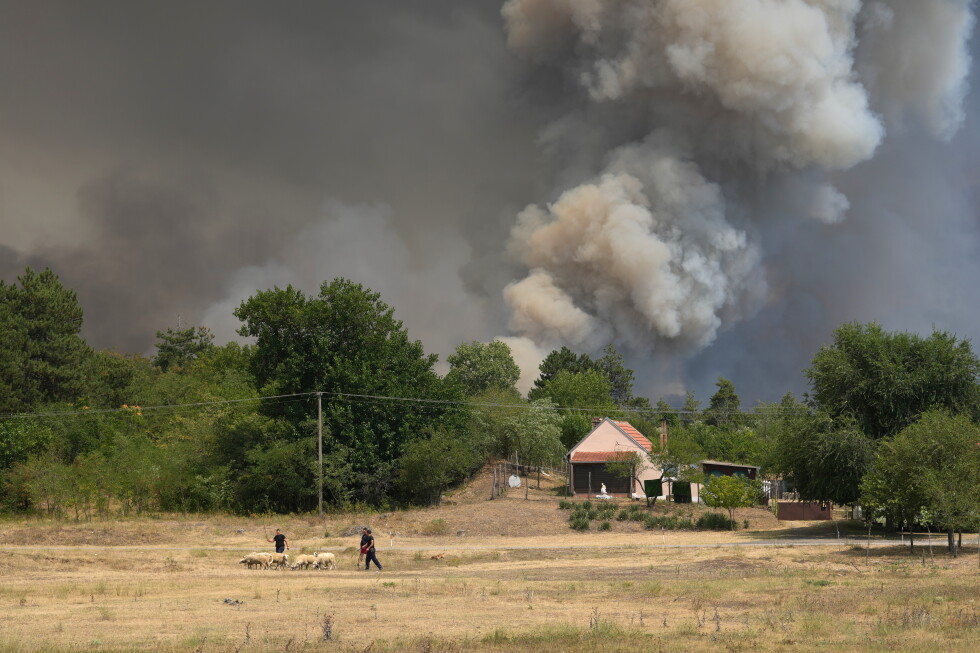
A relentless, record-breaking heat wave continued to wreak havoc across Europe this week, fueling out-of-control wildfires in the Balkans, drying up key river systems, and forcing emergency energy cuts across multiple Central and Eastern European nations.
In northeast Serbia, thick plumes of acrid gray smoke rose over a protected pine woodland on Friday as emergency responders raced to contain a large wildfire burning near Deliblatska Pescara, a major nature reserve located 40 miles outside the capital city of Belgrade. Firefighters deployed aerial water drops from helicopters to slow the blaze’s advance, which had crept close to the small settlements of Cardak and Sumarak. As a precautionary measure, local officials ordered all residents of Sumarak to evacuate their homes, though as of Friday evening, no residential structures had been damaged and no injuries or fatalities had been reported.
A second large wildfire was burning near the central Serbian town of Kraljevo, bringing the total number of active blazes across the country to nine. Unforgiving conditions — including days of temperatures soaring past 40 degrees Celsius (104 degrees Fahrenheit), months of prolonged drought, and strong gusty winds that swept the country on Friday — have severely hampered containment efforts. Following an emergency government meeting Friday, Serbia’s Interior Minister Ivica Dacic announced that the national military would be deployed to support firefighting teams, and called on all state-owned entities to contribute available equipment and personnel to the response. Dacic emphasized that while the situation was tense, it remained under control and was not critical.
Wildfire risks are not isolated to Serbia: neighboring Montenegro also reported active blazes near the historic town of Cetinje on Friday, as the entire Balkan region grapples with the combined effects of extreme heat and record dry conditions.
This heat event is part of a broader pattern of extreme weather across the continent that has shattered temperature records in multiple countries. This week, Slovakia notched an all-time national high of 42.2 degrees Celsius (108 degrees Fahrenheit) in the southern village of Dolne Plachtince, while nearby Austria recorded its own national record of 41.2 degrees Celsius (106.2 degrees Fahrenheit) in Bad Deutsch-Altenburg. Hungary marked its warmest overnight low on record, as temperatures in Budapest never dropped below 28 degrees Celsius (82 degrees Fahrenheit) overnight. In Italy, national officials issued the highest level of heat alert for all major cities, warning that the extreme temperatures posed a health risk to the entire population, not just vulnerable groups such as the elderly and immunocompromised.
Climate scientists and political leaders have repeatedly warned that heat waves of this intensity and frequency are a direct consequence of human-caused climate change, and are expected to become more common as global temperatures continue to rise.
Beyond the immediate danger of wildfires, the prolonged drought accompanying the heat wave has pushed major European river systems to critically low levels, triggering energy emergencies across Central and Eastern Europe. The Danube, a key waterway that supports nuclear power plant cooling, hydropower generation, and commercial shipping, has dropped to levels so low that multiple operators have been forced to cut or shut down production.
In Romania, authorities are currently working to sink four rock-filled barges into the Danube near the Bala Canal in an effort to redirect enough water to the Cernavoda nuclear plant, which depends on the river for reactor cooling. The intervention is intended to keep the facility’s second reactor online after the first was forced to shut down last week due to low water levels. In Hungary, the country’s only nuclear plant was recently forced to cut output to just 10 percent of normal capacity, prompting the government to call for mandatory energy conservation during peak usage hours.
On Friday, Hungarian Prime Minister Péter Magyar announced that a small reprieve was on the way: slightly cooler temperatures and modest rainfall had raised Danube water levels by 20 to 30 centimeters (8 to 12 inches), allowing the government to suspend energy saving measures. Magyar thanked Hungarian citizens for their cooperation, noting that the collective effort had preserved the country’s energy and water security. Still, he warned that the reprieve would likely be temporary, with more hot, dry weather forecasted to push water levels back down in the coming weeks.
The drought has disrupted energy production far beyond the Danube basin: Slovakia’s largest hydroelectric plant in Gabčíkovo shut down seven of its eight turbines last week due to low water, while Germany faces growing disruptions to commercial transportation and industrial activity as Rhine River water levels continue to drop. In Moldova, which relies heavily on imported electricity from Romania, authorities have also called on residents to voluntarily cut energy use during peak hours to avoid widespread outages.