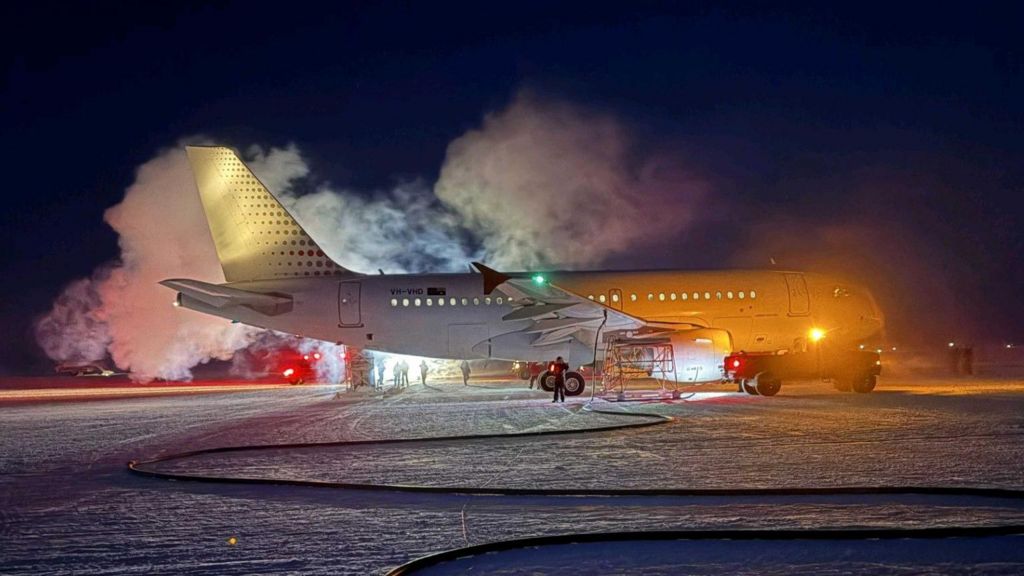
In a remarkable feat of aviation skill and emergency response, an Australian aviation team from Skytraders has pulled off a rare and dangerous midwinter medical evacuation of an American researcher from Antarctica, pulling off the operation in extreme darkness and bone-chilling temperatures never before attempted by a civilian airliner this close to the southern hemisphere’s winter solstice.
The urgent mission was triggered last week when the United States government reached out to Skytraders requesting immediate assistance to extract a sick or injured expedition member from McMurdo Station, the largest research facility on the southern continent. Within just 24 hours of receiving the emergency call, the company’s team completed a full refit of their Airbus A319 jet, converting the aircraft into a fully functional specialized medical evacuation configuration ready for the harsh Antarctic conditions.
After the refit was complete, the crew faced a new hurdle: waiting 12 hours for a narrow break in the unpredictable polar weather to get a safe launch window. Finally, in the early hours of Friday, the specially modified plane, callsign Snowbird 1, departed from Hobart, the capital of Australia’s southern state of Tasmania, and began the long journey south to McMurdo Station, located on Ross Island off the coast of Antarctica.
Against all odds, the flight crew successfully landed the jet on the station’s ice runway, facing what pilot Captain Al Wallach described as conditions that pushed even the most purpose-built aircraft to the absolute limit of their operational capabilities. At the time of landing, temperatures plummeted to -43°C (-45.4°F), and the entire region was gripped by the total, unbroken darkness of the Antarctic midwinter.
Following the landing, the patient was safely transferred onto the medevac-configured plane. Snowbird 1 then departed the ice station and flew north to Christchurch, New Zealand, where the patient was immediately transferred to local medical providers for care. Skytraders officials confirmed the patient is now recovering well, though no further details about the individual’s identity or specific medical condition have been released to the public.
Skytraders Deputy Chief Executive Duncan Mackay explained that while the company has completed winter medical evacuations from Antarctica before, this mission marked the closest any civilian airliner has ever operated to the winter solstice, which fell on June 21 in the southern hemisphere. Successfully landing on an ice runway in total darkness at such extreme temperatures, Mackay noted, requires decades of accumulated experience and intimate knowledge of the continent’s unforgiving conditions.
Captain Wallach emphasized that the successful outcome of the mission was a collective effort, crediting the wide range of specialist teams that made the operation possible. Beyond the flight crew, the mission relied on skilled meteorologists to track the fragile weather window, operational planners to map out the risky flight path, on-ice teams to prepare the frozen runway, and medical personnel ready to support the patient during the flight.
“Every Antarctic mission demands absolute precision, but winter operations raise the complexity significantly,” Wallach said. “The conditions we encountered were right on the edge of even the most specialised aircraft capability.”
This is not the first time Skytraders has supported the United States Antarctic Program with emergency medical evacuations from McMurdo Station. In a similar 2020 mission conducted in March, the company evacuated another station member when temperatures hit -30°C, a reading 13 degrees warmer than the conditions faced during last week’s unprecedented operation.