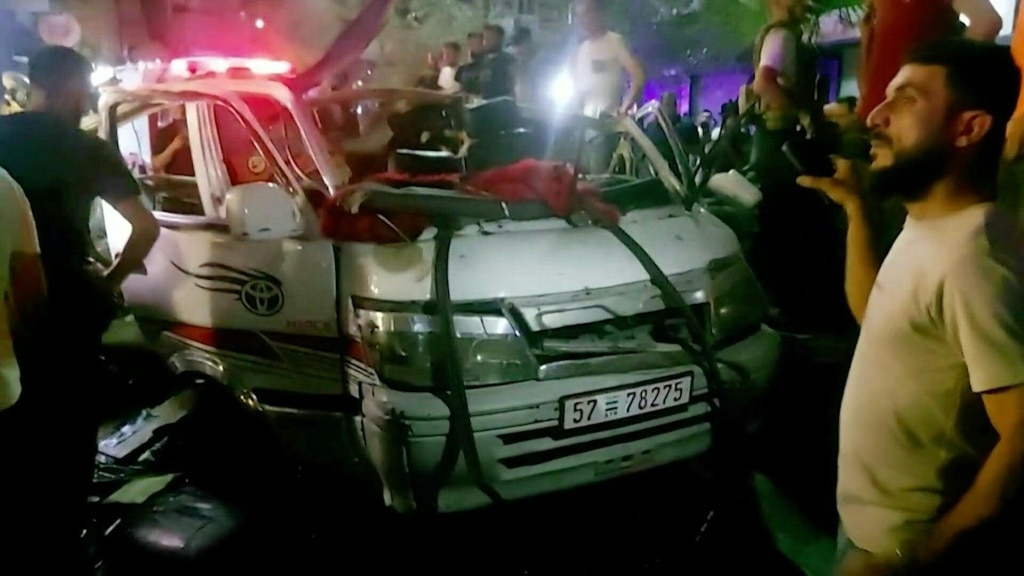
A deadly improvised explosive device detonated inside a civilian minibus on Thursday in the Damascus suburb of Jaramana, a multi-religious town home to large Druze and Christian communities, killing at least two people and injuring 13 others, Syrian state media has confirmed, citing official data from the country’s health ministry.
Agence France-Presse (AFP) photographers on the scene documented the extensive damage caused by the blast: the minibus’s roof was completely blown off, its internal chassis was reduced to mangled wreckage, and scattered debris covered a major thoroughfare that was immediately closed to traffic by responding authorities. Multiple ambulances were spotted rushing emergency personnel and supplies to the blast site, while forensic medical teams have begun the process of recovering and identifying human remains, according to reports from Syria’s official state news agency SANA.
Preliminary government investigations confirm the blast was a targeted attack, with the explosive device pre-planted on the vehicle before detonation, an official source told Syrian state television. As of Thursday evening, no armed faction had issued a claim of responsibility for the attack.
This latest incident comes amid a sustained wave of instability across Syria, nearly 12 months after former long-time ruler Bashar al-Assad was toppled from power in December 2024. Since taking control of the country, Syria’s new Islamist-led administration has made restoring national security and extending full state authority across its territory a top policy priority, but the capital Damascus and its surrounding suburbs have emerged as a repeated flashpoint for attacks targeting both civilians and state security forces.
Jaramana itself has already experienced sectarian violence earlier this year, in spring 2025, and this bombing fits a pattern of frequent attacks that have rocked the country in recent months. Just one month prior, during a historic visit to Damascus by French President Emmanuel Macron—the first EU head of state to travel to Syria since Assad’s ouster—two homemade bombs detonated, leaving one dead and 36 injured. Macron was unharmed, as he was not at his nearby hotel when the blasts went off, and Syrian security forces later announced they had captured an Islamic State (IS)-affiliated cell responsible for the attack.
Just days before the Macron visit bombing, a separate explosion at a central Damascus cafe killed 10 people and wounded roughly 20 others. The deadliest attack to hit Syria this year occurred in June 2025, when a suicide bombing targeting a Damascus church left 25 people dead. While a Sunni Islamist faction initially claimed the attack, Syrian authorities have pinned the blame on IS.
While current Syrian President Ahmed al-Sharaa has repeatedly pledged to protect the country’s minority communities in Syria’s multi-ethnic, multi-sectarian society, the past year has seen widespread sectarian bloodshed: massacres of Alawite communities in their coastal heartland, and violent clashes involving the Druze minority in southern Syria. In a December address marking the one-year anniversary of Assad’s ouster, al-Sharaa called for national unity, saying all Syrians must work together to “build a strong Syria.”
Syria joined the U.S.-led global coalition against IS last year, more than six years after the jihadist group was declared territorially defeated in Iraq and Syria in 2019. Despite the loss of all occupied territory, IS retains an extensive network of dormant sleeper cells across both countries, and continues to issue calls for armed attacks against the new Syrian authorities.