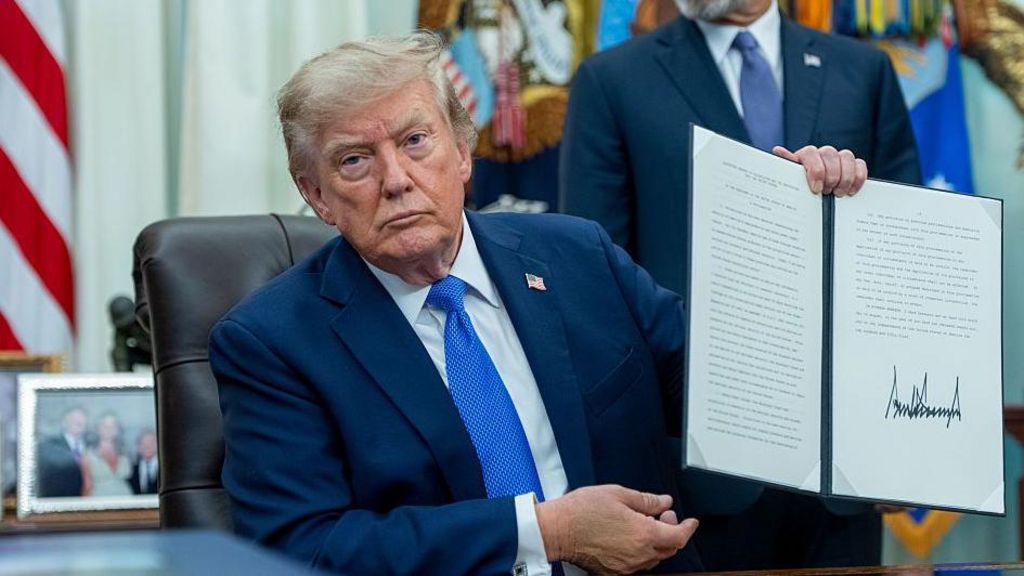
Weeks after the U.S. Supreme Court blocked his first sweeping effort to eliminate longstanding birthright citizenship protections, former and current President Donald Trump has launched a new push to roll back the 150-year-old policy, signing two new executive actions focused on narrowing eligibility and cracking down on the controversial practice of birth tourism. The Thursday signing, held in the Oval Office, comes as the Trump administration continues its aggressive campaign to restrict immigration and rewrite the rules of citizenship for people born on U.S. soil.
The first of the two orders expands existing legal carve-outs that deny birthright citizenship to children born in the U.S. to non-citizen parents. Under the new framework, any child born in the U.S. to two non-citizen parents will not receive automatic citizenship if one parent falls into specific high-risk categories: members of foreign terrorist organizations, employees of foreign governments, individuals who have previously attempted to obtain U.S. citizenship through fraudulent means, or people residing in U.S. territories where citizenship is not already mandated by federal statute. Currently, birthright citizenship for people born in U.S. territories including Puerto Rico is explicitly codified in federal law.
The second executive order targets birth tourism, the practice where pregnant foreign nationals travel to the U.S. specifically to give birth, granting their children automatic U.S. citizenship under the longstanding interpretation of the 14th Amendment. Speaking at the signing, Trump defended the new restrictions, arguing that reform of birthright citizenship should have been enacted decades ago, and criticized the Supreme Court’s June ruling that struck down his earlier 2025 effort to end the policy entirely. He called the high court’s decision a “bad decision, very unfair decision” that harmed the U.S., noting that his administration is now pursuing its goals through a revised legal approach. “Our country suffers because of it, and we’re ending it in a different way,” Trump said.
The text of the first executive order frames the new restrictions as a necessary safeguard against exploitation of U.S. immigration policy. “My Administration has guarded against the risks posed by malign foreign actors who attempt to swindle American citizens by taking advantage of the generosity of our Nation,” the order reads.
Trump and senior White House officials have repeatedly targeted birth tourism in public remarks, repeatedly claiming that adversarial nations including Russia and China encourage the practice to let their citizens infiltrate the U.S. Trump claimed Thursday that hundreds of thousands of children are born in the U.S. through birth tourism each year, a figure that contradicts independent research from nonpartisan policy analysts. The nonpartisan Migration Policy Institute (MPI) estimates that even the most generous census-based calculations put the annual number of births from birth tourism between just 22,000 and 26,000. Government data analyzed by MPI puts the 2024 number even lower, at roughly 9,600 births to foreign women listing non-U.S. residential addresses.
White House Deputy Chief of Staff for Policy and Homeland Security Advisor Stephen Miller, a key architect of the Trump administration’s restrictive immigration policies, joined the president for the announcement, arguing that birth tourism allows foreign visitors to exploit U.S. benefits systems. “The idea is that people come here pretending to be a tourist, pretending to be a visitor. But the real reason they’re here is to have a child, to make that child an automatic citizen, leave our country and then have a U.S. citizen child,” Miller said, adding that these children would then gain access to public welfare benefits, voting rights, and “all the other rights and privileges that belong solely to Americans.” Miller also asserted that the president holds clear legal authority to restrict birth tourism under the Immigration and Nationality Act, which grants the sitting president power to set entry exceptions and limitations for people seeking to enter the U.S.
This latest effort follows a high-profile legal battle over Trump’s first executive order on birthright citizenship, which he signed just days into his 2025 second term. That order sought to end the birthright citizenship protections guaranteed by the 14th Amendment to the U.S. Constitution. Legal challenges quickly made their way to the Supreme Court, which ruled in June that Trump’s 2025 policy was unconstitutional, leaving the existing birthright citizenship framework intact. The ruling represented a major legal setback for the Trump administration’s broader goal of restricting immigration and reshaping citizenship eligibility for people entering or born in the U.S.