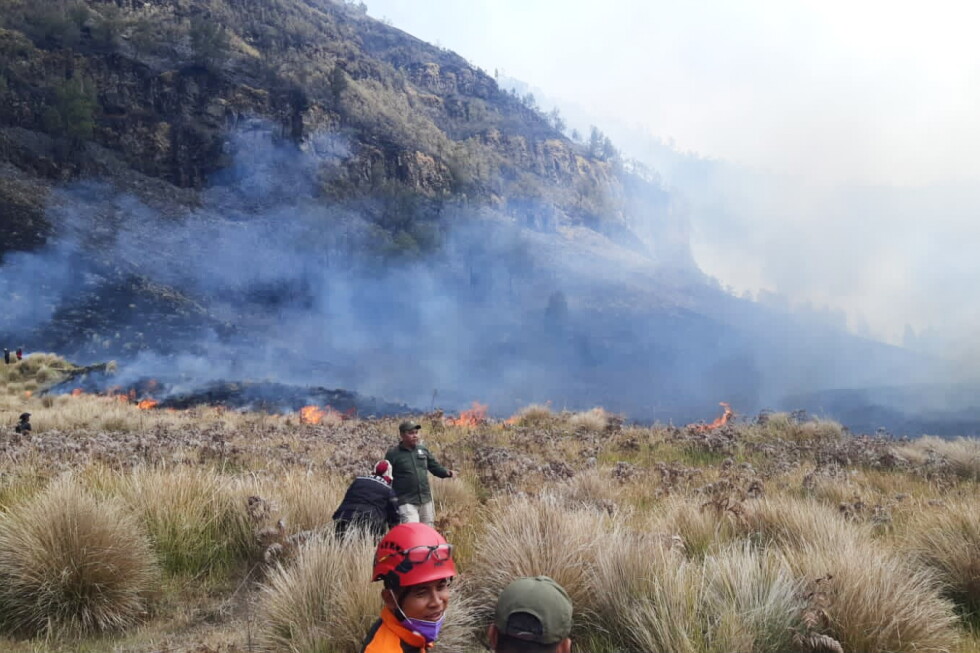
Indonesia is grappling with a rapidly spreading wildfire that has destroyed 60 hectares of protected land in the popular Mount Bromo tourism region, according to official updates released Thursday. The blaze, which first ignited Monday, burns across an area equivalent to more than 80 full-size soccer pitches within the boundaries of Bromo Tengger Semeru National Park, one of East Java Province’s most visited natural attractions and a key draw for domestic and international tourism.
The country’s National Disaster Management Agency confirmed Thursday that uneven, challenging terrain has created major obstacles for teams working to contain the fire, and investigators have not yet identified what sparked the blaze. In an official written statement, agency spokesperson Abdul Muhari outlined the core barriers slowing suppression efforts: multiple active hot spots are scattered across the steep slopes of Mount Bromo, locations that are nearly inaccessible to ground-based firefighting crews. Compounding this danger, sustained strong winds in the region are fueling the fire and accelerating its spread across dry vegetation.
To overcome these access barriers, the agency deployed two water-bombing helicopters to the site Thursday to target the unreachable slope hot spots. Authorities are also preparing additional unconventional firefighting measures, including weather modification operations such as cloud seeding to trigger much-needed rain over the burning area. As a critical public safety precaution, local officials have closed a portion of the Mount Bromo tourist district until further notice, barring visitor access to the fire zone.
The Mount Bromo fire is not an isolated incident: Indonesia has already recorded multiple separate forest fire outbreaks across the islands of Sumatra and Borneo since the start of this month. In West Kalimantan Province’s Ketapang Regency, one person has already died from oxygen starvation while attempting to flee through thick toxic wildfire smoke. Historically, large-scale forest fires across Sumatra and Borneo peak during annual dry seasons, and the resulting smoke haze often drifts to neighboring Singapore and Malaysia, causing widespread air quality crises across the region.
Associated Press journalist Niniek Karmini contributed reporting from Jakarta, Indonesia.