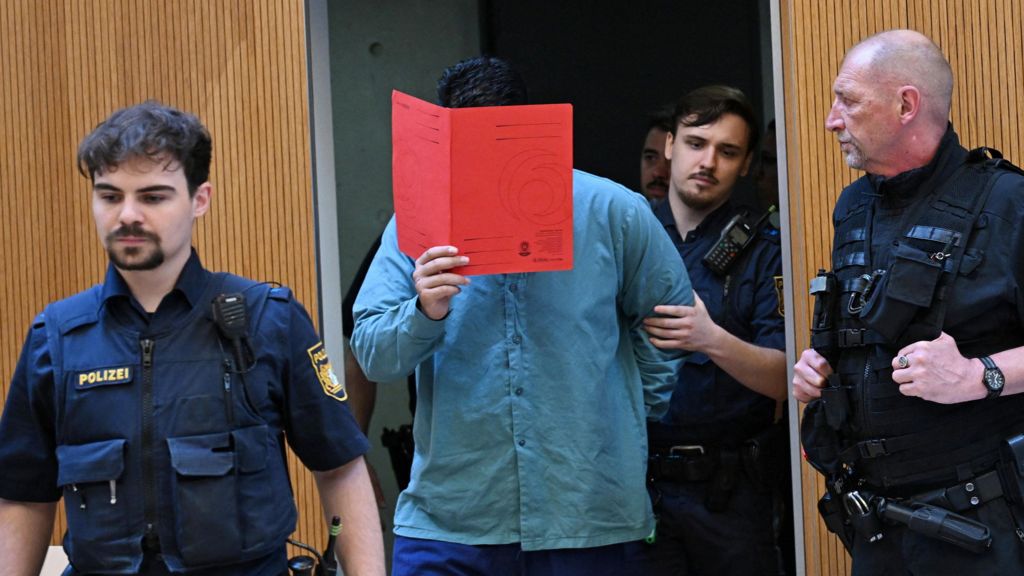
In a landmark verdict delivered Wednesday, Munich Higher Regional Court has sentenced 25-year-old Afghan national Farhad N to life imprisonment for a deadly vehicle attack on a central Munich trade union rally that left two people dead and more than 40 others injured in February 2025. Under German privacy rules, the defendant’s full surname has not been released to the public.
The court found Farhad N guilty on all counts brought by prosecutors: two charges of murder, 23 counts of attempted murder, and multiple additional counts of grievous bodily harm. Judges further ruled the attack carried particularly serious aggravating circumstances, a designation that drastically reduces the chance of early parole after the defendant completes the mandatory 15-year minimum prison term.
Court documents outline that on the morning of February 13, 2025, Farhad N deliberately steered his Mini vehicle into a crowd of roughly 1,400 trade union demonstrators gathered in downtown Munich. The first two victims — a 37-year-old mother and her two-year-old daughter — were rushed to local hospitals but died shortly after the collision. Dozens of other attendees were wounded, with many sustaining life-threatening critical injuries.
In his ruling, the presiding judge laid out the defendant’s stated motives, confirming Farhad N carried out the attack to target random civilians in Germany as retaliation for Western military and policy actions in Islamic countries, specifically naming U.S. and Western intervention in Gaza and Afghanistan. The judge added that the defendant believed the mass killing would be seen as an act pleasing to God, and that he sought to prove his piety as a Muslim to Allah, himself and his family. Prosecutors noted that personal anger, long-held disappointment, and deep-seated bitterness toward the West also contributed to his decision to launch the attack.
The case unfolded against a backdrop of long-running political division over migration in Germany. Farhad N first entered Germany as an unaccompanied minor in 2016, at the peak of Europe’s continent-wide migrant crisis, when Germany welcomed more than one million asylum seekers over the 2015-2016 period. While his initial asylum application was ultimately rejected, he was never deported, and was allowed to remain in the country on legal resident status, holding a valid work permit. Prior to the attack, he had held jobs as a shop detective and security staff, had no prior criminal convictions, and was active on Instagram sharing content focused on bodybuilding and religious topics.
Throughout the trial, Farhad N’s defense team argued for a lenient 15-year prison sentence and involuntary commitment to a psychiatric hospital, claiming the defendant showed clear diagnostic signs of schizophrenia. The verdict is not final: under German legal procedure, Farhad N retains the right to file an appeal against the conviction and sentencing.
The 2025 Munich attack was one of several violent incidents in Germany in recent years that have been seized on by far-right political groups to amplify anti-migration rhetoric. The 2015-2016 migrant influx has remained one of the most divisive issues in German politics, and directly contributed to the sharp rise in electoral support for the far-right Alternative for Germany (AfD) party over the past decade.