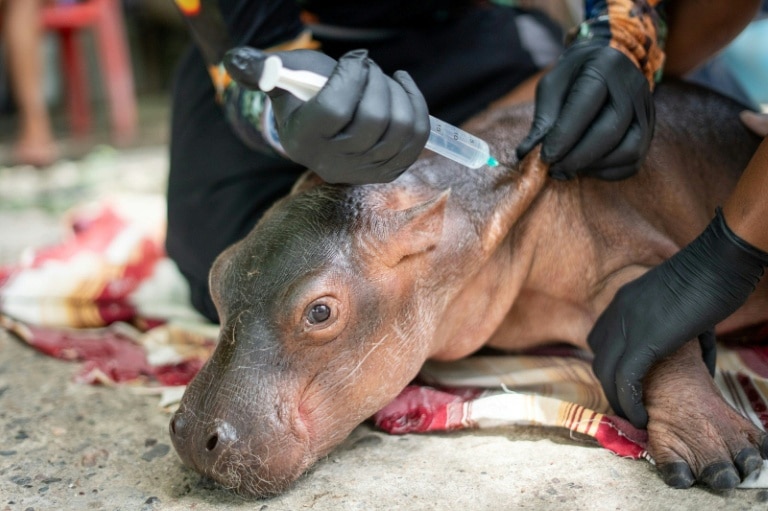
A 15-day-old hippopotamus, part of the notorious invasive colony descended from animals once owned by the late Colombian drug kingpin Pablo Escobar, has died shortly after wildlife teams pulled the malnourished calf to safety in northwestern Colombia, an environmental agency confirmed to Agence France-Presse on Wednesday.
Today, Colombia is home to roughly 200 wild hippos, all traced back to four specimens that Escobar imported from Africa in the 1980s to stock a private zoo on his luxurious Hacienda Napoles estate. This population makes up the largest wild hippo colony found outside of the African continent, a fact that has put Colombian environmental authorities in a years-long battle to manage the destructive invasive species.
The infant hippo at the center of this latest incident was found by local fishermen along a riverbank, separated from its mother and already suffering from severe health complications. Wildlife crews launched an emergency rescue mission earlier on Wednesday to retrieve the vulnerable young animal, which was immediately moved to a dedicated hippo sanctuary located on the grounds of the former Escobar estate – a property that now operates as a public theme park.
Veterinary staff with the regional environmental authority Cornare detailed the calf’s critical condition upon arrival. In a statement to AFP, the attending vet explained that the young hippo was admitted with long-term signs of dehydration, severe malnutrition, and an acute gastrointestinal infection that exacerbated its already fragile health. Despite aggressive intervention including targeted rehydration therapy and emergency clinical care, the animal never showed positive improvement, and ultimately did not survive the treatment.
The fate of this young hippo underscores the broader, ongoing crisis surrounding Escobar’s hippo colony. After Escobar was killed by police in 1993 during an escape attempt, the abandoned zoo animals escaped captivity and established wild populations along the banks of the Magdalena River, Colombia’s most important river system. Since then, the large, aggressive herbivores have thrown the local ecosystem drastically off balance: they outcompete native species for food and habitat, alter river ecosystems, and have even been recorded attacking local residents in the region.
Classified as a destructive invasive species by Colombian environmental officials, the hippo population has grown far faster than management efforts could contain. For years, authorities tried to slow population growth through sterilization programs, but those initiatives failed to curb the colony’s expansion. Earlier this year, the national government approved a controversial management plan that will allow the culling of approximately 80 hippos to reduce the population and protect native ecosystems.