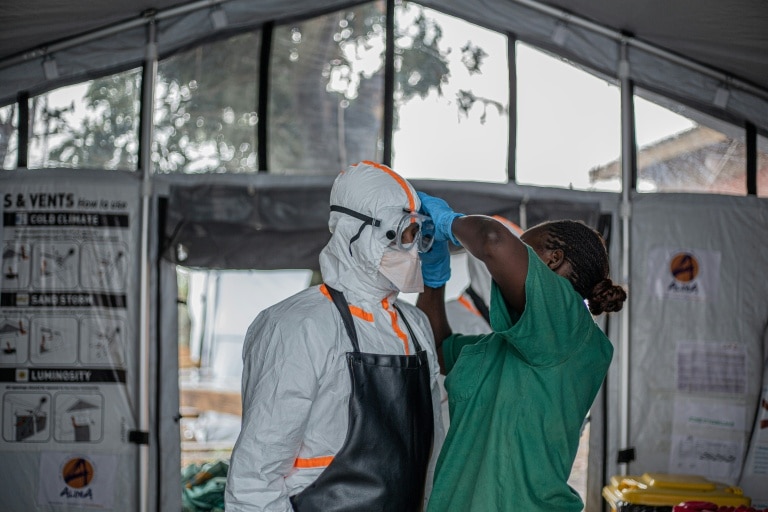
The World Health Organization’s top leader has issued a urgent call for accelerated action to curb a fast-expanding Ebola outbreak in the Democratic Republic of the Congo (DRC), stressing the critical need to shield frontline medical workers during an official visit to the African nation this week.
The DRC first declared its 17th documented Ebola outbreak on May 15, and the crisis has since escalated at an alarming rate. Updated WHO data puts the total number of confirmed cases at 3,874, with the death toll already reaching 1,751.
WHO Director-General Tedros Adhanom Ghebreyesus began his trip in the DRC’s capital Kinshasa on Tuesday, with scheduled talks planned with Congolese President Felix Tshisekedi, a spokesperson confirmed to news agency AFP on Wednesday. Following meetings with local and international response organizations, Tedros shared updates on the outbreak’s trajectory via social media platform X, warning that the virus is outpacing current containment efforts.
“In some of the worst-hit hotspots, new cases have doubled over just the past week. The outbreak is spreading faster than our scale-up of the response,” Tedros wrote. “We must urgently and massively scale up all our efforts.”
He outlined the core priorities for the expanded response: reaching every at-risk and affected community despite widespread instability and mass population displacement, strengthening inter-agency coordination, guaranteeing frontline health workers access to adequate protective gear, specialized training and ongoing support, and speeding up expansion of patient care, disease surveillance and safe, culturally appropriate burials for fatal cases.
International support for the response picked up steam Wednesday, as the United States announced it would allocate more than $242 million in new emergency funding to fight the worsening outbreak. The State Department noted that this additional injection brings total direct U.S. financial support for the response to over $500 million, retaining the country’s position as the single largest financial contributor to global Ebola containment efforts in the DRC.
This is Tedros’ second visit to the DRC since the outbreak began; he previously traveled to the northeastern province of Ituri in late May, a region that accounts for nearly 90 percent of all confirmed Ebola cases across the country. The five eastern DRC provinces affected by the outbreak are plagued by longstanding weak state governance and a near-total lack of robust healthcare infrastructure, creating major barriers to effective containment.
The depth of the challenge facing response teams was highlighted this week in Mongbwalu, a mining town in Ituri, where staff at a local Ebola treatment center held protests over unpaid government stipends. Hospital sources report police fired warning shots to disperse the demonstrators.
In a small step toward expanding care capacity, the United Nations Office for the Coordination of Humanitarian Affairs (OCHA) announced that a new 100-bed Ebola treatment center opened Tuesday in Bunia, the capital of Ituri province.
Ebola, a viral hemorrhagic fever transmitted through direct contact with bodily fluids, has claimed more than 15,000 lives across Africa over the past 50 years. The current DRC outbreak is driven by the Bundibugyo strain of the virus, for which no officially approved vaccine or targeted treatment exists as of yet. But global scientific and pharmaceutical efforts are advancing rapidly to close this gap.
Canada gave regulatory approval Tuesday for U.S. biotech giant Moderna to launch clinical trials for an experimental Bundibugyo candidate vaccine. At the end of July, the first volunteer received a dose of a separate experimental vaccine developed by Britain’s University of Oxford, built using the same platform that powered the AstraZeneca COVID-19 vaccine. A third candidate, developed by Singapore-based Hilleman Laboratories, is also moving toward human trials. The WHO has identified the Hilleman candidate as the “most promising” of the three, as it uses the same rVSV technology platform as Ervebo, the only currently licensed Ebola vaccine, which targets the separate Zaire strain of the virus.
In addition to vaccine development, two experimental treatments are already being tested on confirmed Ebola patients in Ituri: the monoclonal antibody MBP134 and the antiviral drug remdesivir, being trialed both alone and in combination. A third trial is also underway in Ituri for the oral antiviral obeldesivir, administered to people who have had confirmed exposure to Bundibugyo cases.