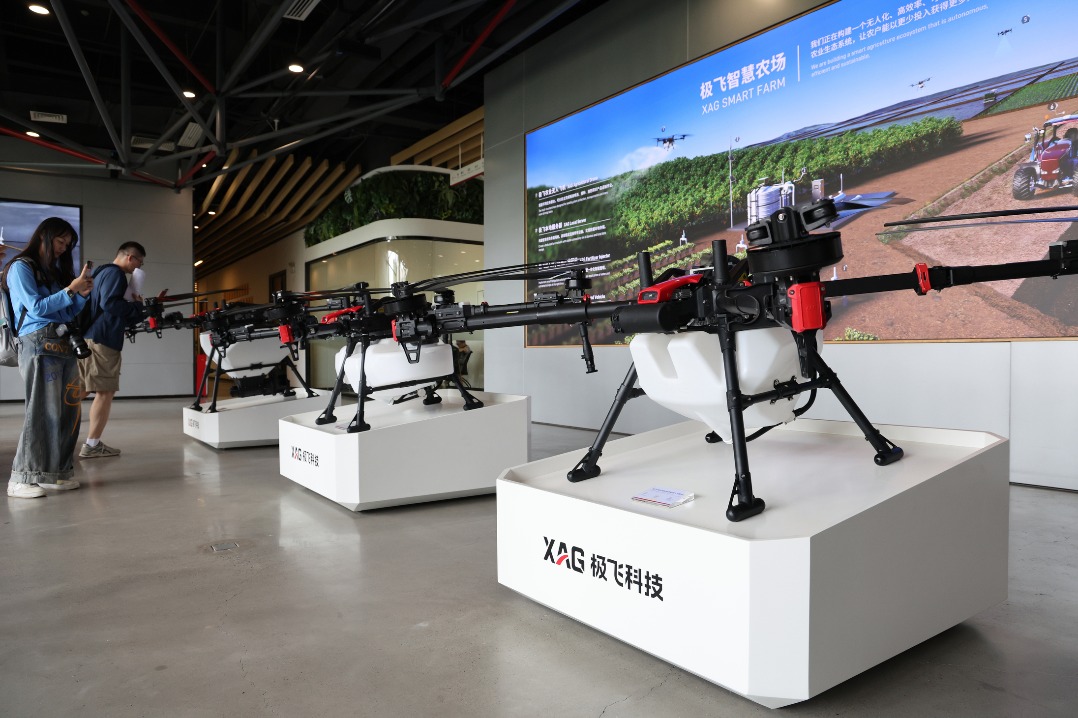
Across the United States, thousands of agricultural workers and small business owners are sounding the alarm over a impending federal restriction on Chinese-made drones, warning the policy could deliver immediate, irreversible damage to America’s $1.3 trillion agriculture industry. For countless growers and rural operators, these unmanned aerial systems have become as foundational to modern farming as the traditional tractor, transforming everything from crop monitoring to pest control.
Tony Zenari, a small family farm operator, relies on his Chinese-built drone daily to survey crop health, track weed spread and map flood damage across his fields. Without access to replacement parts, repairs, or new units, Zenari says he will be forced to return to inefficient, high-cost diesel-powered tractors that cost thousands of dollars a week to operate, raising emissions and threatening his farm’s viability. For combat veteran Nick Grott, who founded Indiana’s Patriot Aerial Solutions after his honorable discharge from the military, agricultural drone technology gave him a new professional purpose. Grott, who has tried domestic drone alternatives, says American models still lag behind Chinese manufacturers in key areas like software reliability, video transmission and controller connectivity — features critical to safe, effective agricultural work. William B. Blaylock II, another operator, uses Chinese drones to cut inspection time for farm infrastructure and search for missing or injured cattle across vast stretches of open land, completing work that once took days in just hours.
These personal accounts are part of more than 32,000 public comments submitted to the U.S. Federal Communications Commission (FCC) urging the agency to reverse its December 2025 decision to add all new foreign-made drones and critical components — including models from industry leader DJI and manufacturer Autel — to a “covered list” of devices deemed to pose an “unacceptable risk” to U.S. national security. While the FCC granted limited exemptions to some devices after the announcement, the order still blocks widespread access to camera-equipped agricultural drones built by the two Chinese firms.
DJI challenged the FCC’s ruling in a January 2026 petition, arguing the decision violates both constitutional protections and federal law. As the agency’s original May 11 public comment deadline approached, regulators were inundated with submissions, the vast majority from farmers, aerial spray specialists and small rural businesses calling for a policy reversal. In response to a June 9 filing of an independent cybersecurity audit conducted by U.S. cybersecurity firm OnDefend, the FCC extended the public comment window to August 28.
The independent OnDefend audit, which was added to the official FCC public record, found no evidence of hidden backdoors in DJI drone systems, no unauthorized data transmissions sent outside the United States, and no viable pathway for bad actors to hijack or weaponize the devices for malicious purposes. DJI’s petition is currently under review by the FCC’s Office of Engineering and Technology and the full five-member commission, awaiting a final ruling that will shape the future of U.S. precision agriculture.
Operators across the industry emphasize that the FCC’s national security justifications for the ban remain entirely unsubstantiated. Andrew Adams, of Michigan-based Aerial Acres AG, LLC, notes that Chinese-built drones have delivered unprecedented precision, efficiency and cost savings to U.S. growers at a time when farm margins are shrinking and input costs are skyrocketing. The technology allows farmers to apply crop protection products and nutrients with pinpoint accuracy, cutting waste and reducing the sector’s environmental footprint. For small and mid-sized farm operations in particular, Adams says affordable Chinese drones have leveled the competitive playing field against large industrial agribusinesses that can absorb higher overhead costs.
Aaron Wright, founder of Whiskey Mike Drone Solutions, which uses DJI and EAVision spray drones to treat thousands of acres of farmland annually, points out that domestic alternatives still cannot match the combination of hardware performance, software functionality and affordability offered by Chinese manufacturers. “Capitalism is all about free choice in the marketplace,” Wright wrote in his public comment. “Give DJI a chance to prove if they are indeed a threat to our national security or not.”
Even operators who support targeted, reasonable national security standards say a broad, blanket ban on Chinese-built drones creates unnecessary hardship for millions of responsible civilian users. Blaylock notes that for most American operators, current Chinese-manufactured drones offer an unbeatable mix of affordability, reliability, camera quality, flight safety features and ease of use that no domestic product can match. Cutting off access to these tools without a viable replacement would cripple legal agricultural, commercial and creative work across the country, he argues.
Industry experts and operators agree that U.S. drone manufacturing is not currently positioned to replace Chinese models in the near term, even if the ban goes into effect immediately. Many key components required for domestic drone assembly, including batteries and motors, are already included on the FCC’s covered list, and domestic supply chains cannot shift away from Chinese-sourced parts overnight.
A 2023 U.S. Department of Agriculture report identified drone technology as a core pillar of the precision agriculture toolkit needed to address three of the sector’s biggest ongoing challenges: rising production costs, climate change adaptation, and widespread labor shortages. Drones enable fast, accurate scouting, mapping and data collection that directly improve planting and harvest decision-making, boosting crop yields and reducing waste.
Industry data underscores just how deeply integrated Chinese-built drones are into U.S. agricultural operations. The American Spray Drone Coalition reports that 93.5 percent of the 8,950 agricultural spray drones sold in the U.S. in 2024 were manufactured in China. Following the FCC’s announcement, total annual sales dropped to just 3,711 units in 2025, with Chinese-made models accounting for 75.8 percent of the much smaller market amid a sharp decline in DJI imports.
Volitant Technologies LLC, a Nebraska-based agricultural drone retailer that serves hundreds of farmer customers across the Midwest, describes DJI’s popular Agras series as “the operational backbone of precision agriculture for thousands of US farms” at a time when growers are facing some of the toughest economic conditions in decades. Losing access to new drone models and critical firmware updates, the company says, will leave U.S. farmers with degraded device performance, lower crop yields, and no path to adopt next-generation precision farming tools without absorbing massive unexpected cost increases.
For U.S. growers, this threat is not a distant hypothetical. “This is not a theoretical future harm,” Volitant Technologies wrote in its public comment. “Farmers are already making contingency plans for a supply chain that may not be there in two years.”