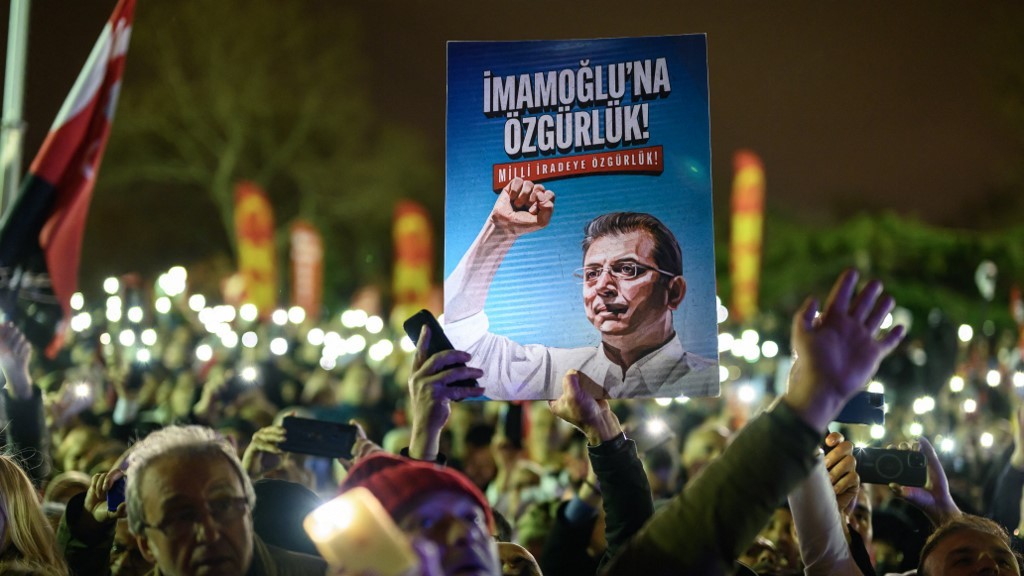
When social media platform X announced this week it would mount a legal challenge against a Turkish government order to block a campaign account supporting imprisoned Istanbul mayor Ekrem Imamoglu’s 2025 presidential bid, the claim was met with immediate skepticism from digital rights and free expression advocates.
The campaign account, launched to boost Imamoglu’s candidacy in Turkey’s upcoming national election, was first taken offline for users within Turkey in late March 2025, after authorities submitted a formal block request to the platform. In a public post to its own platform Wednesday, X explained that it had complied with the block order the previous week, arguing that Turkish legislation left the company no choice: failure to act would have triggered aggressive bandwidth throttling of X’s entire service across the country by Turkey’s Information and Communication Technologies Authority (BTK).
“Although Turkey’s laws force us to comply with the order, we are challenging the order in court and, in the spirit of full transparency, are sharing the court order,” the company stated, alongside a public copy of the official government directive. This is not the first time X has moved to block Imamoglu-linked content: the mayor’s personal main X account, which boasted close to 10 million followers before it was restricted, was blocked in May 2024 under an identical government order, which X also says it is contesting through the Turkish court system. Other major global social platforms have complied with similar Turkish government requests: both Meta and YouTube have already restricted access to Imamoglu-associated accounts and content at authorities’ demand.
Yaman Akdeniz, founder of Turkish free expression nonprofit IFOD, told Middle East Eye that he doubts X, owned by Elon Musk who has repeatedly labeled himself a “free speech absolutist,” has any real intention of meaningfully opposing the Turkish government’s censorship demands. “It is true to say that every now and again they appeal against decisions and lodge a few applications with the Constitutional Court — however, this is very selective and X chooses not to provide further details about the judicial challenges,” Akdeniz explained.
Data from X’s own transparency reports backs up critics’ claims that the platform regularly complies with Turkish content removal requests. Between July and December 2024, X received 11,107 separate content and account removal requests from Turkish authorities, and enforced action on 86 percent of those demands. An earlier review of X’s disclosure data by The Washington Post found that the platform’s compliance rate with legal content removal requests globally rose 20 percentage points between 2021 and the first half of 2024, hitting 71 percent. For Turkish government requests specifically, X complied with 68 percent of the 9,364 demands it received in the first half of 2024 alone. Akdeniz added that X is not an outlier in this practice: “I must say Meta and the others are no different as they have all become the long arm of the Turkish law enforcement mechanism.”
Turkey is far from the only government where X has complied with demands to censor accounts belonging to dissident voices and government critics, a pattern that undermines the platform’s public commitment to free speech. Just this week, The Guardian revealed that X has blocked a collection of prominent Saudi Arabian critics of the Saudi monarchy, including prominent human rights advocate Yahya Assiri and activist Abdullah Alaoudh, whose father is imprisoned cleric Salman al-Ouda. The restrictions came after Snapchat, Meta and Instagram already implemented similar blocks following Saudi government claims that the accounts violated local content regulations. Notably, X had previously issued a public statement claiming it would refuse to follow the other platforms’ lead, saying it “strongly believes in defending and respecting the voice of our users.”
Saudi Arabia’s government has poured billions of dollars in investment into xAI, recently renamed SpaceXAI, the parent company that operates both the X social platform and its AI chatbot Grok, creating a clear conflict of interest that critics say drives the platform’s willingness to comply with Saudi censorship demands. Middle East Eye reached out to X for additional comment on the Turkish court challenge and compliance patterns, but had not received a response as of publication.