In a sunlit classroom at an elder learning center in Lhasa, the capital of China’s Tibet Autonomous Region, 73-year-old retired nurse Kalsang Lhamo carefully draws vertical Tibetan script, her movements slow but steady. For her entire life, Lhamo has spoken her native Tibetan, but she never had the opportunity to learn to write it. Now, as a student at the center, she is finally immersing herself in mastering the traditional language of her people, while also navigating the sweeping political and cultural shifts brought by China’s new national “ethnic unity” law that took effect on July 1.
Under the terms of this landmark legislation, Mandarin Chinese is designated as the primary working language for all public schools and government agencies across the country. The law explicitly bans any activity deemed to incite division among China’s 56 officially recognized ethnic groups, and requires all social institutions—from schools to families to community organizations—to actively foster patriotism, national cohesion, and a shared collective identity as part of the Chinese nation.
The legislation has drawn fierce international condemnation from rights groups, Tibetan activists, and global observers, who argue it represents a significant escalation of Beijing’s campaign to erode the cultural and political rights of Tibetan and other ethnic minority communities. Critics note the law grants the Chinese central government broad authority to crack down on any activity labeled as separatist, extending that jurisdiction even to activities conducted outside China’s borders. Beijing has dismissed all international criticism of the policy as unfounded ideological bias, framing the law as a critical measure to safeguard national unity and improve development opportunities for minority groups.
Tensions over the new law are particularly acute in Tibet, a remote Himalayan region that Beijing labels an autonomous region but controls with strict security and political oversight. This year marks the 75th anniversary of what China calls the “peaceful liberation” of Tibet—an event widely viewed by Tibetans in exile and independent critics as an unlawful invasion of a sovereign Tibetan state.
Tibetan activists warn the law advances a decades-long project of forced cultural assimilation, extending Beijing’s tight control over minority community life. They point to similar language policies already rolled out in other minority regions, including the expansion of Mandarin-only education for Uyghur communities in Xinjiang and the replacement of Mongolian-medium instruction with Mandarin in parts of Inner Mongolia. Writing in *Foreign Affairs*, ethnic studies scholar James Leibold of La Trobe University and Tenzin Dorjee of advocacy group Tibet Action Institute warned that minority communities seeking to preserve their distinct cultures will be forced into a “double life” of public conformity to state policies and private retention of cultural traditions.
This report from the Associated Press is based on reporting conducted during a government-organized press tour of Tibet last month, which included stops in Lhasa and the southern city of Shannan. Chinese authorities arranged all visits to sites including historic palaces, Buddhist temples, tourist attractions, local businesses, and the elder learning center where Lhamo studies, and government officials accompanied foreign journalists for the full duration of the trip, barring independent travel or unapproved reporting. The Associated Press retained full editorial control over all content produced from the tour.
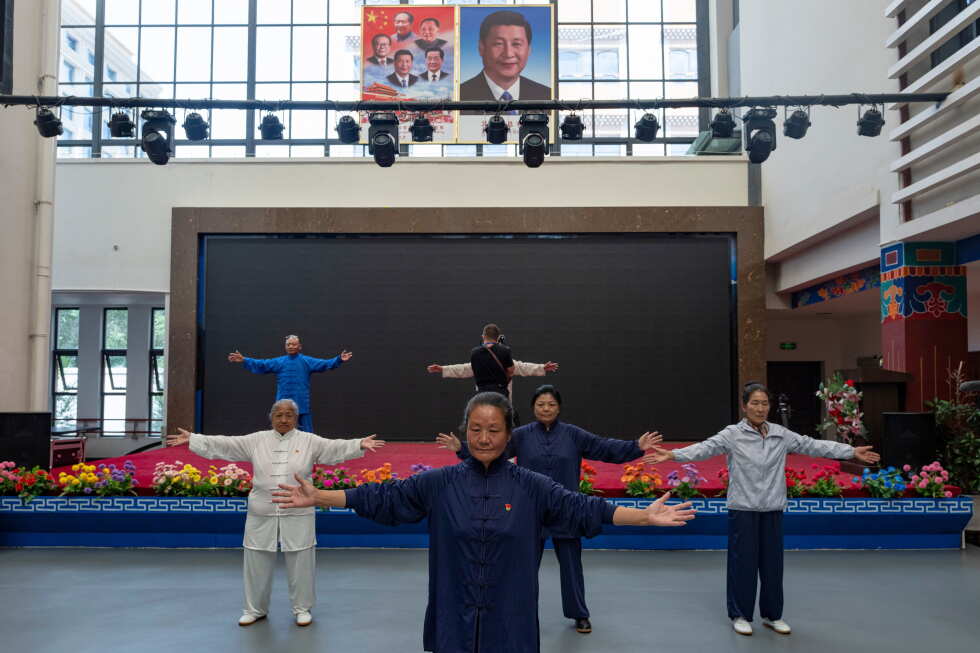
Across Tibet, constant visual reminders reinforce Beijing’s narrative that the region is an inalienable part of China: welcome messages at airports, ubiquitous billboards promoting ethnic unity, Chinese national flags flying over public squares and government buildings, and official portraits of President Xi Jinping displayed in most public institutions.
Even amid the new regulatory environment, some Tibetans have found ways to maintain connection to their language and cultural identity. For Lhamo and others, that means taking classes to learn Tibetan script, speaking the language at home with family, preserving traditional weaving crafts, and continuing to participate in Buddhist religious practices. Critics, however, argue the overall effect of the law is to entrench the dominance of China’s majority Han ethnic culture across public life in minority regions.
At the Jokhang Temple, one of the holiest sites in Tibetan Buddhism, visitors—both Han Chinese tourists and local Tibetan pilgrims—wander the temple grounds and rest in the surrounding courtyards. Nineteen-year-old student Qongqiu Quco, who visits the temple with her aunts (several of whom are Buddhist nuns), says preserving Tibetan language and culture is a core priority for her community. “Everyone in our ethnic group hopes that our culture can be passed down to future generations,” said Quco, an aspiring teacher who speaks Tibetan in most of her daily life. She added, however, that students at her school use Mandarin as a common language to communicate across different regional Tibetan dialects.
For the majority of Tibetans who practice Tibetan Buddhism, the 14th Dalai Lama is their revered spiritual leader. But across all official religious sites in Tibet, there are no public references or portraits of the current Dalai Lama, who fled into exile in India following a failed 1959 uprising against Chinese rule, and has led the unrecognized Tibetan government-in-exile ever since. The question of the Dalai Lama’s reincarnation remains one of the most contentious issues in China-Tibet relations: the Dalai Lama has stated his successor could be born outside China, and that only his own religious office has the authority to recognize a new reincarnation, while Beijing insists any selection must comply with Chinese law and receive formal approval from the central government. China has long labeled the Dalai Lama a separatist agitator seeking to split Tibet from China.
The Potala Palace, once the winter residence of successive Dalai Lamas and one of Tibet’s most iconic cultural sites, also has no public references to the current Dalai Lama. Today, thousands of visitors—Chinese domestic tourists and local Tibetan pilgrims alike—visit the site daily, where the Chinese national flag flies above the historic compound.
Historians and Tibet experts note that the new ethnic unity law does not represent a sudden policy shift, but rather codifies trends that have been unfolding for decades. “I don’t think the law itself changes things,” explained Benno Weiner, a professor of modern China and Tibetan studies at Carnegie Mellon University. “I think it sort of codifies and summarizes a trend that’s been going on,” particularly the gradual erosion of minority language rights and community control over education.
Beijing frames its policies as a way to expand educational access and deliver equal economic opportunity to ethnic minority communities. During the same week the AP conducted its tour, top Chinese Communist Party leader Wang Huning—ranked fourth in the party’s central leadership—visited Tibet, where he stated that maintaining political stability is the top priority for governing the region. Wang called for full implementation of the new ethnic unity law, and urged authorities to “guide Tibetan Buddhism to adapt to socialist society,” according to official reports from China’s state-run Xinhua News Agency.
During its tour, AP visited a range of cultural sites, including a traditional Tibetan medicine clinic, artisan workshops preserving traditional crafts like ceramic making and hand textile weaving, and a public Tibetan opera performance. At each site, workers and performers spoke about their work to preserve local cultural traditions. Weiner, however, notes that Beijing’s approach to cultural preservation often prioritizes elements of Tibetan culture that are deemed politically neutral and beneficial to the growing tourism industry. “The parts of culture that they want to protect and maybe even enhance are the sort of anodyne or non-dangerous clothing, certain celebrations that are not religious in many cases,” he explained. “Things that maybe not that coincidentally also attract tourists.”
At Lhasa’s Tibet Museum, a permanent exhibit highlights centuries of historical ties between Tibetan political authorities and Chinese imperial dynasties, the official narrative Beijing uses to support its claim that Tibet has been an inalienable part of China for centuries. This narrative is vigorously disputed by Tibetans in exile, who argue that Tibet functioned as an independent sovereign state for much of its modern history.
Laba Ciren, the top Chinese Communist Party official at the Tibet Museum, rejected all criticism of the new law in comments to journalists. “It only brings benefits and does not have any negative effects,” he said.
Access to Tibet remains tightly restricted for foreign journalists and independent travelers. For visitors who are permitted to enter, one of the first observations after adjusting to the high altitude of Lhasa’s 3,600-meter Gonggar International Airport is the constant presence of official messaging promoting the new law’s goals of ethnic integration. While some public signs are printed in both Tibetan and Chinese, a large welcome sign outside the airport terminal is printed only in Mandarin, reading simply: “Xizang welcomes you.”
From mountain highways to city streets in Lhasa and Shannan, billboards promoting ethnic unity are a constant presence, with slogans printed in both Mandarin and Tibetan calling to “Forge a strong sense of community for the Chinese nation.”
For Lhamo, who retired from her nursing career 22 years ago and now has adult children with families of their own, attending daily classes at the elder center is a chance to make up for lost opportunity: she was unable to attend formal school as a child. Standing by her notebook filled with neat Tibetan script, she says simply, “Our mother tongue is the Tibetan language,” speaking with quiet pride.