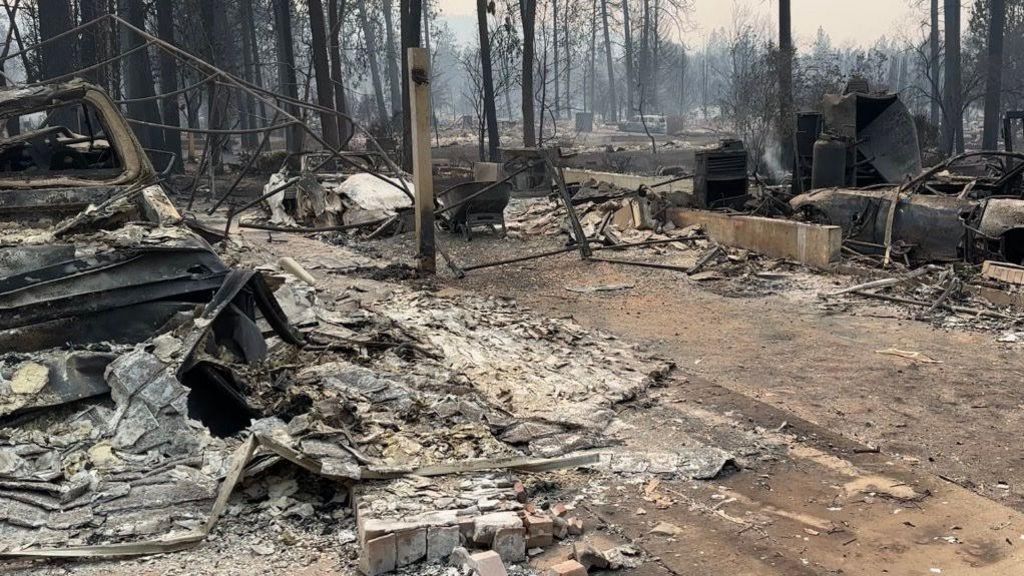
A cluster of fast-moving wildfires sweeping through Spokane, Washington has left a trail of widespread destruction, tearing through hundreds of residential structures, forcing more than 60,000 people to flee their homes and upending the lives of countless local families.
For many residents, the disaster unfolded with little warning, catching them off guard even in a region long accustomed to seasonal wildfire risk. Amy Mulligan, one of the thousands displaced, was going about a routine afternoon in her backyard last weekend, listening to an audiobook and making final preparations for her five-year-old child’s upcoming birthday party when she first detected the faint tang of smoke in the air.
Accustomed to periodic wildfire activity across the Spokane area, Mulligan did not immediately panic. She climbed up to her home’s deck to investigate and spotted plumes of thick black smoke billowing in the distance, but a quick check of her phone’s emergency alert system showed no active warnings. Dismissing the risk, she assumed local fire crews already had the blaze under control.
Minutes later, that calm evaporated completely. Her brother-in-law rushed to her home with urgent news: a nearby neighborhood was under mandatory evacuation. When Mulligan stepped outside again, the fire was no longer a distant threat. The smoke was already rolling over the ridge behind her property, and neighbors were rushing to escape, speeding away in their vehicles while shouting urgent warnings to get out immediately.
“That activity started to really scare me because that was different than in the past,” Mulligan recalled in an interview. She, her husband, and their two children grabbed a small handful of essential belongings, jumped into their car, and fled the area. Stuck in gridlock evacuation traffic, the couple’s nine-year-old daughter succumbed to panic, hyperventilating and crying as she watched the fire advance around them. It took sustained calming breathing exercises in the car to help her manage her terror as the family inched toward safety.
Seventy-year-old James Main and his wife were among the many residents who received no official warning at all before the fire reached their neighborhood. “Normally, things would come on your phone and say, ‘Hey, this area, you know, you’ve got fire, level three fire, or anything. There was zero warning for this whole deal,” Main said. He first spotted the blaze, and within just 30 minutes, realized the situation was catastrophic. As he scrambled to pack for evacuation, he experienced a sudden wave of debilitating anxiety that left him frozen. “I kind of froze up for just a few minutes. I think it was like an anxiety attack,” he said. “I’ve never had one before, but I think I had one then.”
When the couple finally got into their truck to escape, they found their route shrouded in thick, pitch-black smoke that cut visibility to nearly nothing. “We don’t know if we’re heading out of a fire or into a fire because we can’t freaking see,” Main recalled.
As of Tuesday afternoon, three separate wildfires have scorched more than 10,000 acres across the Spokane region, according to the state’s official wildfire tracking system. The largest of the blazes, the Old Trails fire that destroyed both Mulligan’s and Main’s homes, remains active. Authorities have arrested a suspect on suspicion of setting the Old Trails fire intentionally through arson.
Remarkably, as of the latest update, no fatalities have been reported across the three wildfires. But the destruction left in their path is staggering: more than 700 homes and other structures have been reduced to ash and rubble. When Main returned to his property after the fire passed to survey the damage, nothing remained of his home beyond charred foundations, smoldering ash, and blackened tree trunks poking through the debris. When asked what the future holds for him and his wife, he answered simply: “We don’t know.”
For Mulligan, the loss of her home is devastating, but the pain of losing irreplaceable personal mementos cuts far deeper. Her home now is nothing but ash, but the items that brought her to tears are not the structure or its furniture – they are the heirlooms that no insurance payout can ever replace, and no government damage tally ever counts. Among those lost treasures is a family ring passed down to her from her grandmother. The ring had been given to her grandmother by Mulligan’s grandfather on their 49th wedding anniversary, a gesture the grandmother always believed her husband planned because he knew he would not live to see their 50th – a prediction that came true that same year.
“She had always said she thought that he knew, and that’s why he went ahead and got her this ring. And she had given it to me,” Mulligan said, pausing to hold back tears. “And it’s gone.”
In the coming weeks and months, thousands of displaced Spokane residents like Mulligan and Main will grapple with the overwhelming work of rebuilding their lives from scratch, after a single day of raging wildfires turned their sense of security and familiar lives upside down.