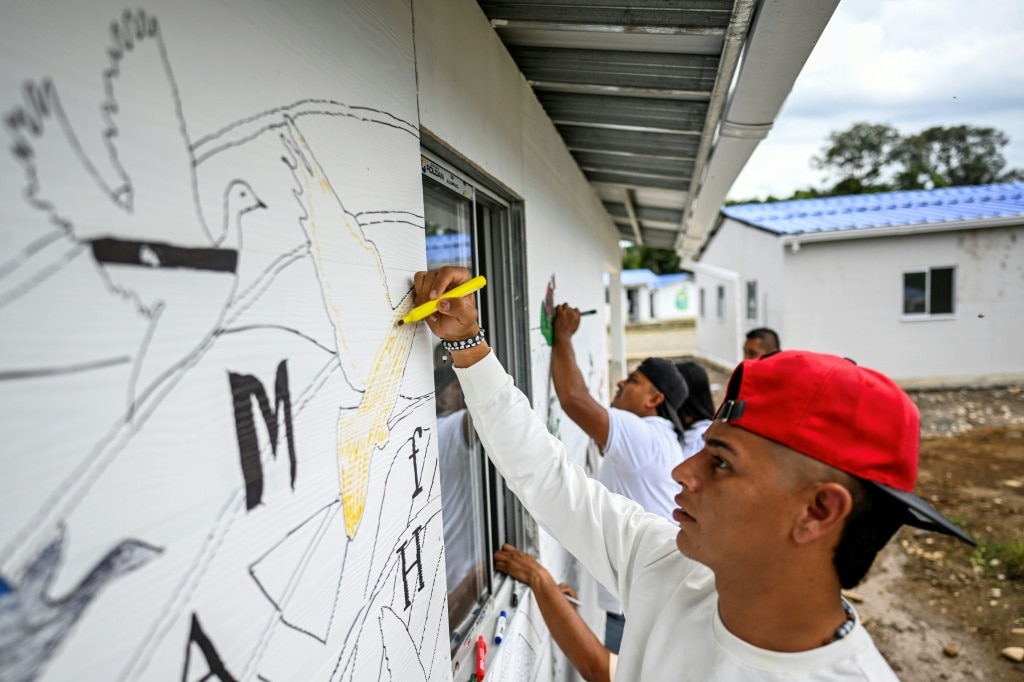
After more than 60 years of brutal armed conflict that tore apart communities across Colombia, dozens of former rebels who recently laid down their weapons to embrace civilian life now stand on edge, their hard-won transition at risk of unraveling as a hardline right-wing administration prepares to take power.
Derlis Aizama, 24, and Daniel Paredes, a former guerrilla couple who met while fighting together with the National Coordinating Committee of the Bolivarian Army, traded their arms for a quiet domestic life just two months ago. They are among 99 ex-combatants from the group — which controls strategic cocaine-producing territories along Colombia’s border with Ecuador — who finalized a disarmament agreement with outgoing leftist President Gustavo Petro, marking the most significant success of Petro’s signature “total peace” initiative. That initiative aimed to end decades of violence by negotiating with fragmented remaining armed groups, building on the landmark 2016 peace deal that disbanded the once-formidable FARC rebel army.
But when US-backed president-elect Abelardo de la Espriella is inaugurated this Friday, that hard-won agreement will hang in the balance. De la Espriella campaigned on a hardline security platform, tapping into widespread public anxiety over a recent surge in violence that has reached its highest level in a decade. He has explicitly pledged to abandon Petro’s negotiation strategy, promising instead to launch an all-out military offensive against remaining armed groups. He has also announced plans to dismantle the special transitional court established by the 2016 peace deal, which was created to try the conflict’s worst atrocities, and eliminate the government peace office that oversees negotiations with armed groups.
For the ex-combatants waiting in a special reintegration zone in Colombia’s southern Putumayo region, the incoming administration’s policies have created a climate of deep fear and uncertainty. De la Espriella has given all active combatants until inauguration day to surrender, warning those who do not will face only “death or prison.”
“We are here because we want to rebuild our lives, to create a home,” Aizama told AFP in an interview from the reintegration zone, adding that she already feels unsafe amid the looming policy shift.
Darwin, a 32-year-old ex-guerrilla who declined to share his surname for security reasons, said he joined the group decades ago because a lack of economic opportunity in his coca-growing region left him with few other options. Since laying down his weapon, he has thrown himself into reading — counting the classic fairy tale *Cinderella* among his favorite works — and has no interest in returning to armed conflict. Still, he admitted, “It makes us a little nervous.”
Mauricio Zambrano, another ex-combatant in the zone, has built a makeshift gym using cement blocks and metal pipes as weights to help fellow former fighters distract themselves from the uncertainty. He noted that de la Espriella made “very drastic comments” after his election victory, though the incoming president has not issued any specific statements about the 99 disarmed ex-combatants in Putumayo.
Many ex-fighters in the zone are continuing their education, working to finish high school while trapped in a legal limbo, waiting for clarity on their future. Armando Novoa, the government negotiator who brokered the June disarmament deal, has tried to reassure the group that existing legal protections will shield their agreement. Under international humanitarian law, Novoa argued, the disarmed ex-combatants — who are now defenseless and no longer engaged in combat — are entitled to legal protection. “It would be true institutional suicide to ignore this reality and throw 99 people back into the arms of violence and weapons,” he told AFP.
Critics of Petro’s peace strategy argue that armed groups have used negotiation periods to consolidate power and expand their territorial control, a criticism that helped fuel public support for de la Espriella’s hardline platform. For the 99 ex-combatants who have already given up their weapons, however, the incoming policy shift leaves their dream of a peaceful civilian life hanging in the balance.