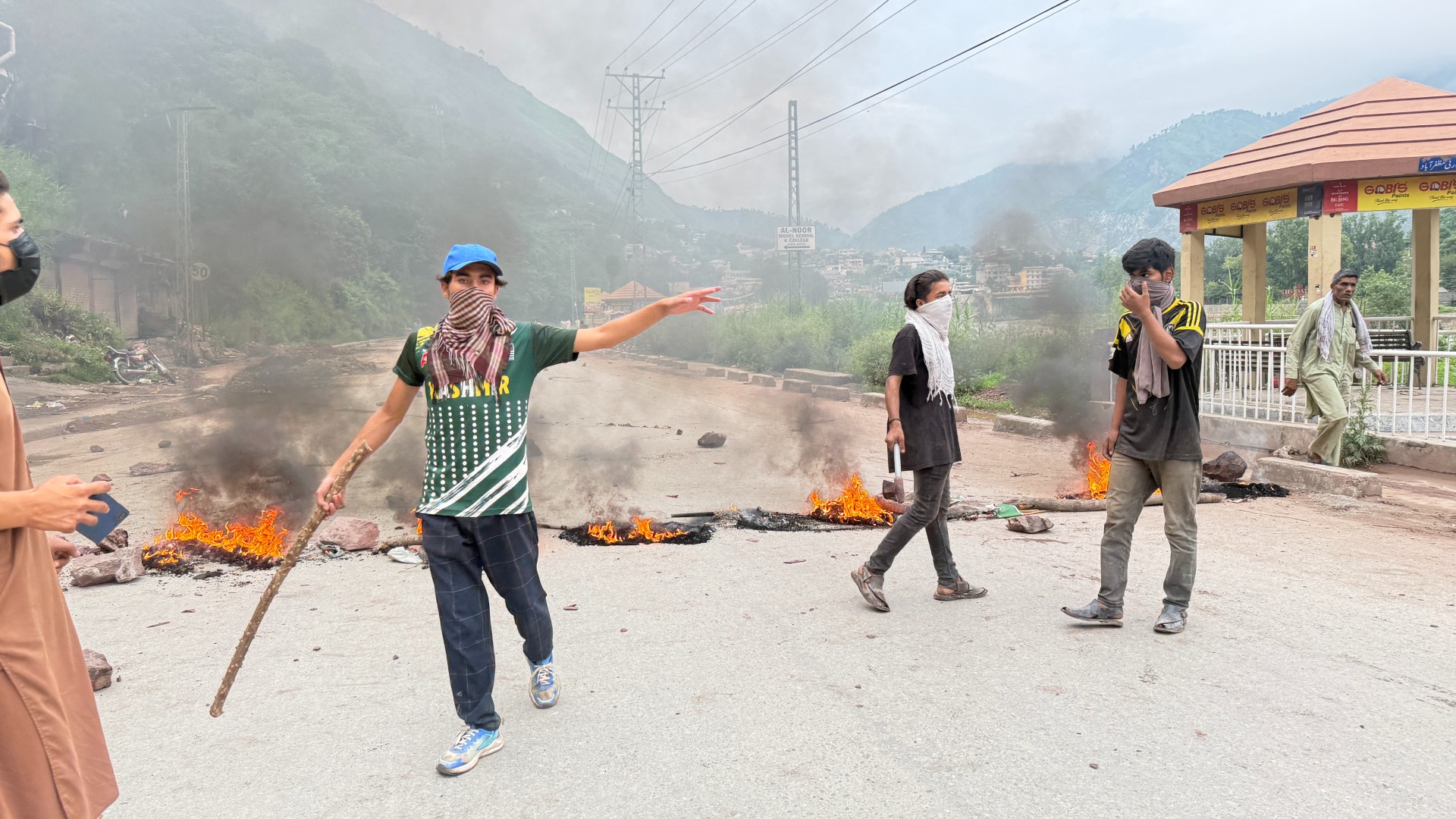
For decades, global discourse surrounding the disputed Himalayan region of Kashmir has centered almost entirely on the Indian-administered side of the Line of Control (LoC), the heavily militarized de facto border that divides the territory between India and Pakistan. International coverage has fixated on insurgency, state repression, large-scale military deployments, and high-stakes diplomatic clashes between the two nuclear-armed neighbors. Far less scrutiny has been directed at the political shifts unfolding across the LoC in Pakistan-administered Kashmir, officially designated Azad Jammu and Kashmir (AJK).
Long framed by Islamabad as a model of autonomous self-governance in contrast to Indian-administered Kashmir, AJK is now experiencing one of the largest waves of popular unrest the region has seen in decades. What began as scattered frustration over skyrocketing household electricity costs and soaring flour prices quickly grew into a systemic challenge to Pakistani federal authority over the territory. Departing from the long-dominant narrative of cross-border geopolitical rivalry with India, this new uprising is rooted in deep, long-simmering discontent with local and federal governance structures that have marginalized AJK residents.
Leading the protest movement is the Joint Awami Action Committee (JAAC), a broad grassroots coalition formed in 2023 that operates outside the established party system. The alliance brings together traders, legal professionals, students, civil society organizers, and independent local political figures, who reject mainstream Pakistani political parties as either ineffective or overly subservient to federal interests in Islamabad. The JAAC centered its initial platform on bread-and-butter issues that resonate across AJK’s diverse communities: exorbitant energy costs, inflated staple food prices, punitive taxation, and chronically underfunded public services.
That platform struck a chord with a population grappling with severe systemic economic hardship. Data collected by researchers puts youth unemployment in AJK at roughly 27 percent, nearly three times Pakistan’s national average. Fewer than 8 percent of women in the region participate in the formal workforce, according to Danish Khan, co-director of the Inequality, Poverty, Power and Social Justice Initiative at Franklin & Marshall College, who outlined the crisis in a recent analysis for *The Friday Times*. Khan warned that the region has produced a growing “reserve army of young unemployed people” with little economic prospect to sustain themselves.
Development across AJK’s mountainous terrain has long lagged far behind the rest of Pakistan. Poorly maintained, inadequate roads severely limit access to critical public services including healthcare and education, a problem that becomes life-threatening during the region’s long, harsh winters. Many communities still carry the physical and economic scars of the 2005 Kashmir earthquake that killed more than 70,000 people across the region, with full reconstruction never completed.
As the movement grew, initial demonstrations over affordable living expanded into mass public gatherings across major towns, shutting down commercial centers and forcing government representatives to enter negotiations. By early 2024 and 2025, the federal government conceded to key immediate demands, agreeing to lower electricity rates for AJK residents and extend wheat subsidies that set prices below the national average. But movement organizers and local activists dismiss these concessions as temporary, superficial fixes that do not address the root causes of hardship.
“ The price reductions addressed immediate grievances, but they did not address the deeper structures of economic exclusion,” explained Faisal Mir, a political economy researcher based in the region. What began as a campaign against inflation has since evolved into a broader rebuke of AJK’s entire governing system, linking daily economic struggle directly to political arrangements that concentrate power in Islamabad rather than in the region.
A new generation of AJK residents, tired of outdated rhetoric about competing Indian and Pakistani nationalist claims, is now demanding accountability, transparent governance, and genuine political representation. Rather than debating the long-term international status of Kashmir, they are asking basic questions: who governs them today, and whose interests do their leaders actually serve?
“No one knows when the Kashmir dispute will finally be resolved,” Mujtaba Naqvi, a JAAC supporter in the regional capital of Muzaffarabad, told Middle East Eye. “What we need to know is who will provide us with jobs and a fair life today.”
These demands have zeroed in on one of the most controversial provisions of AJK’s constitutional framework: the 12 legislative seats reserved for Kashmiri refugees who reside outside the territory. With a total population of roughly 5 million, AJK is formally structured as a semi-autonomous region with its own president, prime minister, regional parliament, and supreme court. All candidates for office are required to swear an oath of allegiance to Pakistan to stand for election.
The current controversy centers on the composition of the regional legislative assembly. Of the body’s 53 total seats, 33 are elected by residents living within AJK’s borders. The remaining 12 seats are reserved for Kashmiris who migrated from Indian-administered Kashmir to Pakistan during and after the 1947 and 1965 Indo-Pakistani wars. Even though these voters reside permanently in Pakistan’s four mainland provinces rather than in AJK, they retain the right to elect their own representatives to the regional assembly.
Supporters of the arrangement argue that the 12 reserved seats protect the political rights of displaced Kashmiri families and sustain Pakistan’s diplomatic position that the entire former princely state of Jammu and Kashmir remains an internationally disputed territory. Removing refugee representation, they contend, would weaken Pakistan’s hand in its decades-long standoff with India — a conflict that has sparked four full-scale wars since the 1947 partition of British India, and a brief four-day military confrontation as recently as 2025.
In early June, AJK’s supreme court ruled that the 12 reserved refugee seats are constitutionally protected, upholding the existing arrangement. But the JAAC and local critics frame the system as a mechanism for covert federal interference in regional politics. Mainstream Pakistani federal parties regularly use the 12 reserved seats to tip the balance of power and form majority governments in Muzaffarabad, a dynamic that has fueled persistent political instability: the current assembly has already seen four different prime ministers take office in rapid succession.
“These 12 seats continuously dictate government formation,” political activist Raja Nafees, who backs the JAAC’s reform demands, told Middle East Eye. “Voters who don’t even live here end up deciding who rules us.”
For decades, mainstream AJK political parties, which operated largely as extensions of the Pakistani federal government, controlled regional politics without meaningful opposition. Today, that long-standing status quo has collapsed entirely.
Alarmed by widespread unrest and informal boycott calls led by the JAAC over the reserved seats, federal and regional authorities scheduled 2026 AJK regional elections across three staggered phases held between July 27 and August 10. The strategic move backfired dramatically: voter turnout plummeted in the first two phases, leading independent analysts to question the election’s legitimacy and warn that any resulting assembly will lack a credible popular mandate. Political infighting between major Pakistani parties has further eroded public trust, with the Pakistan People’s Party, led by President Asif Ali Zardari, accusing ruling party Pakistan Muslim League-Nawaz (PML-N) and Prime Minister Shehbaz Sharif of widespread vote rigging.
At the same time, the long-standing nationalist slogan “Kashmir Banega Khudmukhtar” — meaning “Kashmir will be sovereign” — promoted by groups such as the Jammu Kashmir Liberation Front (JKLF), has gained unprecedented public support during the protests. This reflects a growing political narrative that rejects the traditional binary of alignment with either India or Pakistan, calling instead for full self-determination for the region’s people.
Since protests first escalated in 2024, authorities in Islamabad and Muzaffarabad have responded to the uprising with a combination of policy concessions and coercive crackdowns. While early negotiations produced agreements on electricity and wheat subsidies, the government shifted to a far harsher approach once demonstrations expanded to demand structural political reform.
When the JAAC announced a mass protest march from Rawalakot to Muzaffarabad scheduled for June 9, Pakistani authorities labeled the group a threat to public order. On June 5, the JAAC was officially banned under Pakistan’s anti-terrorism legislation, and dozens of key leaders, including JAAC head Shaukat Mir, were taken into custody. After a second round of negotiations collapsed on July 26, the JAAC called for a renewed protest march. The group accuses state security forces of using lethal force to block demonstrators from assembling.
Independent estimates confirm that more than 45 people — the majority of them protesters, alongside law enforcement personnel and civilian bystanders — have been killed in clashes since the June 5 ban. Official government information on casualties remains extremely limited, as widespread internet blackouts and strict region-wide curfews have prevented independent journalists and human rights observers from verifying the full scale of violence.
Government officials maintain that all constitutional disputes should be resolved through established legal channels rather than public protest. In a July 31 press briefing, military spokesperson Lieutenant General Ahmed Sharif Chaudhry stated that the region has historically received substantial federal attention, care, and resource allocation. He said authorities had “wholeheartedly” urged the JAAC to participate in elections and pursue reform through the courts and parliament.
“But they want to pursue this by force, but only the state has the monopoly of violence,” Chaudhry added. Other federal ministers have gone even further, dismissing the JAAC as an “armed mob” and making unsubstantiated claims that the group has secret ties to India and Taliban militants. JAAC leaders have firmly denied these allegations, emphasizing that their campaign is strictly peaceful and centered on defending basic democratic rights for AJK residents.
As the political standoff drags on, ordinary local residents are bearing the worst of its consequences. Persistent internet blackouts have crippled local commerce and the region’s critical summer tourism sector. In Rawalakot, the JAAC’s main stronghold, where organizers called for the mass march, heavy curfews and road blockades have brought the usually busy peak summer travel season to a complete standstill. Local traders face growing risk of financial ruin, while ordinary residents endure prolonged communication blackouts and disrupted access to basic services, leaving the entire region mired in deep uncertainty about its future.
The current constitutional and political upheaval in AJK has unfolded against the backdrop of India’s 2019 revocation of Article 370, the constitutional provision that granted limited autonomy and special status to Indian-administered Kashmir. New Delhi’s decision to place Indian-administered Kashmir under direct federal control fundamentally reshaped the political landscape on both sides of the LoC.
The move drew widespread condemnation from Pakistan and sparked large solidarity demonstrations in AJK. When protesters organized by groups including the JKLF attempted to march toward the LoC in solidarity with Indian-administered Kashmir, Pakistani security forces forcibly dispersed and blocked the march. Analysts note that many of the key organizers of those 2019 demonstrations are now leading figures within the JAAC. Many AJK residents viewed Islamabad’s diplomatic response to the 2019 revocation as weak and inadequate, leading growing numbers to question Pakistan’s commitment to protecting AJK’s distinct regional identity.
A further source of public anxiety is the impact of Kashmir’s unresolved international status on major infrastructure investment, particularly for projects under the China-Pakistan Economic Corridor (CPEC). This vacuum has fueled widespread public speculation that Islamabad may eventually move to redefine AJK’s legal status, potentially merging it with neighboring mainland Pakistani provinces or converting it into a formal province of Pakistan. While the Pakistani government has never publicly stated any such plans, pervasive anxiety about a potential takeover has reshaped public discourse, deepened distrust of federal institutions, and strengthened popular demands for greater regional autonomy.