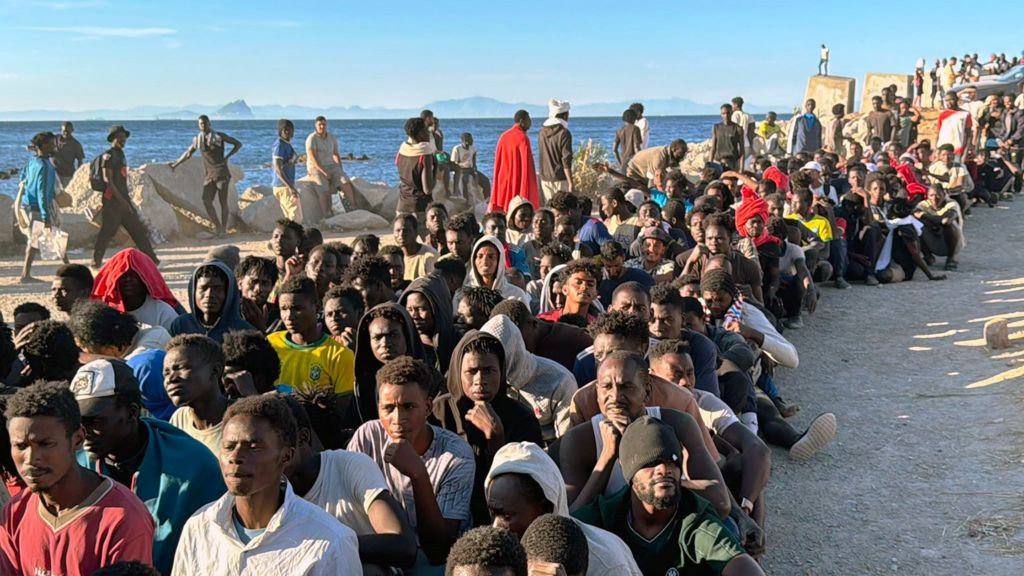
In the wake of an unprecedented mass migration event that saw more than 70,000 people cross into Spain’s North African exclave of Ceuta in just 48 hours late last month, European Union interior ministers have formally commended Madrid for its rapid handling of the crisis, despite sharp divisions among member states that have tested the bloc’s border and migration policy frameworks.
Spanish Interior Minister Fernando Grande-Marlaska confirmed that between July 30 and 31, approximately 72,000 migrants entered Ceuta from neighboring Morocco. In the days following the influx, Spanish authorities have moved to repatriate roughly 70,000 people back to Morocco, though the event has already left a devastating human toll: at least 75 people have been confirmed dead on the Spanish side of the border, with 11 additional fatalities recorded in Moroccan territory.
The emergency meeting of EU interior ministers, held Tuesday, was convened after several member states publicly raised concerns over Spain’s management of the crisis, with far-right Italian leadership leading the criticism. Italian Prime Minister Giorgia Meloni framed the unplanned mass crossing as a direct security threat to the entire European continent, prompting Rome to suspend its Schengen Area free movement agreement with Spain late last week. Since Italy and Spain share no land border, the restriction only applies to air travel, requiring enhanced security checks for passengers traveling between the two nations.
The divided stances among EU members deepened as Finland and Denmark publicly backed Italy’s action, while Czech Prime Minister Andrej Babiš went further, calling for a temporary suspension of Spain’s full Schengen membership. In total, 23 EU nations signed a joint letter expressing formal concern over the situation in Ceuta.
Spanish Prime Minister Pedro Sánchez pushed back against the criticism, noting that Ceuta is not formally part of the Schengen border-free zone, and accused critical governments of attacking Spain for political gain, driven by “prejudice, fake news, ignorance, or political interest.” He acknowledged that most member states had offered support and solidarity, but condemned the actions of those that had not.
Following Tuesday’s closed-door meeting, Irish Justice Minister Jim O’Callaghan, who chaired the discussions, reaffirmed that the bloc remains united in solidarity with Spain, emphasizing that cross-border migration can only be addressed through coordinated, collective European action. Grande-Marlaska struck a conciliatory tone after the meeting, stating that the integrity of the Schengen Area remained intact and that he hoped Italy would reverse its additional border checks at the earliest opportunity.
EU Commissioner Magnus Brunner characterized the Ceuta crisis as a critical stress test for European border security and collective resilience, a challenge he said the bloc had ultimately passed successfully. Brunner confirmed that the EU has offered Spain emergency funding to bolster border infrastructure and support ongoing crisis management operations. He added that investigations into the root causes of the sudden mass influx point to coordination by criminal smuggling networks and the spread of misleading disinformation across social media platforms that encouraged migrants to attempt the crossing.
The mass crossing followed a recent ruling by Spain’s Supreme Court that barred authorities from summarily returning migrants intercepted at sea while attempting to reach Ceuta or Melilla, Spain’s second North African exclave, to Morocco. Moroccan officials claim they warned Spanish leaders that the ruling would trigger a major migration crisis, but Madrid has rejected this assertion, saying it received no intelligence warning of the unprecedented scale of the crossing.
As of this week, hundreds of migrants remain in Ceuta, with photos and on-the-ground reports showing large groups gathering on city beaches to wait for food, water and emergency aid distributed by the Red Cross. Some migrants have carried handwritten banners calling for asylum, while many have been forced to sleep on public beaches and city streets due to overcrowding in local reception facilities.
Public concern has grown over the conditions for vulnerable migrants remaining in Ceuta, particularly unaccompanied minor migrants, with local reports indicating roughly 800 children are being held in temporary facilities across the city. Grande-Marlaska moved to address these concerns, confirming that the Spanish government is committed to upholding the human rights of all migrants, including minors, and has earmarked 25 million euros (approximately $28.8 million) specifically to support care for underage migrants in Ceuta.
Grande-Marlaska added that Spanish authorities are continuing close, firm cooperation with Moroccan officials to prevent further unauthorized border crossings, and that all remaining migrants in Ceuta will be processed and returned to Morocco as quickly as possible.