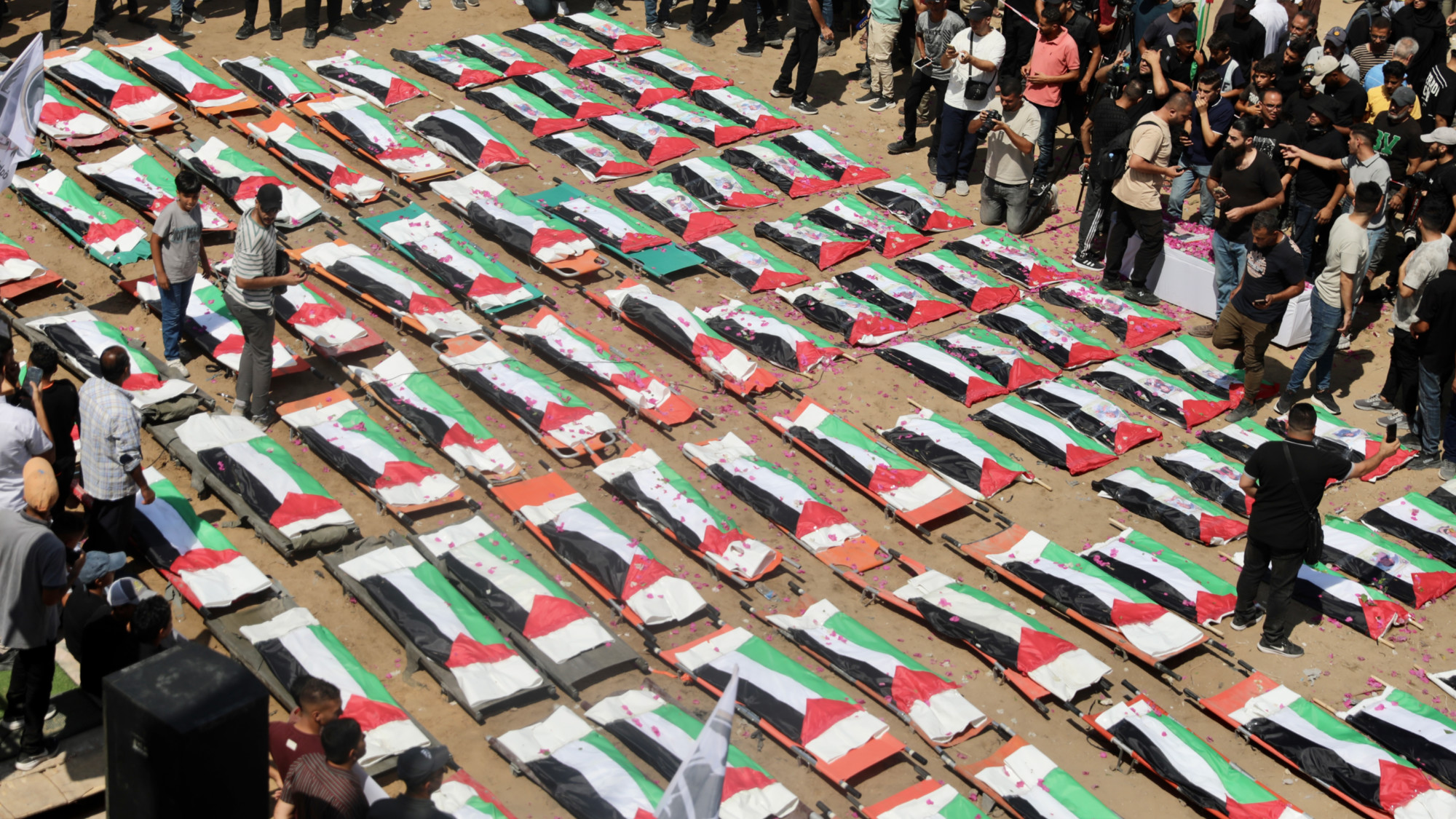
On a somber Tuesday in Gaza City, hundreds of mourning relatives gathered to lay to rest 112 members of two interconnected Palestinian clans, the Abu Shari’a and al-Hasayna families, who were killed in a devastating 2023 Israeli airstrike. Their remains, which lay trapped under collapsed concrete for nearly three years, were only recovered by civil defence teams last month, bringing an end to a years-long wait for closure that came paired with a devastating reawakening of grief.
The airstrike that killed these family members targeted Gaza’s densely populated Sabra neighborhood in November 2023, and stands as one of the deadliest single attacks in the ongoing Israeli military campaign in Gaza. Israeli warplanes completely leveled an entire residential block where hundreds of clan members had gathered to shelter, killing more than 300 people in total – among them 44 children, 37 women, and more than 10 people living with disabilities. For months after the attack, most of the victims’ remains remained trapped under the rubble of the destroyed buildings, as Israeli restrictions blocked critical heavy rescue equipment from entering the besieged territory, halting all recovery efforts.
It was not until July 14 that Palestinian Civil Defence crews were able to resume search operations at the site, working with limited, insufficient tools to extract remains from the rubble. The intense force of the Israeli bombs had scattered human remains across the site, turning the already painstaking work into an even more grueling challenge. After 17 days of nonstop work under extremely harsh conditions, crews recovered the 112 remains laid to rest this week. Even so, dozens more victims from the strike are still believed to be entombed in the debris, and thousands more across Gaza share the same fate.
“We worked for 17 days to recover the bodies in extremely difficult conditions. In the end, we managed to recover the remains of 112 people,” Mahmoud Basal, spokesperson for the Palestinian Civil Defence in the Gaza Strip, told Middle East Eye. “Thousands of people are still buried beneath the rubble, while their families continue to grieve and plead for the means to recover them.”
Among those killed in the strike were prominent community leaders, including Fathi Abu Shari’a, the clan’s respected elder mukhtar. After the first blast hit Abu Shari’a’s home, hundreds of surviving family members fled to the residence of Mofeed al-Hasayneh, a former Palestinian Authority minister of public works and housing who also held United States citizenship. The family believed the home would be spared from attack, with around 200 al-Hasayneh members gathering there for shelter – but the building was also hit by an Israeli bomb, killing everyone inside including al-Hasayneh.
Mahmoud al-Hasayneh, a survivor of the attack who lost multiple extended family members in the strike, shared his family’s decades-long agony of waiting for recovery. Al-Hasayneh was not at the home when it was bombed, but his son was injured, and his brother, sister-in-law, their children, two of his sisters and their entire families, and dozens of other aunts, uncles, and cousins were killed. Many of the victims held dual citizenship from the United States, the United Kingdom, and Romania, he added, noting that Israeli forces did not spare women, children, or any civilian space in the attack.
“Unfortunately, the Israelis respected neither children nor women, nor immunity, nor any house, nor any sanctity,” al-Hasayneh said. “They struck everyone here.”
For relatives scattered across the globe, every step of the slow recovery process reopened deep trauma. “Every time a body was recovered, relatives abroad would call and cry. We opened a new wound,” al-Hasayneh said. “We pray that God will envelop them in His mercy and honour them. This is the greatest honour for the deceased: that they are helped in being buried.”
For the families gathered for the mass funeral, where the remains were laid out in rows, each draped in a Palestinian flag, the moment carried conflicting, bittersweet emotion: relief at finally being able to lay their loved ones to rest, after nearly 1000 days of waiting, paired with a crushing return of the grief they felt when the massacre first occurred.
“There is a feeling of both pain and joy,” said Amer Abu Shari’a, who lost multiple family members in the attack. “Joy because we will bury and honour these martyrs after three years. But the sorrow has returned, as if the massacre happened today.”
The mass burial of the 112 clan members shines a light on the broader crisis of missing people across the Gaza Strip. Omar Nofal, head of Gaza’s government committee for missing persons, told reporters that around 6,000 people have been officially registered as missing since the war began, but the actual number is likely closer to 15,000 – all still trapped under rubble from thousands of destroyed buildings across the territory. According to the Palestinian Ministry of Health, Israeli forces have killed more than 73,000 Palestinians in Gaza since October 2023, and wounded more than 170,000 others, with thousands more still unaccounted for under collapsed infrastructure.