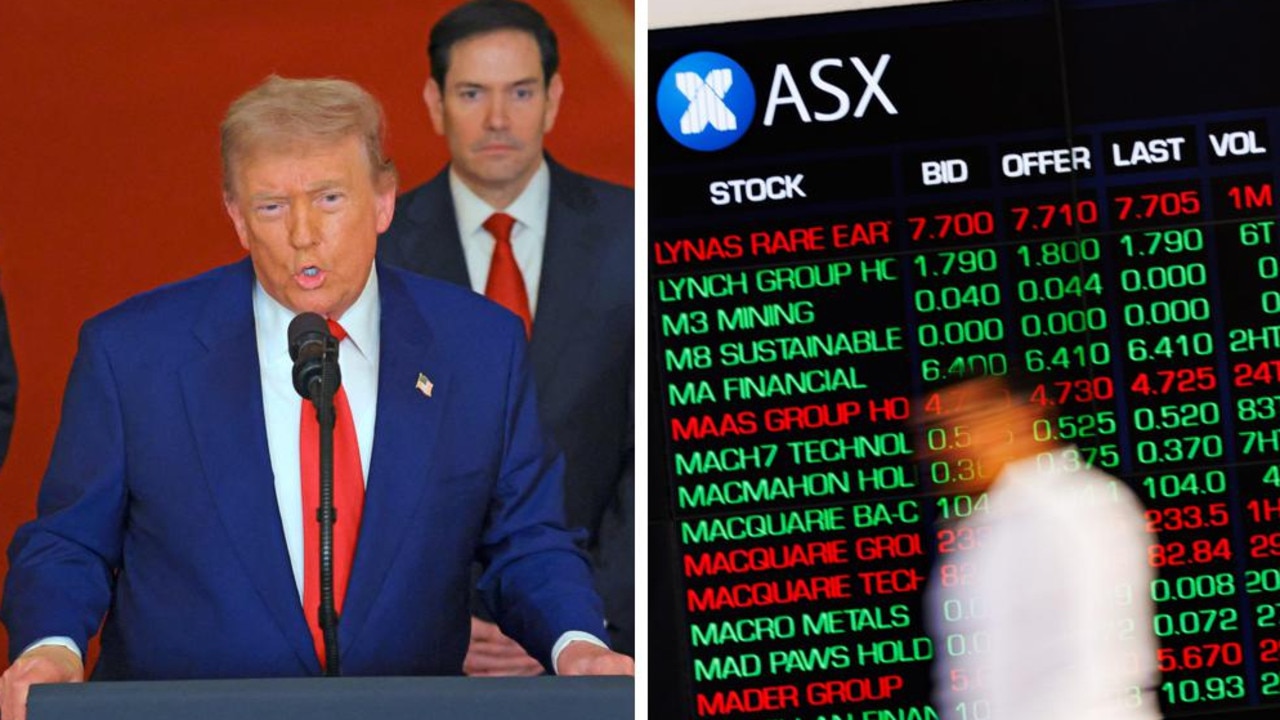
A wave of investor optimism sparked by reports of ongoing US-Iran peace negotiations under former President Donald Trump has delivered a sharp boost to Australia’s benchmark stock index, pushing the ASX 200 to its highest level in five months. The key index climbed 126.50 points, a 1.40% gain, to close at 9145.80 on Tuesday, while the broader All Ordinaries index followed suit with a 1.45% jump of 133.50 points, finishing the trading session at 9311.90. The Australian dollar also strengthened against the US dollar, rising to 70.19 US cents by market close. Nearly all sectors recorded gains on the day, with 10 out of 11 industry groups finishing in positive territory, led by triple-digit growth in technology, healthcare and financial stocks. Tech stocks led the rally: logistics tech firm WiseTech Global rose 3.05% to $37.86, cloud accounting platform Xero gained 3.49% to hit $73.80, and data centre operator Next DC climbed 4.15% to close at $14.04. Healthcare stocks also posted robust gains: vaccine manufacturing giant CSL added 3.64%, medical imaging firm Pro Medicus outperformed many peers with a 4.94% rise to $172.82, and cochlear implant producer Cochlear gained 1.31% to reach $122.32. Australia’s four largest national banks all contributed to the financial sector’s 1.93% overall jump. National Australia Bank (NAB) led the pack with a 3.00% bounce to $42.85, ANZ rose 2.36% to $38.17, Westpac gained 1.70% to $38.82, and the Commonwealth Bank of Australia closed up 1.59% at $180.72. Tuesday’s bullish trading on the Australian exchange followed a positive overnight session on Wall Street, which rallied after Trump announced that negotiations to end escalated conflict with Iran and reopen the strategically critical Strait of Hormuz were underway. Tony Sycamore, senior market analyst for global financial services firm IG, noted that market participants have reacted strongly to signals of de-escalation in the Middle East. “The ASX200 hit the turbochargers today,” he explained, adding that the local exchange benefited not just from a solid Wall Street lead, but also from more stable market positioning after last week’s sharp sell-off in tech stocks, combined with easing geopolitical tension following Trump’s decision to pause planned military strikes on Iran. While de-escalation typically puts downward pressure on oil prices, Brent crude edged up slightly to near $85 a barrel on Tuesday, a small recovery following a sharp price drop the previous trading day. Samara Hammoud, international economics foreign exchange strategist for the Commonwealth Bank, explained that the modest oil gain came even as Trump offered Iran what he described as a “last chance” for diplomacy after calling off what he said would have been the largest military attack on the country since World War II. Hammoud also noted that Iran has denied holding direct negotiations with the US, but confirmed that talks mediated by Oman to reopen the Strait of Hormuz – currently closed to commercial shipping – are making progress. The small uptick in crude prices helped lift the energy sector, with major Australian producer Woodside Energy gaining 1.38% to $32.95 and competitor Santos adding 0.91% to $7.76. Not all stocks recorded gains on the session. Debt collection firm Credit Corp fell 6.98% to $12.79, despite reporting a 12% rise in quarterly profits driven by strong growth in its US debt-buying division. Investors sold off the stock over concerns that its recent rapid price growth was unsustainable. Mining giant BHP recorded a modest 0.33% drop to $60.52, after trade unions confirmed planned 48-hour strike action set for August 8 and 9 over an ongoing pay dispute. Infrastructure firm Atac Arteria also slipped 0.79% to $5.05 after the company announced it was abandoning plans to sell its German motorway assets.