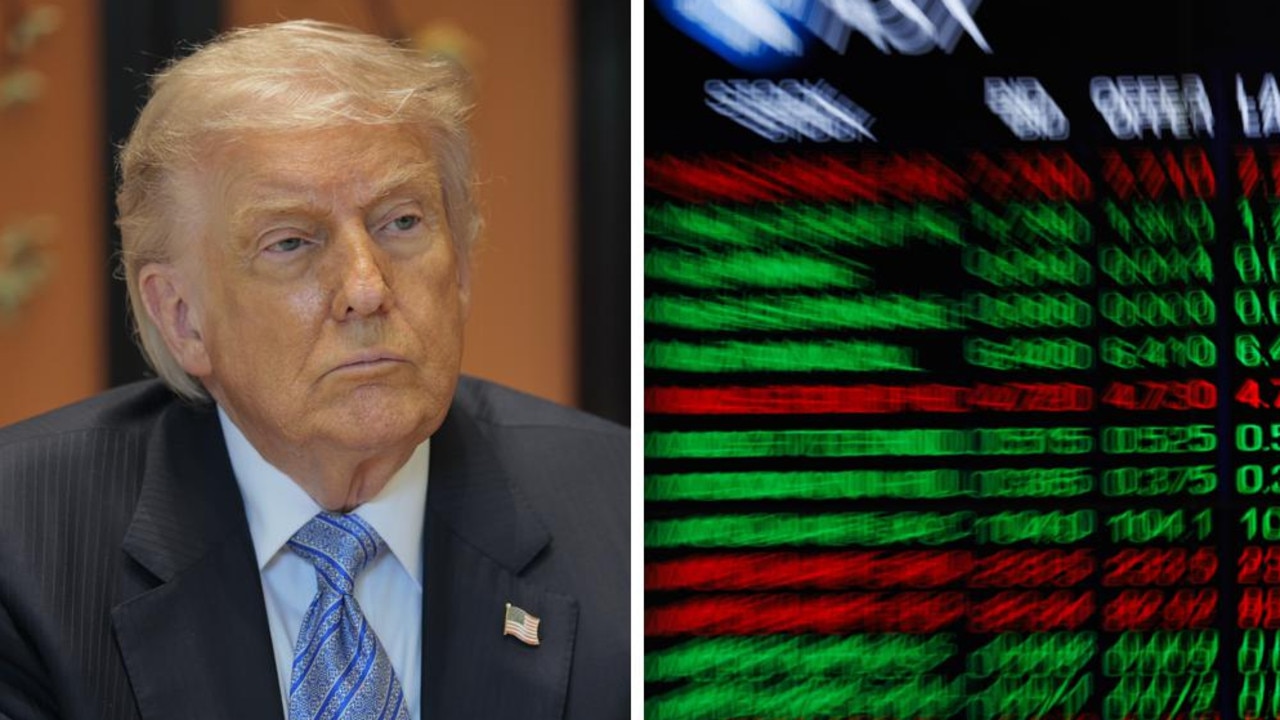
Australia’s benchmark share index bounced back from steep early losses to close in positive territory on Monday, after a sudden policy shift from former U.S. President Donald Trump that pulled back from planned military strikes against Iran and calmed global market jitters over energy inflation.
Heading into the trading day, futures markets had priced in a roughly 1% opening drop for the Australian Securities Exchange, as investors braced for escalating Middle East tensions that threatened to push global oil prices sharply higher. But the market trajectory shifted dramatically mid-morning after Trump announced he had called off what he described as a major planned military strike on Iran, a strike that would have been the largest offensive against the country since World War II. The announcement eased widespread fears that conflict would disrupt global oil supplies and trigger a new spike in global inflation.
By the closing bell, the benchmark ASX 200 had gained 42.50 points, or 0.47%, to settle at 9019.30. The broader All Ordinaries index followed suit, adding 41.40 points, or 0.45%, to reach 9178.40. The Australian dollar edged lower during Monday’s session but held above the key psychological threshold of 70 U.S. cents, closing at 70.34 U.S. cents.
Nine out of the ASX’s 11 industry sectors finished the day in positive territory, led by strong gains in utilities, healthcare, and consumer discretionary stocks. The utilities sector posted the strongest performance of any group: Origin Energy climbed 2.88% to $11.07, AGL Energy rose 1.93% to $8.44, and Genesis Energy surged 5.85% to $2.17. Consumer discretionary stocks also posted solid gains, with retail conglomerate Wesfarmers rising 1.45% to $90.66, electronics retailer JB Hi-Fi adding 0.60 points to close at $82.42, and automotive group Eagers Automotive gaining 1.40% to $23.85.
The only notable drag on overall market gains came from the energy sector, where falling oil prices pushed most major stocks lower. Brent crude futures fell 5.3% to settle at $83.26 a barrel, after dipping as low as $81.55 earlier in the session as tensions de-escalated. Top Australian energy producers reflected the drop: Woodside Energy shares fell 1.37% to $32.50, and Santos slumped 1.91% to $7.89. Refiner and retailer Ampol bucked the trend, posting a marginal 0.08% gain to close at $39.93.
Speaking to reporters aboard Air Force One on Sunday, Trump explained that he had opted to pause planned strikes to open the door for diplomatic negotiations, set to launch on Monday afternoon. “Obviously, they don’t want to be attacked. They knew the extent of the attack because they saw it forming,” he said. “Now what we’re doing is we’re talking to them in the form of a negotiation. It begins tomorrow afternoon.”
Tony Sycamore, senior market analyst for IG, noted that the sudden de-escalation removed a key layer of risk that had spooked investors in prior sessions. He added that Trump also signaled a potential deal governing shipping through the Strait of Hormuz — a critical global oil chokepoint — is within reach, with talks on Iran’s nuclear program to follow after initial negotiations. Still, Sycamore struck a cautious note on the long-term outlook for tensions: “Whether this turns into a rinse and repeat of last week — with hopes of a deal collapsing as Iran digs in its heels and continues to leverage its control over the Strait, potentially through an attack on a US base or a tanker transiting the waterway remains to be seen.”
In individual company news, mining giant Fortescue continued a downward trend from the previous week, sliding another 3.84% to close at $17.80 — a 12-month low for the stock. The drop was driven by falling iron ore prices, with Singapore iron ore futures falling 1.90% to $94.25 a tonne. Elsewhere, Steadfast Group jumped 2.94% to $5.26 after the company issued an update to the market confirming that a KKR-led consortium reaffirmed its planned takeover offer for the business at $6 per share.