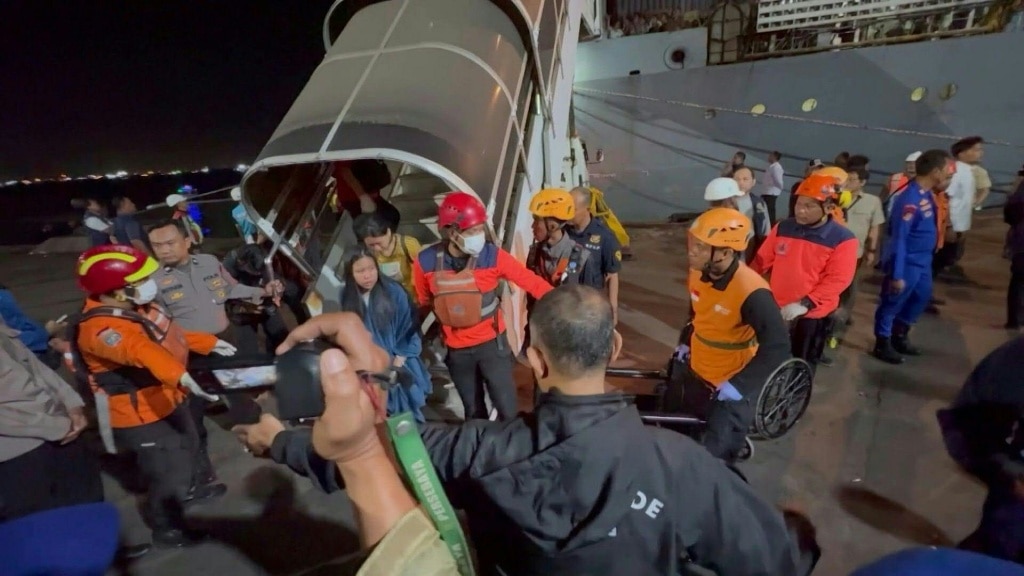
On Sunday morning, a passenger ferry traveling from Surabaya, Indonesia’s second-largest urban center, to Makassar on Sulawesi Island caught fire, resulting in at least five confirmed deaths and a still-unclear number of missing passengers, with survivors recalling multiple loud explosions moments before the blaze broke out. More than a day after the disaster, search and rescue teams continue to comb the waters around the incident site, which lies approximately six hours by sea from the port of Surabaya.
Inconsistent official counts have added confusion to the emergency response effort. According to the head of Indonesia’s national search and rescue agency, Nanang Sigit, the vessel carried 236 passengers and crew when it departed port. As of Monday, he confirmed that 229 people had been rescued alive, five bodies had been recovered, and just two people remained unaccounted for, a figure that officials are still cross-checking with the ferry’s operator. However, these numbers differ sharply from earlier reports: on Sunday, officials cited a total passenger manifest of 271 people, with 41 reported missing. East Java police official Arman Asmara Syarifuddin also gave a conflicting count Monday, stating that roughly 28 people are still missing. The root cause of the major discrepancies in official figures has not been explained to date.
Survivors rescued and brought back to Surabaya have shared harrowing accounts of the disaster. Muhammad Abdul Karim, one of the passengers rescued after seven hours adrift at sea, told reporters that the fire broke out as many passengers were eating their morning breakfast. “Initially, the smoke entered the information room, the sleeping quarters. And then explosions happened,” he explained. The blaze started in the stern section of the ferry, sending panicked passengers rushing toward the bow, where crews distributed life jackets to everyone on board. As the flames spread rapidly toward the front of the vessel, Karim jumped into the sea alongside an elderly passenger, and looked back to see the fire engulf nearly the entire ship. “The waves were big and the ship coming to save us was quite far. Those were our fears when we were about to jump,” Karim said, adding that he did not spot any usable lifeboats on the ferry during the emergency.
Another survivor, 36-year-old Bambang Susilo, recalled that the rising heat of the ferry’s floor convinced him he had no option but to jump more than 10 meters into the open ocean alongside another passenger. “We had no choice but to surrender” to our fate, he told reporters from Bhayangkara Hospital in Surabaya, where he waited to claim the body of a colleague who died in the incident. Bambang and five other passengers swam roughly five kilometers to reach a waiting rescue vessel. Most rescued passengers have been transported back to Surabaya, with search operations continuing around the clock through Sunday night into Monday. A second rescue vessel was deployed on Monday to expand the search for the missing.
This latest ferry disaster highlights the persistent risk of marine accidents across Indonesia, a sprawling archipelago nation made up of more than 17,000 islands that relies heavily on maritime transport to connect its population of 270 million. Industry analysts and safety officials have long warned that lax enforcement of marine safety standards, combined with the nation’s often unpredictable tropical weather, creates frequent hazards for passenger ferries. Just one month prior to this incident, another ferry carrying more than 70 people sank near Selayar, a small tropical island south of Sulawesi. That disaster left at least four people dead, with 14 others remaining missing when search operations were called off.