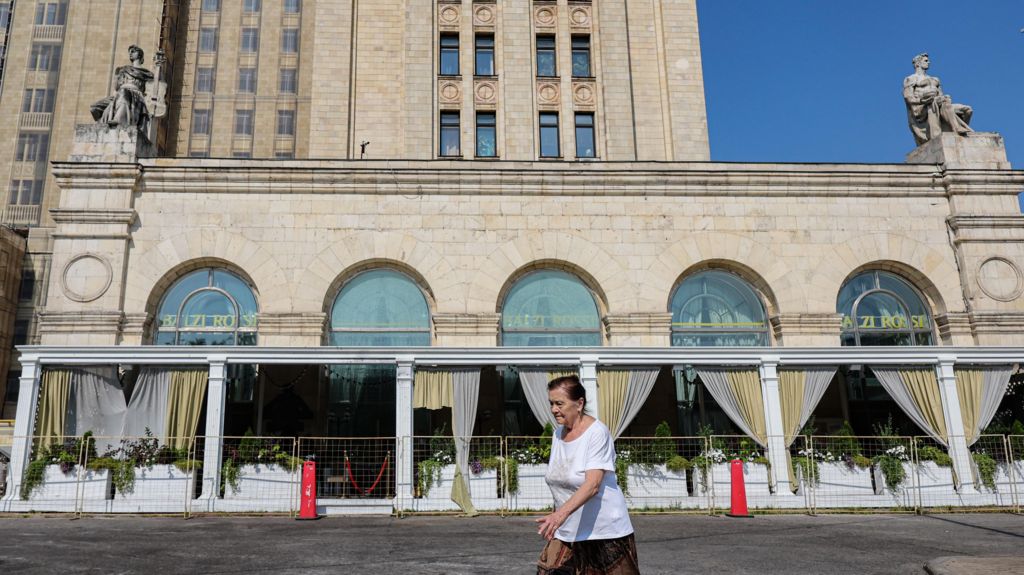
On a quiet weekday in central Moscow, the heavy security presence that transformed Kudrinskaya Square just days prior has faded. The police cordon surrounding the upscale Balzi Rossi Italian restaurant has been dismantled, and official investigators have wrapped up their initial on-site work and departed the area. But the visible scars of Saturday night’s deadly attack still linger, telling a clear story of the violence that unfolded here.
Standing beside the restaurant’s open-air summer terrace, BBC Russia editor Steve Rosenberg, reporting from the scene, noted shattered glass panes and walls pocked with shrapnel damage — tangible evidence of the bomb that detonated, leaving death and injury in its wake. Official Russian state media has confirmed that at least three people were killed in the blast, and 21 others were injured, with several reported to be in critical condition in local hospitals.
Per Russia’s National Anti-Terrorism Committee, the explosive device was carried by a woman who attempted to gain entry to the restaurant Saturday night. Multiple independent Russian news outlets have added context to the official narrative, suggesting the woman was likely working as a courier, tasked with delivering a package to a guest attending a private function at the venue. These reports indicate she may have been unaware the parcel contained an explosive. When a private security guard stationed at the restaurant blocked her entry, the device detonated moments later.
In the hours following the attack, unconfirmed reports circulated online claiming a high-ranking senior Russian military commander was among the guests at the private dinner. To date, however, no official confirmation of the guest list or attendance has been released by Russian authorities, and the Kremlin has not yet issued any formal comment on the incident.
While the Kremlin has remained silent, Russia’s Embassy in Italy was quick to release a statement on Sunday directly blaming Ukrainian forces for the attack. Without referencing unconfirmed claims of a Russian military target, the embassy framed the attack as an attempt to intimidate Italian citizens working in Russia. “It is clear that when planning a terrorist attack on one of the best Italian restaurants in Moscow, the Kyiv terrorists wanted to scare Italians working in Russia,” the statement read.
Local residents interviewed on Kudrinskaya Square almost uniformly linked the blast to the ongoing war in Ukraine, a conflict that has seen multiple targeted bombings of senior Russian military figures over the past two years, all of which Moscow has previously blamed on Kyiv.
“The explosions, the deaths, they frighten me,” local resident Ludmila told Rosenberg. “It’s probably linked to the war that’s going on.” Another resident, Galina, directed her anger at the United Kingdom for its military and political support for Ukraine, claiming the attack was the work of British intelligence. She went so far as to confront Rosenberg, a British journalist, over his past coverage of Russian President Vladimir Putin, saying “I’ve seen you asking our president nasty questions. It makes me want to come up and punch you.”
For Alexandra, a local resident who was walking her dog just steps from the restaurant when the bomb went off, the trauma of the incident is immediate and overwhelming. “I heard a loud bang. I realised immediately that it was an explosion. I live here in the building. It’s terrible,” she said. Days later, she still struggled to process what she witnessed: “I can’t get over this, I can’t. Because it basically happened right in front of me. It was terrible. I just don’t know how I’m going to get over this.”
Notably, the deadly bombing received almost no coverage on major Russian state-controlled television channels over the weekend following the attack. The Sunday morning flagship news bulletin on Russia-1, one of the country’s largest domestic broadcasters, led with segments on Russian missile strikes against Ukrainian infrastructure, national celebrations for Paratroopers’ Day and Railway Workers’ Day, and updates on political developments involving former U.S. President Donald Trump and Iran. There was no mention at all of the explosion in central Moscow, just a short drive from the Kremlin.
Media analysts say the absence of coverage is consistent with a pattern from Russian authorities, who often limit coverage of domestic attacks to avoid stoking widespread public alarm. For residents who experienced the blast firsthand, however, that effort to downplay the incident cannot undo the fear and trauma the attack has left behind.