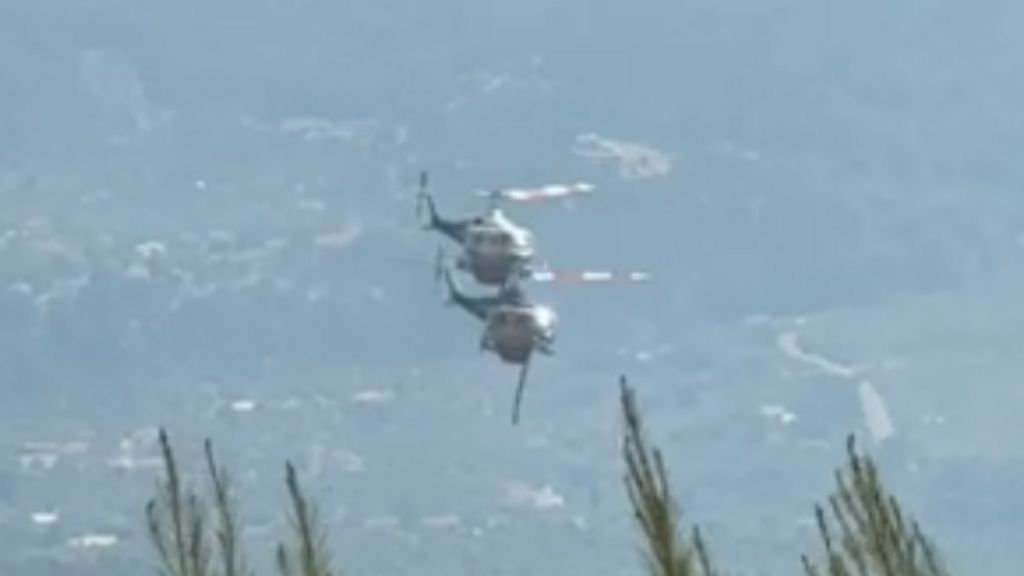
A devastating mid-air collision between two firefighting helicopters has left two people dead in Greece, as the country grapples with a wave of destructive wildfires fueled by record-breaking heatwaves that have swept across much of Southern Europe this summer.
Local authorities confirmed the identities of the victims: a Danish helicopter pilot and a Greek fire service liaison officer assigned to the mission. On board the second helicopter, a British pilot and a second Greek liaison officer walked away from the crash with their lives, though details of their current health conditions have not yet been released to the public.
Footage of the collision, which took place roughly 40 miles west of Athens in the Psatha region near the Attica-Boeotia border, captures one of the leased Bell helicopters striking the rotor blades of the other. The impact immediately ignited an intense blaze on the damaged aircraft, and both helicopters ultimately crashed into a deep ravine below the collision site.
The crash unfolded as hundreds of Greek firefighters have been locked in what local media has called a “titanic battle” to contain multiple large wildfires that have sprung up across the country over the past week. Blazes are burning across a wide swathe of Greek territory, spanning Porto Germeno, Psatha, Fokida, Megara and Kefalonia. Over 500 firefighters have worked around the clock for 72 straight hours to gain control of the spread, forcing mass evacuations of at-risk communities across the affected regions.
Greece is far from the only European nation facing this climate-fueled crisis. Early this same week, large uncontrolled wildfires broke out in both France and Spain, forcing widespread evacuations. The blazes near Madrid, Spain and Bordeaux, France have been partially contained but continue to burn, though approximately 300,000 people who were forced to leave their homes have begun returning to their properties.
Climate scientists and fire officials have repeatedly warned that human-caused climate change is drastically increasing the frequency and severity of extreme wildfire conditions across the Mediterranean. This year, an unusually mild and wet winter across Southern Europe encouraged more abundant vegetation growth across forests and wildlands. As successive record-breaking heatwaves rolled through the region this summer, that extra vegetation dried out completely, creating massive amounts of highly flammable fuel for wildfires to feed on. While most blazes are still ignited by human activity, whether accidental or intentional, the amplified heat and dry conditions driven by climate change make it far easier for small fires to explode into large, uncontrollable infernos.