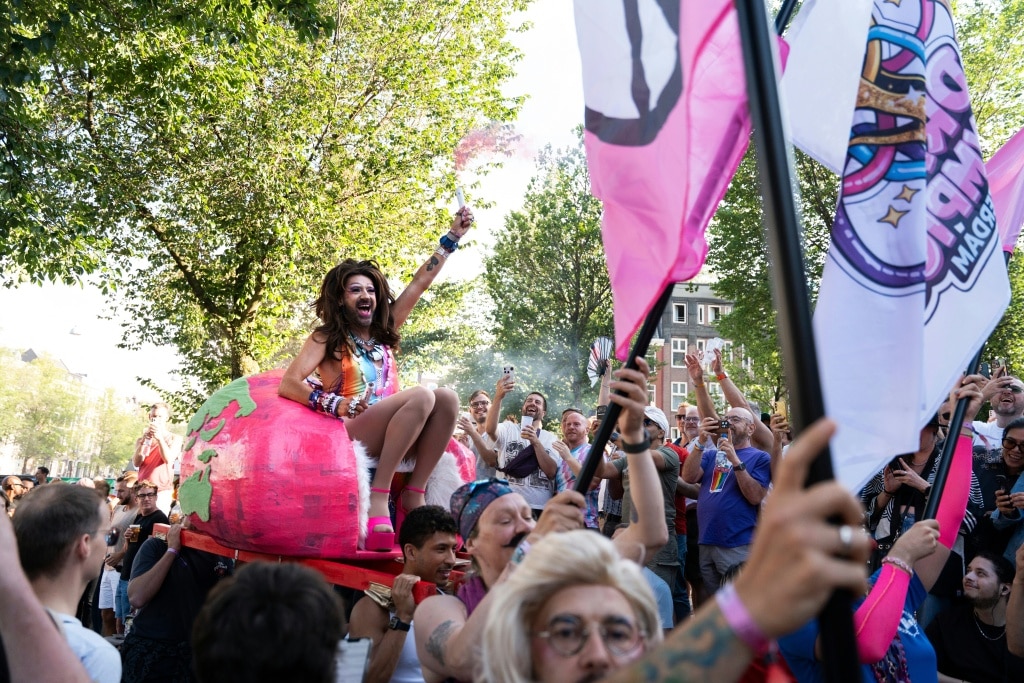
Against a backdrop of roaring cheers and glittering costumes, the 22nd annual Drag Olympics kicked off Friday in Amsterdam, drawing hundreds of participants and spectators to what organizers call the world’s biggest sporting event exclusively for drag queens and drag kings.
Hosted by the House of Hopelezz, Amsterdam’s longest-running drag community, this year’s event brought together amateur and veteran performers alike from across the globe, including competitors from the Netherlands, Ireland, Morocco, Russia, France, Mexico and Iran. Unlike traditional international Olympic games, the competition features five playful, drag-focused events that blend athleticism with campy flair: a high-heeled sprint, handbag toss, tug-of-war, cheekily named “bitch” volleyball, and hula hoop.
For first-time competitor Nippy Le Twist, 35, whose legal name is Rutger van Aken, the event marked a rare public moment to embrace a side of her identity she only shared with close friends during COVID-19 lockdowns. Speaking to Agence France-Presse ahead of her first race, Le Twist said, “The first time that I was here was two years ago, and I was totally mesmerised with the performances in between the competition. It’s a side of myself that I haven’t publicly shown before, only during the COVID times with close friends at home. And I’m excited to see what this evokes in myself.”
Jennifer Hopelezz, founder of the House of Hopelezz and creator of the Drag Olympics, noted that the event has grown dramatically since its early days, shifting from a small private gathering to a major public celebration. “It’s a silly event, it’s a stupid event, but it’s just, yeah, it’s a fun thing to do and every year it got busier and busier, more public, more audience and more competitors,” Hopelezz, whose legal name is Richard Keldoulis, said. Open to anyone willing to don a wig and a pair of heels, the event even offered on-site professional makeup artists to address last-minute cosmetic crises, with organizers gently reminding participants to prioritize wearability over height when choosing their competition heels.
The opening ceremony carried weight beyond celebration, coming just one week after a deadly attack on Berlin’s annual Gay Pride parade. Draped in a high-cut rainbow swimsuit that emphasized her elaborately padded hips, Hopelezz led a procession through the crowd carrying a DIY Olympic torch that emitted bright pink smoke, before calling for a global Olympic truce to stand against anti-queer violence and ongoing conflicts around the world. “People are a bit nervous, and there’s a bit of a shadow over Pride, but we’re kind of determined not to go back in the closet, be visible and celebrate Pride, and not let people take that away from us,” she told the assembled crowd.
Between competitive events, many drag artists wove explicitly political messaging into their performances, turning the stage into a platform for marginalized queer voices. A Lebanese-Palestinian drag queen incorporated commentary on the ongoing war in the Middle East into her set, while drag king Vinny von Vincy took the stage to declare that “Islamophobia does not protect queer people.” For Vincy, whose legal name is Saskia de Wildt and is 42, the event offers a rare safe space to celebrate parts of her identity that are often sidelined or rejected in mainstream spaces. “I feel like I can really express parts of myself and celebrate parts of myself that sometimes I’m marginalised for, or not so appreciated in different spaces,” she said.
This year’s Drag Olympics is just one part of a packed month of Pride celebrations in Amsterdam, which is hosting 2025’s WorldPride festivities. The iconic annual Pride canal parade, set for Saturday, will be attended by openly gay Dutch Prime Minister Rob Jetten, with community events continuing across the city for an additional week after the parade concludes.