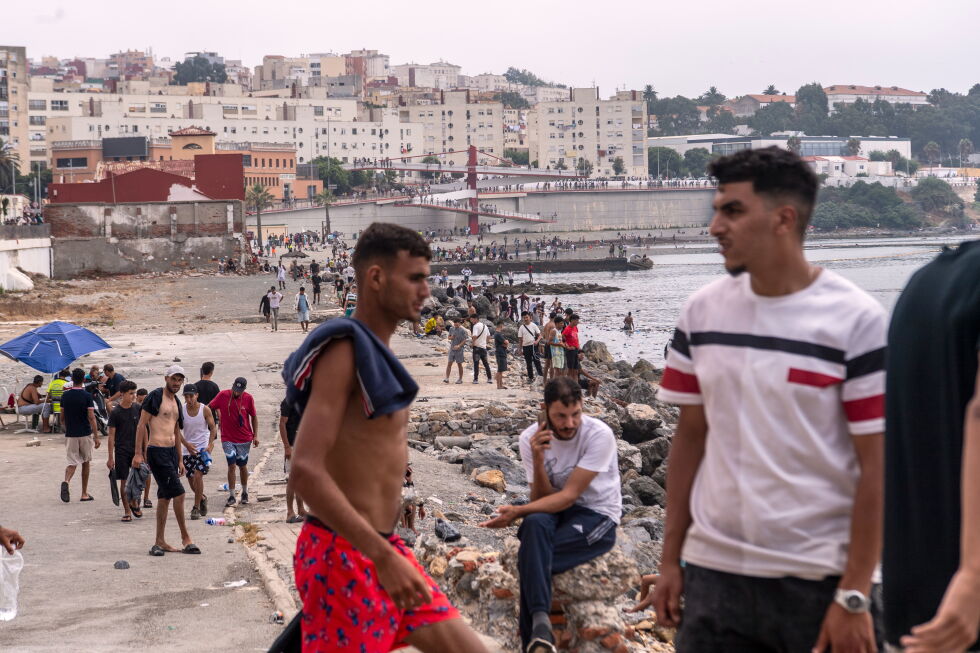
The Spanish North African enclave of Ceuta was recently overwhelmed by an unprecedented surge of migrant crossings, an event that has laid bare the deep economic desperation driving many Moroccans to risk everything for a chance at a new life in the European Union. What unfolded over 24 hours between Thursday and Friday was one of the largest mass border movements the territory has ever seen, with more than 60,000 people crossing into the small territory that is home to just around 85,000 permanent residents.
For many migrants, the journey was rooted in years of unmet hope and limited economic opportunity at home. Twenty-one-year-old aspiring teacher Abdulah Buji was among the first to rush toward the border after word spread that fence lines had been breached. Riding his motorbike from his home in northern Morocco, Buji joined thousands of other people who swam across the water into Ceuta, clinging to the belief that reaching Spanish soil would open the door to a better future than what Morocco could offer. “I am a talented boy. I just want a chance,” Buji told reporters, explaining that after 14 years of education, the only work available in his home country would force him to work 12-hour days for extremely low pay. But his optimism quickly faded once he arrived. Spanish authorities had already moved to seal off any onward travel to mainland Spain, and ordered all new arrivals to return to Morocco or face forced expulsion and detention. Having already lost all his belongings and savings during the crossing, Buji ultimately chose to head back to Morocco, disappointed that the opportunity he sought was nowhere to be found. He is far from alone: more than 50 migrants died while attempting the swim around Ceuta’s border fence during this mass crossing event.
By the end of the first full day after the surge began, roughly 45,000 of the 60,000 arrivals had returned to Moroccan territory. The remaining thousands spent the night sleeping on Ceuta’s streets, surrounded by armed Spanish police and military personnel deployed to restore order, as shocked local residents adjusted to the sudden influx that equaled 70% of the enclave’s entire population. Local officials urgently called for additional security personnel to manage the crisis, and residents expressed growing unease as thousands of mostly young migrant men wandered the streets with no clear destination. This event marks a far larger humanitarian emergency than a similar 2021 incident, when Moroccan authorities temporarily lifted border controls and allowed several thousand migrants to enter Ceuta over two days.
As word of the initial crossings spread across social media, thousands more people across Morocco headed toward the Ceuta border, crowding train stations in major cities including the capital Rabat and Casablanca, Morocco’s largest urban center. Local media footage showed Moroccan police blocking many would-be migrants from boarding trains and buses bound for the northern border region. Researchers note that the mass movement was heavily amplified by social media, where posts encouraging crossings and sharing practical tips for entering Ceuta circulated widely in the days before the surge. “It isn’t clear what triggered the influx, but social media was awash with posts encouraging Moroccans to try to enter Ceuta days before it began,” explained Myriam Cherti, a senior migration researcher at the University of Oxford’s Centre on Migration, Policy and Society. Cherti added that many of the migrants she has interviewed have attempted to cross the border dozens of times, driven not by recklessness but by deep desperation. “They’re doing it out of despair, they’re doing it because they’ve tried other ways to build a life and failed, they’re doing it because they feel the obligation that they want to help their families and support them,” she said. “And that’s possible if they make it to Spain and not necessarily possible if they stay” in Morocco.
Thirty-three-year-old Ahmed Karim, who successfully crossed into Ceuta, echoed that sentiment, noting that widespread unemployment and strict border restrictions leave most Moroccans with no legal path to travel to Europe or North America. “They don’t have the opportunity,” he said.
Not all of those who crossed into Ceuta came to stay; many arrived searching for missing loved ones who had attempted the crossing and had not been heard from. Ikrra Khai, a 33-year-old who regularly holds a temporary work permit to harvest crops on Spanish farms, was in Ceuta searching for the brother of a close friend. “I don’t know if he is dead or alive,” she said. “I have his residency card. But I don’t know where he is. I’m searching.”
The reporting for this story was led by Joseph Wilson from Barcelona, Spain, with additional contributions from Danica Kirka in London and Akram Oubachir in Fnideq, Morocco.