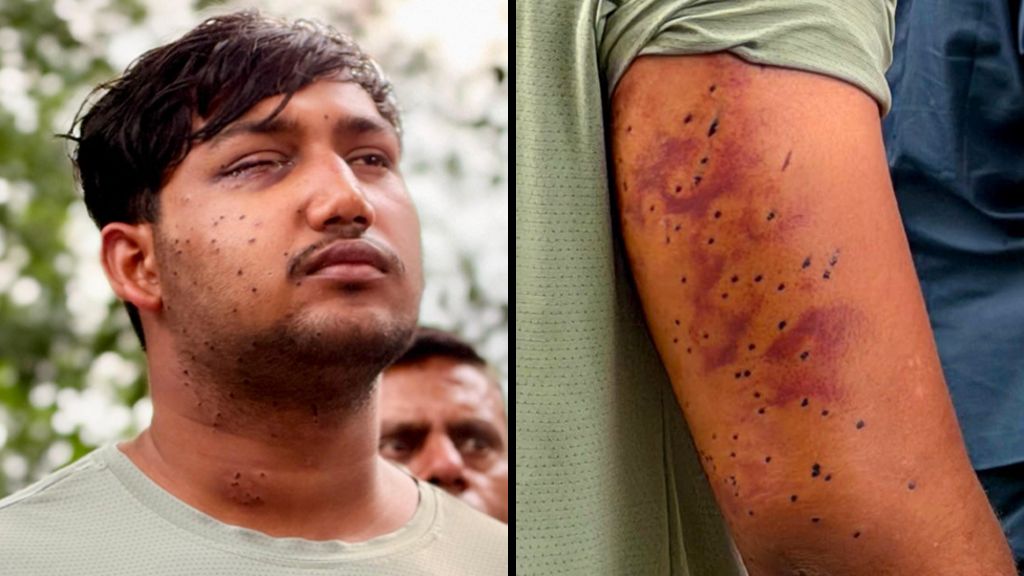
Last week’s mass protest in central Delhi, organized by the Cockroach Janta Party (CJP) to demand education reforms and the resignation of India’s education minister, descended into extreme violence on July 20. What began as a peaceful march toward the Indian parliament has sparked a national controversy after independent ballistic and forensic experts confirmed to the BBC that at least four injured protesters sustained wounds consistent with pellet gun use by security forces — a finding that directly contradicts official denials from Indian law enforcement and government officials.
Tens of thousands of demonstrators gathered for the protest, which was sparked by widespread anger over repeated leaks of high-stakes government recruitment and academic exams. Eyewitness accounts and video footage show police and paramilitary personnel responding to the crowd with baton charges, wooden stick beatings, and tear gas. Official government figures put the number of injured at 60 protesters and 118 security personnel, but CJP leaders say the actual count of injured demonstrators is far higher. In the weeks following the crackdown, senior government officials have repeatedly refused to confirm emerging media reports of pellet gun deployment against crowds.
Pellet guns, more formally 12-gauge pump-action shotguns loaded with “birdshot” cartridges, fire between 200 and 400 small toxic lead pellets that spread in a wide arc when fired, striking bystanders and protesters indiscriminately. Originally designed for bird hunting, the weapons are banned or strictly restricted for crowd control use in dozens of countries due to their potential to cause permanent, life-changing injury. Even at distances of up to 100 feet, experts note, pellet shots can cause devastating harm, with lead pellets often remaining embedded in soft tissue long after the incident.
The BBC collected photographic evidence, medical records, and firsthand testimony from four injured protesters, which was reviewed by two independent armament and forensic specialists. Philip Boyce, a UK-based ballistics forensic scientist, told the outlet the dozens of tiny round puncture wounds visible in photos are a definitive marker of birdshot injuries. “The injuries depicted are definitely from a pellet gun,” Boyce said, identifying the weapon used as a 12-gauge pump-action shotgun. He added that while the Delhi injuries appear to have been fired from a distance of at least 50 yards, they can still be life-threatening and cause long-term health complications from toxic lead exposure.
NR Jenzen-Jones, director of the UK-based Armament Research Services (ARES), confirmed Boyce’s assessment, noting that imagery from the protest shows police deploying shotguns for crowd control, and the injury patterns match those typical of birdshot use. “While shotguns are a common tool in the less-lethal arsenals of many states, Indian law enforcement agencies have a long history of employing shotgun cartridges loaded with small lead pellets… in crowd-control scenarios,” Jenzen-Jones explained. He added that the weapons are not safe for crowd management: “They can result in life-changing or, occasionally, life-threatening injuries. They also pepper the body with toxic lead, which can sometimes be difficult to remove safely.”
Multiple injured protesters have shared their firsthand accounts of the violence with the BBC. A 28-year-old journalist, who requested anonymity for security reasons, said he was walking near Connaught Place — a busy commercial hub adjacent to parliament — when he saw a security officer aim a weapon at him. He turned to run, and seconds later felt a burning pain on his right arm and back. Medical records from Delhi’s Safdarjung Hospital confirm 30 embedded pellets: 26 on his right elbow and four on his upper right back. Doctors have advised against surgery to remove the pellets, warning it could worsen his injury, leaving the journalist worried about long-term health effects and permanent scarring.
Shaikh Irshad Mansoori, a Gurugram-based private sector employee, suffered more severe injuries when a member of the Rapid Action Force (RAF), a paramilitary unit under the Central Reserve Police Force (CRPF), fired on his group of protesters. Scans confirm more than 40 pellets embedded across his body, including three lodged deep in his neck, left eye muscle, and under his nose. Surgeons were only able to safely remove seven pellets, leaving the pellet in his neck in place due to the high risk of surgery. More than 10 days after the incident, Mansoori says he still experiences persistent pain.
The most high-profile injured protester is 19-year-old Delhi University student Sahil Lochab, who appeared alongside opposition leader Rahul Gandhi at a press conference held by the Indian National Congress last Saturday. Lochab, who joined the protest after his police recruitment exam was canceled last year due to a paper leak, now risks permanent blindness in one eye from pellet injuries. Images show dozens of tiny pellet punctures covering one side of his face, his right arm, and his torso. “I couldn’t see who fired the pellet gun but it came from the side where the forces were,” Lochab said. “My right eye was swollen so much that it felt it had popped out of my face… I want justice. Whoever did this to me doesn’t deserve to be in power.”
Senior officials have pushed back against the allegations. Delhi Police initially called all claims of pellet gun use “completely false and misleading,” stating the force does not even possess pellet guns. Recent Indian media reports have attributed the firing to the RAF, which falls under the command of the CRPF. The BBC has reached out to CRPF chief Gyanendra Pratap Singh for comment, but has not received a response. In a parliamentary address Wednesday, Union Minister Jitendra Singh stated no bullets were fired during the protest and only tear gas was used, but he declined to directly address questions about pellet gun deployment. Gandhi has called for the dismissal of Home Minister Amit Shah, who oversees both Delhi Police and the CRPF.
Notably, pellet guns have a long controversial history of use in Indian-administered Kashmir, where security forces have deployed the weapons against protesters since 2010. Data compiled by Human Rights Watch shows pellet gun use there has injured thousands of people, killed at least 17, and left dozens permanently blind. If confirmed, the use of pellet guns on protesters in Delhi marks the first time the weapons have been deployed against citizens in India’s national capital, escalating concerns about excessive force against political demonstrators.