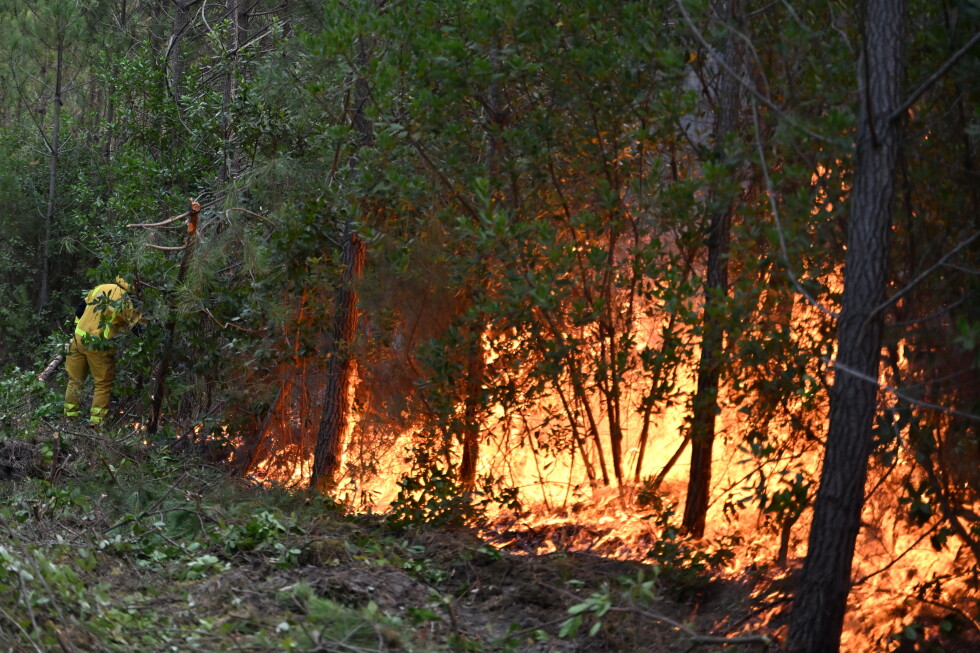
PARIS – For the third time in less than a century, Western Europe’s largest man-made forest is recovering from a devastating wildfire that has laid bare the combined threats of accelerating climate change and centuries-old industrial forestry practices. The massive blaze swept through 40,000 hectares of Les Landes’ pine plantations – an area four times the size of Paris – leaving a trail of ash and charred tree trunks across the 10,000-square-kilometer timber landscape in southwest France. The region has already weathered deadly catastrophic fires: an 82-fatality blaze in 1949, and another large destructive fire in 2022 that displaced 37,000 people and destroyed 320 square kilometers of woodland.
The Les Landes forest was not a natural ecosystem. Its origins trace to an 1857 law enacted under Napoleon III’s Second French Empire, which ordered the drainage of the region’s unproductive marshy heathlands to create an industrial timber and resin production hub. Municipalities were directed to plant dense, uniform rows of maritime pine, displacing local peasant communities and traditional sheep herding practices that had defined the region for generations. Today, the forest remains focused primarily on timber output, carrying enormous economic weight for southwest France: the sector supports 60,000 local jobs and generates more than 10 billion euros ($11.5 billion) in annual revenue. More than 90% of the forest is privately owned, with 75% of that land held by just 20% of owners, while the National Forest Office and local governments manage the remaining public portion.
While maritime pine boasts natural fire resistance via its thick bark and ability to regenerate after small blazes, the monoculture structure of the Les Landes plantations creates a tinderbox waiting to ignite, forestry experts explain. Unlike diverse mixed forests that combine conifers and broadleaf trees, single-species pine stands lack layered vegetation that shades and cools the forest floor. In a healthy mixed forest, less than 3% of solar radiation reaches the ground, keeping soil moist and retaining water-rich humus that prevents fires from taking hold. In Les Landes, the uniform rows of closely spaced pines leave soil exposed, baking it dry and depleting most areas of humus entirely. Fallen pine needles accumulate in thick, flammable layers that can smolder for weeks after a main blaze passes, while heat-ignited resinous pine cones can be carried hundreds of meters by wind to spark new spot fires.
Europe, the world’s fastest-warming continent, has amplified these existing vulnerabilities: rising temperatures and prolonged droughts created the ideal conditions for the 2025 blaze to spread out of control. As fire crews and local residents work for weeks to extinguish stubborn smoldering embers that repeatedly reignite, the disaster has sparked a national reckoning in France over how to adapt forest management to a hotter, drier climate worsened by human-caused greenhouse gas emissions from fossil fuel use.
President Emmanuel Macron has called for replanting the burned areas to create an entirely different type of forest, noting that shifting conditions driven by climate change, plus growing pressure from expanding housing and tourism, require a fundamental break from past practices.
Experts have put forward a slate of potential reforms to reduce wildfire risk. Geographer Arthur Guérin-Turcq, who authored a report on the 2022 Les Landes wildfires, argues that the monoculture structure allows fires to spread unimpeded all the way to populated villages, making it essential to create buffer zones of less fire-prone land around settlements – such as wetlands, active farmland, or low-risk commercial spaces. Many forestry specialists also advocate for introducing broadleaf trees, which retain more soil moisture and reduce flammability, into the plantation landscape. Local fire defense leaders are pushing for larger, well-maintained firebreaks, even if that means sacrificing up to 2,000 hectares of forest to prevent catastrophic total loss. Still, Guérin-Turcq notes that transforming the entire Les Landes landscape faces major barriers, including the region’s poor, thin soils that are not well-suited to many broadleaf species.
Overhauling management of the forest will require complex negotiations between private landowners, the timber industry, and national and local public authorities. Nicolas Lafon, president of the Southwest Foresters’ Association which represents most private landowners, emphasized that forest owners are the primary victims of the disaster, not the cause, and called for national government to commit sufficient funding to support long-term reform. “Forest owners reject any attempt to portray them as being responsible for a disaster of which they are the primary victims,” he said. “They now expect the French government, elected officials, and all public stakeholders to implement a truly ambitious, coherent, and long-term national forest policy.” Lafon added that any transition away from monoculture in high-risk areas will require financial compensation for landowners to offset lost revenue.
The national rethink extends beyond forest structure to wildlife protection: an online petition calling for a temporary ban on hunting in recently burned areas, where surviving animal populations are already severely stressed, has gathered more than 300,000 signatures as of reporting.