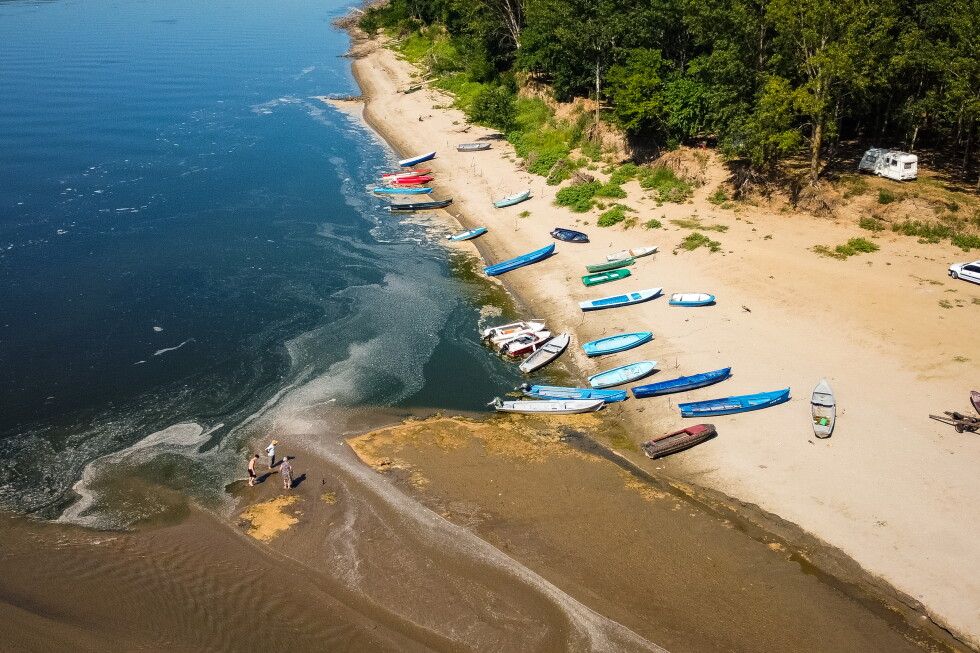
As catastrophic wildfires scorch southern France and Spain and a second blistering heat wave builds across Western Europe, a years-long persistent drought is pushing one of Europe’s most critical waterways to unprecedented lows, laying bare the tangible, immediate impacts of human-caused climate change for communities and industries across the continent. The Danube River, which cuts a 1,770-mile path through 10 European nations from the Black Forest of southwestern Germany to the Black Sea, has dropped to never-recorded depths along most of its route, revealing long-submerged rock formations, sand bars, and century-old shipwrecks that have remained hidden for generations.
In Budapest, the capital of Hungary, the country’s national water authority recorded a water level of just 23 centimeters (9 inches) on Wednesday morning, a full 10 centimeters below the previous all-time low set in 2018. With no meaningful rainfall forecast for the coming days and temperatures projected to surge past 38 degrees Celsius (100 degrees Fahrenheit) across the entire Danube basin, officials warn the river will continue to recede further.
Much of Central Europe has faced persistent, extreme drought for the majority of 2022, and back-to-back record heat waves have accelerated evaporation, draining rivers and streams at an alarming rate. Data from the Hungarian Meteorological Service shows 90-day total precipitation across nearly the entire country is 80 to 130 millimeters (3.1 to 5.1 inches) below the long-term average for the period.
On Tuesday, after the Danube hit its new record low, Budapest-based photographer Gábor Kertész traveled to the base of the city’s iconic Margaret Bridge — a spot that is almost always submerged, now exposed as a dry sand shoal — to capture the unprecedented scene. “The bare rocks, the dry sand bars around the bridge pillars… it’s all shocking to see how things were before and how they are now,” Kertész told reporters. “Where will this lead, what will happen? We don’t know that yet, but this must be the result of climate change.”
The record low water has already upended key economic activities across every nation along the river’s path. Popular international river cruises, a mainstay of Central European tourism that brings millions of visitors to Budapest annually, have been forced to dock kilometers upriver from their customary terminals, forcing passengers to arrange alternate transportation to reach city sightseeing routes. Commercial cargo shipping has nearly ceased entirely across large stretches of the river, according to Hungary’s Ministry of Transport and Investment.
In northwestern Bulgaria, where the Danube forms the natural border with Romania, authorities evacuated 186 passengers from the cruise ship Viking Ullur on Tuesday after the vessel ran aground on an unexpected shallow shoal near the port city of Vidin. The ship had been scheduled to restock food and water supplies in Vidin, but could not reach the port after running aground, leaving passengers without adequate provisions, according to Bulgaria’s state-run news agency BTA. While all passengers were safely evacuated, the ship’s 52-person crew may remain on board for an extended period while authorities assess navigation conditions and plan refloating operations, Bulgarian police confirmed.
Further downstream in northern Serbia, hundreds of small recreational vessels and dozens of large cargo ships remain stranded on dried-out riverbanks near the city of Novi Sad. Radovan Segrt, a houseboat owner who operates popular river excursion tours for tourists, told the Associated Press that the Danube’s shoreline has retreated “some 15 to 20 meters (50 to 65 feet) from its original position.” “The summer season is over now, as far as boat riding is concerned,” Segrt said.
Beyond transportation and tourism, the dropping water levels have also forced cuts to critical nuclear energy production across the region. The Danube’s cool water is routinely used to cool reactor cores at multiple nuclear plants along its banks, and reduced flow has made safe operation impossible for some facilities. In Romania, where Danube flow dropped to just 1,630 cubic meters per second — roughly one-third of the typical average for July — authorities shut down one reactor unit at the Cernavoda nuclear power plant on Tuesday for safety reasons, and announced a second unit would be taken offline imminently.
In Hungary, the Paks nuclear plant — which generates nearly 40% of the country’s total electricity supply — began powering down one reactor on Wednesday after two consecutive rounds of output reductions at two other reactors over the prior 48 hours, all due to limited access to cooling water.
The exposed riverbed has brought unexpected oddities alongside the widespread disruption, including both hidden dangers and rare opportunities for amateur historians and treasure hunters. Last week, Budapest officials closed the Margaret Bridge for 48 hours after an unexploded World War II aerial bomb was exposed by receding waters at the bridge’s base, forcing a controlled detonation by bomb disposal units.
Amateur treasure hunter Zsolt Horváth told reporters he was taking advantage of the extreme low water to recover historical artifacts from the exposed riverbank on Tuesday, using a powerful magnet to pull metal objects from the mud. He said he had already uncovered rare items including an early 20th-century radio amplifier and bullet casings from both World Wars. “Having so little water in the Danube is a blessing for this kind of activity, otherwise, it’s a curse,” Horváth explained.
The report featured contributions from Associated Press correspondents across four European nations, including Stephen McGrath in Leamington Spa, England, Veselin Toshkov in Sofia, Bulgaria, Béla Szandelszky in Budapest, Hungary, and Radul Radovanovic in Novi Sad, Serbia.